
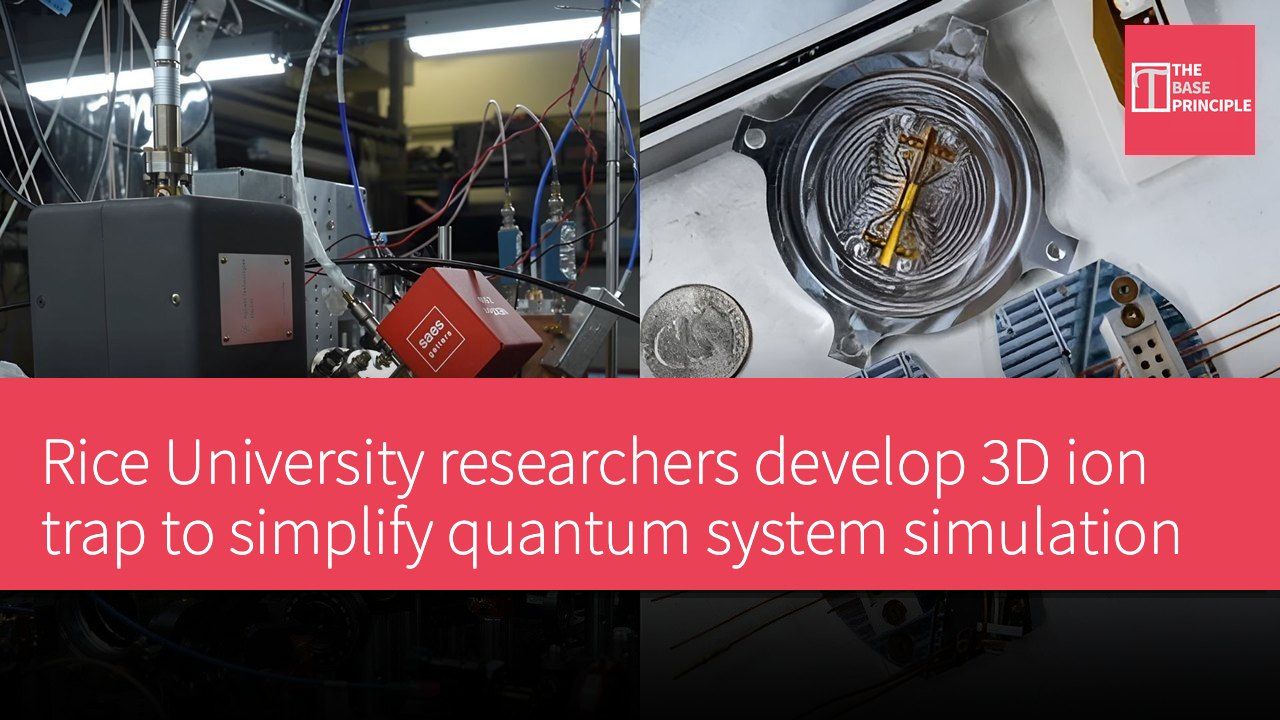
- Rice University develops 3D ion trap to simplify quantum system simulation.
- New design overcomes limitations of earlier monolithic designs, enabling operation with heavy ions.
- Third-generation design improves heat dissipation, reduces ion motion.
- The technology could help study charge transfer processes in photosynthesis.
Simulating complex quantum systems can strain even powerful supercomputers. Rice University researchers have developed a three-dimensional ion trap designed to make these systems easier to study in the laboratory. The device can operate with heavy ions such as ytterbium, overcoming the limitations of earlier monolithic designs. Researchers from Duke University and Translume Inc. also collaborated on the project.
Combining the best trap designs, quantum simulators can reconstruct difficult-to-model systems under controlled laboratory conditions. In trapped-ion experiments, electric fields hold charged atoms in place while lasers control their interactions. Scientists then measure these ions to understand the systems they represent. Traditional blade traps offer superior performance but require manual assembly, making consistent reproduction difficult. Microfabricated chip traps provide higher precision and easier scaling but often struggle to match that performance. Rice University physicist Guido Pagano and his colleagues aimed to combine these advantages in a compact 3D design.
Challenges and solutions of 3D design
Early monolithic traps worked only with lighter ions such as calcium, but heavier species presented additional engineering challenges. The team started with a piece of fused silica glass, using laser and chemical processing to create channels for ions and trenches for electrodes. Researchers then installed electrodes and coated the structure with sputtered metal. These trenches help isolate electrodes, preventing short circuits during fabrication and reducing the risk of electrical breakdown at high voltages.
The first prototype revealed a major problem. When researchers applied the required radio-frequency voltage, the trap experienced thermal and electrical issues, even glowing visibly during heating. The second version fixed the primary defects but introduced unwanted axial micromotion and high ion heating rates. Both issues threatened the precise control needed for reliable quantum experiments. The third-generation design resolved these problems, improving heat dissipation and reducing ion motion, and researchers also used a plasma-based surface treatment to lower ion heating rates.
Pagano's lab and collaborators at Duke University separately tested the completed traps. Their measurements matched previous computer simulations, confirming the devices operate as intended. The new design could make trapped-ion experiments easier to reproduce in academic laboratories. Its compatibility with ytterbium also expands the range of ions researchers can use in monolithic 3D traps. Abhishek Menon, the study's corresponding author and a graduate student, said solving the engineering challenges associated with heavier ions could also simplify trapping lighter species.
Potential applications of the new technology
The technology could help researchers investigate complex processes, including charge transfer in photosynthesis. Scientists can understand the underlying behavior through controlled experiments without having to directly simulate the entire quantum system. Roman Zhuravel, a co-author of the study and an assistant research professor in Pagano's lab, said the trap can help scientists break difficult quantum problems into manageable experiments. The design provides laboratories with another tool for studying systems that conventional computers struggle to simulate. Its engineering approach could also guide future ion traps to address a broader range of quantum technology needs.
The research has been published in the journal Physical Review Applied.
Research significance of the 3D ion trap
This research demonstrates how a 3D ion trap can overcome the challenges of traditional quantum simulation, particularly the engineering difficulties in handling heavier ions. The device not only improves experimental reproducibility but also expands the range of ions available for quantum simulation. This holds significant implications for future quantum technology development, as it provides a new research tool capable of deepening understanding of complex quantum system behavior and potentially driving advances in fields such as quantum computing and quantum communication.