
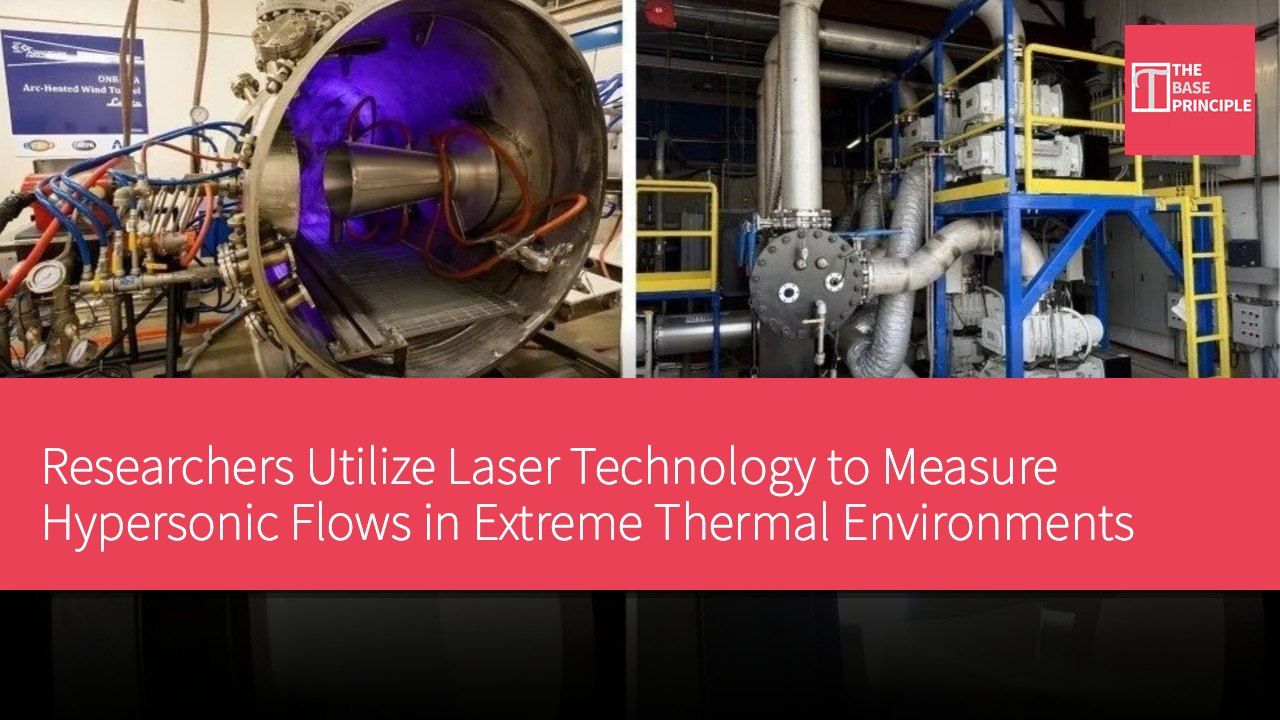
- The new laser technology can measure extreme supersonic airflow and plasma flows.
- This technology overcomes interference issues associated with traditional measurement methods.
- Accurate measurement of turbulence helps improve thermal protection systems for aircraft.
- The research findings will enhance the safety of high-speed spaceflight.
Researchers have developed a new laser technology for measuring extreme supersonic airflow (Mach 5 or higher) and plasma flows in shock layers. The extremely high-temperature plasma generated under hypersonic reentry conditions emits intense light, complicating standard measurements. Additionally, oxygen in high-temperature air weakens the light signals from nitrogen, and turbulence in ground facilities is often more intense than that experienced during actual flight. This non-invasive method can accurately measure turbulence near the surface of the aircraft, aiding in the understanding of heat transfer, improving thermal protection systems, and correcting distortions in ground tests.
Faced with searing flames, reentering spacecraft encounter extreme thermal pressures as atmospheric air compresses into a superheated plasma barrier, which can destroy standard materials. For a long time, scientists have struggled to observe airflow dynamics at such high temperatures without affecting measurements with physical probes. Scientists at the University of Texas at Arlington have now overcome this barrier, using precise laser technology to directly measure plasma flows. The research showcased the femtosecond laser electronic excitation tagging (FLEET) velocimetry technique. Led by Professor Luca Madalena, the team, along with graduate students Aaron Kidd, Nikhil Chand, and Alyssa Wilke, successfully mapped complex plasma flows and turbulence directly within the shock layer of an arc jet facility.
Breakthrough in Overcoming Measurement Challenges
These facilities are the primary core for scientists to recreate and study the extreme heat of space reentry on Earth. The physical principles of supersonic entry are straightforward: smooth airflow is safe, while turbulence is catastrophic. When stable air transitions to chaotic turbulence, the thermal load on the spacecraft can surge by ten times or more. Engineers must carefully design thermal shields. If they misjudge, the vehicle will burn up; if they overdesign out of caution, the thermal shield may become too heavy to launch.
Accurately measuring high-speed airflow within ground test facilities has always posed challenges. Physical sensors interfere with the airflow patterns being measured, while traditional optical tools are obscured by the glowing plasma. High-temperature oxygen weakens the light signals, and facilities often create artificial turbulence that affects real-world calculations. The FLEET technology successfully overcomes these measurement barriers without altering the airflow or losing clarity.
The laser pulses emitted by this technology last only one trillionth of a second, and these ultrafast pulses penetrate the glowing plasma, splitting nitrogen molecules in the air into individual atoms. When these atoms recombine, they emit a unique and fleeting light that moves naturally with the surrounding airflow. A specialized high-speed camera tracks this glowing tracer line over tiny time intervals, capturing high-resolution velocity data without contacting the air. Dr. Madalena stated, "This method allows us to measure turbulence near the material surface within the shock layer."
Enhancing Spaceflight Safety
Using sub-picosecond lasers to map intense plasma flows may bring us closer to mastering high-speed spaceflight and supersonic travel. Researchers can now calibrate ground test data to accurately reflect actual atmospheric flight conditions. Capturing precise velocity measurements near the object's surface reveals real-world thermal pressures while isolating turbulence from the facility. This could ultimately lead to safer and more reliable thermal shields for high-speed space vehicles.
The research findings have been published in the journal Engineering Communications.
Impact of New Technology on Space Exploration
This new laser technology marks a significant advancement in measuring airflow in extreme thermal environments. Traditional methods are hindered by interference from physical probes, making it difficult to accurately capture turbulence dynamics, while the emergence of FLEET technology enables researchers to conduct measurements without affecting the airflow. This is crucial for designing more effective thermal shields, as the performance of thermal shields directly impacts the survivability of spacecraft. As the technology matures, future space missions will be better equipped to handle thermal pressures during high-speed flight, further enhancing the safety and reliability of space exploration.