
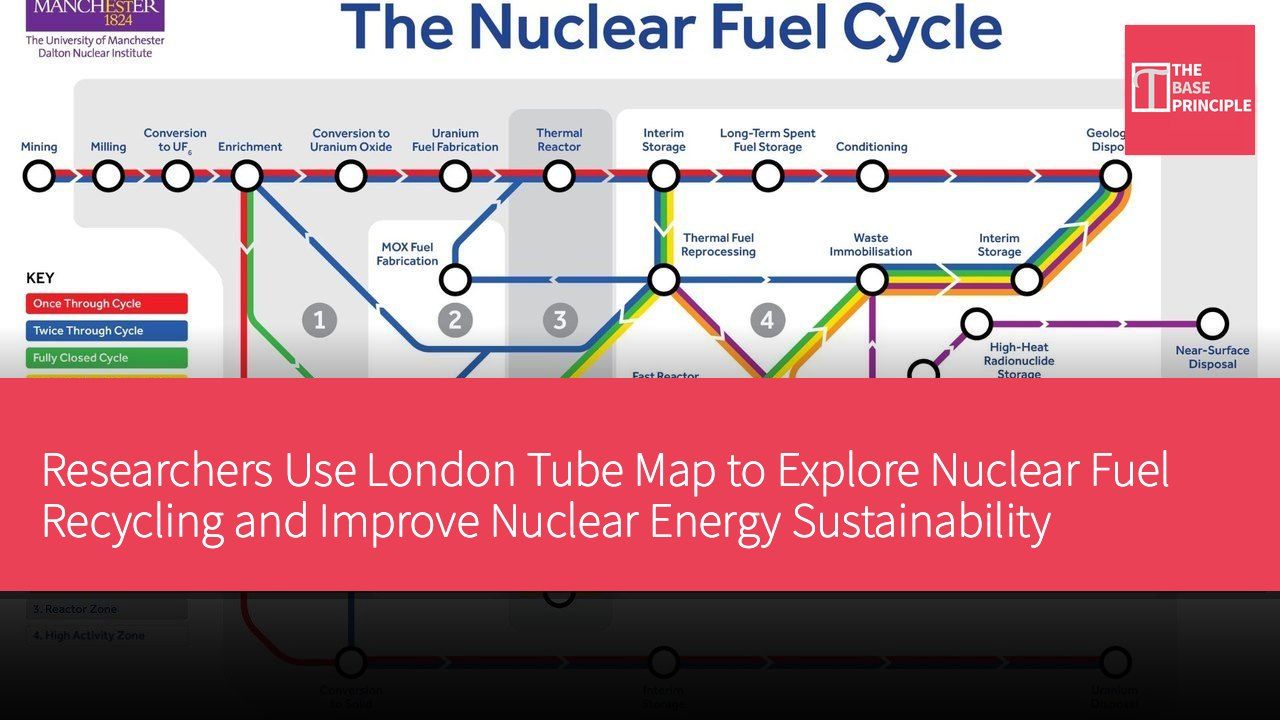
- Researchers used the London Tube map to simplify nuclear fuel recycling pathways.
- Nuclear energy plays a crucial role in renewable energy with its low-carbon emission advantage.
- Closed fuel cycles can enhance nuclear energy sustainability but face multiple challenges.
- The research findings have been published in the journal "Sustainability."
Researchers at the Dalton Nuclear Institute of the University of Manchester have utilized the iconic London Tube map to explore methods for recycling nuclear fuel and enhancing the sustainability of nuclear energy. In an assessment, the researchers compared six fuel cycle pathways, which varied in complexity, but were successfully simplified through the Tube map design—a first in the field. As the world seeks cleaner energy solutions, nuclear power is poised to regain prominence. The high carbon emissions of fossil fuels are pushing countries toward renewable energy sources like wind and solar. Although these energy sources have become economically viable over time, they are not yet perfect substitutes for fossil fuels.
For example, wind and solar power plants require large areas of land to generate the same amount of energy that a relatively small coal-fired power plant can produce. Similarly, energy generated through renewables is intermittent and cannot alone sustain the grid or meet peak demand. In this context, carbon-free energy sources like nuclear power are particularly important.
Challenges to Nuclear Energy Sustainability
In terms of sustainability, nuclear fission, while offering the advantage of low carbon emissions, still requires further efforts to achieve true sustainability. Firstly, it relies on finite resources like uranium, which needs to be mined and is not renewable. After use in reactors, uranium also produces significant amounts of radioactive waste that require long-term disposal strategies. The research team at the Dalton Nuclear Institute is exploring ways to improve the sustainability of this process without sacrificing its benefits. They have found that closed fuel cycles can further enhance sustainability. Professor Robin Taylor of the Dalton Nuclear Institute and the UK National Nuclear Laboratory explained, "Closed fuel cycles do indeed face many challenges, including issues of safety, security, and cost."
Based on the UK's experience with nuclear fuel, the researchers found that these challenges can be addressed.
Visualizing Fuel Cycle Methods
The research team compared various fuel cycle pathways, ranging from options that use fuel once and treat waste as purely waste, to more advanced options involving multiple recycling stages. The nuclear fuel cycle visualization chart developed at the University of Manchester was inspired by the London Tube map. William Bodel, who worked on the project, added, "Presenting a large amount of information simultaneously makes it difficult to visualize the various fuel cycle options." Therefore, the team turned to the London Tube map designed by Harry Beck in the 1930s, which effectively communicates complex information visually.
In the field of nuclear energy research, this is the first time this model has been used to visually explain different fuel cycle options, and it has successfully done so concisely. Bodel summarized in a press release, "Our assessment shows that while nuclear energy is already a sustainable low-carbon energy source, successfully closing the fuel cycle will further enhance it."
The research findings have been published in the journal "Sustainability."
London Tube Map Inspires New Approach to Nuclear Research
The research from the Dalton Nuclear Institute shows that using the London Tube map as a visualization tool can effectively simplify the complexity of nuclear fuel recycling, which is significant for enhancing the sustainability of nuclear energy. As global demand for clean energy increases, the low-carbon emission characteristics of nuclear energy make it an important option. However, the sustainability of nuclear energy still needs to address challenges such as limited resources and waste disposal. This research not only advances nuclear technology but also provides new ideas for future energy strategies.