
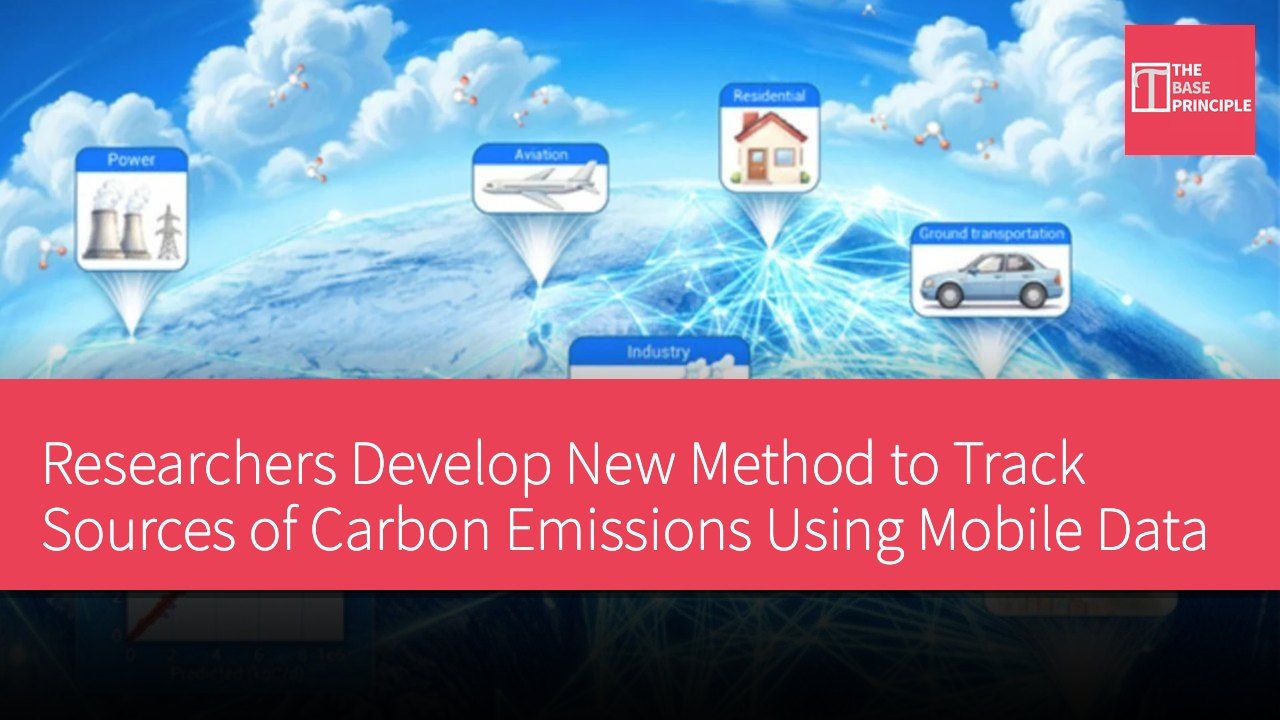
- Researchers developed a machine learning method to track sources of carbon emissions.
- Mobile data shows the connection between daily movement and carbon emissions.
- Information from dynamic mobility networks enhances the accuracy of emission forecasts.
- The study has limitations, such as coverage of mobile data and insufficient algorithm considerations.
Researchers have developed a machine learning method to calculate carbon dioxide emissions caused by human behavior. By analyzing crowd movement data from mobile phones, this method can identify key gathering locations and track how these patterns change over time. According to a study published in The Innovation, there is a connection between daily commuting habits in China and pollution generated by various industries. Scientists tested this method in Italy, the United States, and Mexico. The researchers achieved promising results by using human mobility as an additional metric for social and economic activities, rather than relying solely on traditional emission records.
Daily movements, including commuting, transporting goods, traveling, and shopping, create patterns that help reveal energy consumption and related carbon emissions.
Mobile Data Reveals Carbon Emission Patterns
The study utilizes mobile data for emission estimation, transforming people's geographic location data into mobility networks. In these networks, major cities are represented as points, with paths between cities showing how people move. In addition to these mobility maps, the research team incorporated population data and other information. After examining eight machine learning models, the team found that the tree-based LightGBM algorithm performed the best. In tests, people's mobility predicted emissions across multiple industries, achieving an R-squared value of a perfect 1.00. The predicted R-squared value for flights was 0.99, while for road transport it was 0.98.
When testing with date-segmented data, the R-squared values for these three categories remained high at 1.00, 0.99, and 0.95. In tests conducted using the GRACED database for Italy, the United States, and Mexico, the R-squared scores were 0.91, 0.95, and 0.99. Moreover, when used alongside the ODIAC records from these countries, the model's scores remained between 0.90 and 0.99.
Dynamic Networks Enhance Prediction Accuracy
Information provided by dynamic mobility networks is more comprehensive than fixed locations or population density. Incorporating mobility data into the calculation process increases the accuracy of emissions, particularly for emissions that change over time. Results indicate that in the case of China, mobility data from the past week is sufficient for making good predictions. The mobility research also identified economically interconnected urban clusters that can be viewed as a unit for climate protection. These urban clusters often do not follow administrative boundaries but focus on the actual economic areas connected by the movement of people and goods.
However, this study also has some limitations. For instance, mobile data does not cover everyone, and individuals use their phones differently, with varying network coverage across regions. The current version of the algorithm also does not account for variations in daily routines, holidays, or seasonal energy demands. As more people work from home or use cars, the relationship between mobility and pollution may change. Ultimately, the system in this study serves as a method for tracking emissions, working alongside existing databases to provide information about local behaviors, helping to quickly identify rapid changes in pollution, and making it easier to formulate better climate policies.
This research has been published in The Innovation.
Prospects of Mobile Data in Carbon Emission Research
Using mobile data for tracking carbon emissions demonstrates its potential in environmental monitoring. This approach not only provides more accurate emission forecasts but also reveals the connections between human behavior and environmental impacts. With technological advancements, more innovative techniques may be applied to climate change research in the future, assisting policymakers in developing more effective responses. However, the limitations mentioned in the study, such as data coverage and algorithm constraints, still need to be addressed to enhance the overall reliability of predictions.