
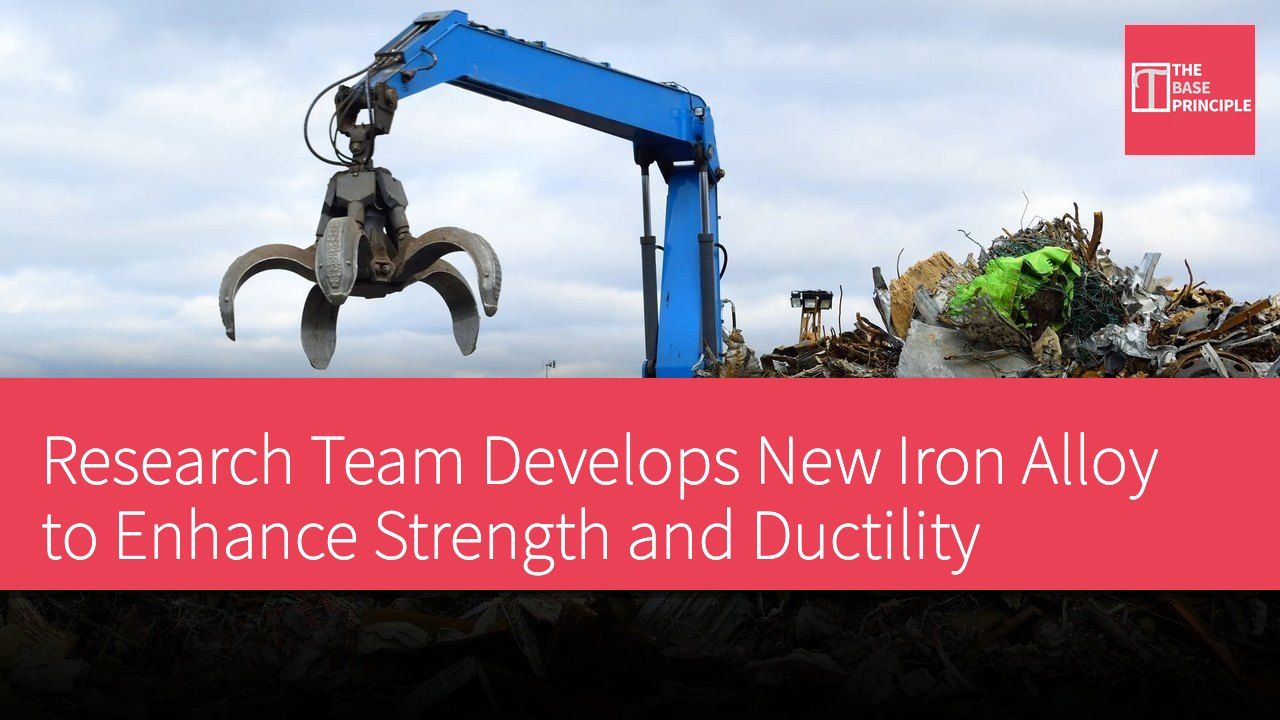
- The research team developed 14 new iron-based alloys with significantly improved strength.
- The new method reduced production costs by 8.1% and utilized impurities found in metal waste.
- These new alloys are produced entirely from recycled waste without the addition of raw iron.
- The technology can be scaled to recycle steel, aluminum, and copper alloys, with broad applications.
Researchers from China and Germany have developed a total of 14 new iron-based alloys using recycled waste materials, significantly increasing their strength while reducing costs by over 8% compared to traditional alternatives. The project was jointly conducted by Shanghai Jiao Tong University, City University of Hong Kong, East China University of Science and Technology, Central South University in China, and the Max Planck Institute for Sustainable Materials in Germany. In the study, the team created a machine learning method that transforms impurities in metal waste into stronger alloys rather than removing them. This approach generated 14 new iron-based alloys, with tensile strength increased by 15.2% and ductility improved by 73.2% at the point of fracture.
Liuliu Han, the head of the partner group at the Max Planck Institute for Sustainable Materials and a co-author of the study, stated, "The traditional method dilutes impurities in metal waste by adding raw materials." The new method reduced production costs by 8.1%.
Environmental Significance of the New Method
Approximately 2 billion tons of metal are produced globally each year, primarily from newly mined materials. However, this production process accounts for about 40% of industrial greenhouse gas emissions and 10% of global energy consumption. While recycling can significantly mitigate this environmental issue, metal waste often contains impurities and varies in chemical composition. This variability complicates the production of alloys with predictable mechanical properties. Producers typically dilute impurities by adding new metals, a process that requires additional energy and increases carbon emissions. To address this challenge, the researchers' machine learning framework treats impurities as potentially useful alloying elements.
The system employs algorithms and neural networks to identify the optimal metal mixtures and processing methods, analyzing factors such as temperature, processing time, tensile strength, and ductility to predict which combinations can deliver better performance. The most promising designs will be tested, and the results will be fed back into the system for future predictions.
To test the method, the team used a common industrial material—cast iron—that possesses strength and flexibility while tolerating impurities. Approximately 12 million tons of cast iron are produced globally each year. The scientists evaluated 17 alloy designs proposed by the framework, of which 14 exhibited the best combinations of strength and ductility in the existing recycled iron dataset. These new alloys achieved a 15.2% increase in tensile strength without sacrificing ductility, or a 73.2% improvement in ductility without compromising strength. According to the scientists, these alloys are produced entirely from recycled waste without the addition of raw iron.
Potential for Future Applications
They are confident that this technology can be scaled to recycle steel, aluminum, and copper alloys, with applications in transportation, energy infrastructure, and industrial manufacturing.
Liuliu Han elaborated on how this method transforms metal impurities into advantages. In a statement, he said, "Thus, we have developed a new machine learning strategy that turns these impurities from a problem into an advantage, allowing us to design alloys that not only tolerate pollutants but can even benefit from them." The research has been published in the journal Science Advances.
Item Specification Tensile Strength Increased by 15.2% Ductility Increased by 73.2% Cost Reduction 8.1%
Environmental and Economic Impact of the New Alloy Technology
The breakthrough of this research lies in utilizing machine learning to convert impurities in metal waste into alloy advantages, demonstrating dual benefits for the environment and the economy. Traditional metal production processes not only consume large amounts of energy but also result in high carbon emissions, while the new technology reduces these issues through recycling. This not only enhances material performance but also lowers production costs, providing a sustainable solution for future industrial applications, particularly in critical areas such as transportation and energy infrastructure.