
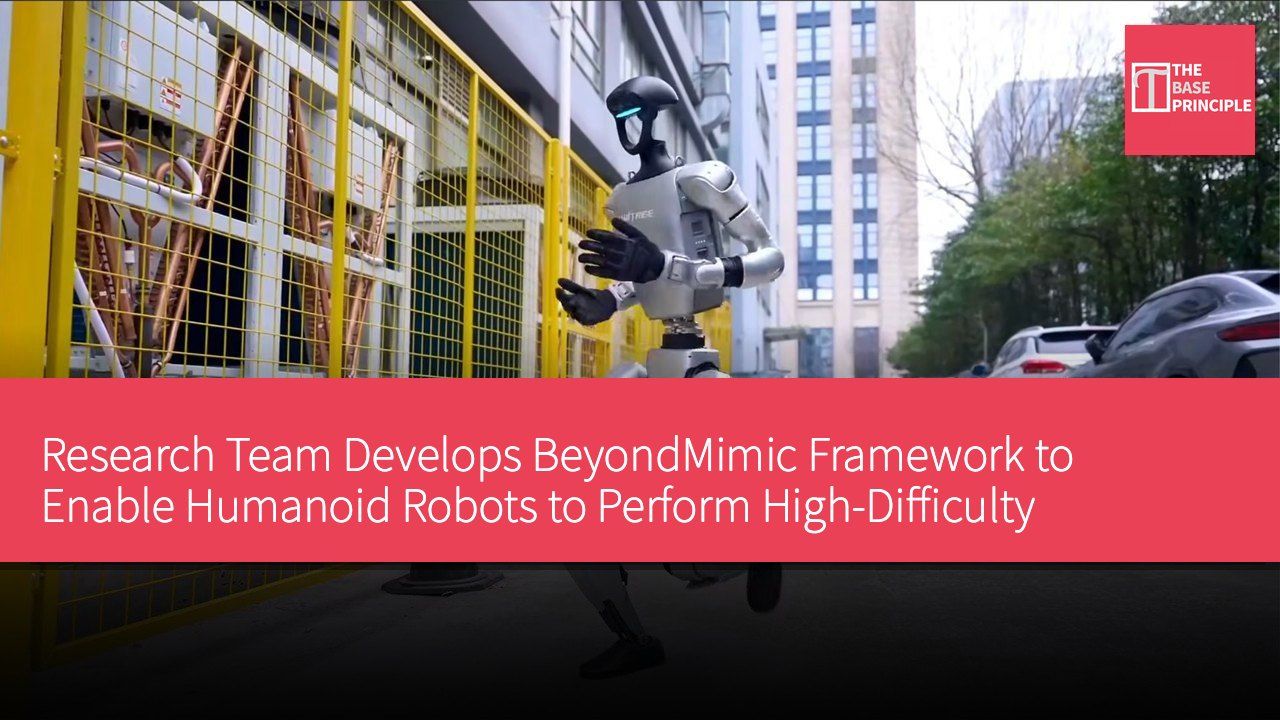
- BeyondMimic enables humanoid robots to perform high-difficulty movements without task-specific training.
- The system can learn from human demonstrations and naturally switch between different skills.
- Research shows that movements generated by BeyondMimic are more human-like, with higher observer preference.
- This framework opens up possibilities for humanoid robots to learn new skills without retraining.
Researchers have recently unveiled a new framework called BeyondMimic, enabling humanoid robots to execute agile and human-like movements and smoothly transition between multiple skills. The system allows robots to perform complex actions such as cartwheels, spinning kicks, various athletic movements, and acrobatics without the need for separate training for each task. BeyondMimic learns from human motion data and can transfer the learned movements to new tasks and environments. The research team claims that this approach could overcome the limitations of existing humanoid robot control systems, which often require extensive fine-tuning or produce stiff, unnatural movements.
The BeyondMimic model allows humanoid robots to learn agile and human-like movements from human demonstrations and combine these skills to execute tasks that have not been explicitly trained for. The system addresses a significant challenge in the field of humanoid robotics: while robots can learn individual actions like walking, jumping, and kicking, making them naturally switch between different skills remains difficult. Existing methods typically require designing reward functions for specific movements, extensive adjustments, or training for each task separately. BeyondMimic employs a two-stage learning framework to overcome these limitations.
The Application of a Two-Stage Learning Framework
In the first stage, the research team uses reinforcement learning (RL) to train the robot to track a variety of human movements. The key is that the team employs a single motion tracking formula, a shared reward structure, and common hyperparameters, without the need to adjust the system for each individual movement.
The researchers trained the system using approximately 2.5 hours of diverse human motion data, enabling it to learn hundreds of skills, ranging from normal walking and running to one-legged balance, jumping, dance movements, martial arts-inspired actions, spinning kicks, and cartwheels. Subsequently, the team deployed 21 representative motion clips to a physical humanoid robot, demonstrating that the system could reliably transfer the skills learned in simulation to hardware. The second stage introduces a latent diffusion model, which gives BeyondMimic the ability to generate and combine movements.
The model does not merely replay learned motion sequences but learns to coordinate the underlying distribution of states and motion trajectories. The research team states that a variational autoencoder first compresses these movements into smoother latent representations, after which the diffusion model learns how these representations evolve.
The Ability to Generate and Adjust Skills
Researchers then use classifier guidance techniques during the inference phase to steer the diffusion model towards targets not covered in the training phase, allowing the robot to adjust existing skills without retraining or fine-tuning the underlying policy. For example, the system can receive joystick commands and generate corresponding walking or running behaviors; it can also move towards specified waypoints, avoid obstacles, or generate complete transition motions based on sparse future keyframes. In one demonstration, the robot seamlessly transitioned from walking to a cartwheel and then back to walking; it also executed motion sequences that alternated between cartwheels and walking, and running.
The method can also combine multiple objectives, such as integrating waypoint tracking with obstacle avoidance costs, enabling the robot to continue towards the target while circumventing obstacles; the same framework can also combine joystick control with collision avoidance. The physical robot demonstrated highly dynamic movements, including aerial cartwheels, spinning kicks, and flip kicks. During the aerial cartwheel, the robot's peak acceleration reached 31 m/s², and the maximum angular velocity of the pelvis reached 15.7 rad/s, which is comparable to the values reported for skilled human aerial movements in the literature.
In addition to agility, researchers also found that the walking and running movements generated by the system were more natural to human observers. In a study involving 77 participants, the movements produced by BeyondMimic were rated as more human-like and natural in 70.8% of the choices, compared to 29.2% for the robot's native controller. The research team states that the core breakthrough is not a single new component but the integration of scalable motion tracking, latent diffusion models, and inference phase guidance techniques.
The Separation of Skill Acquisition and Task Specification
By separating skill acquisition from task specification, BeyondMimic opens up a path for humanoid robots to learn a large repertoire of human movements and recombine these skills to adapt to new situations without the need for task-specific retraining.
Item Specification/Data Framework Name BeyondMimic Learning Method Two-stage (Reinforcement Learning + Latent Diffusion Model) Training Data Duration Approximately 2.5 hours of human motion data Number of Skills Learned Hundreds Number of Motion Clips Deployed to Physical Robot 21 Peak Acceleration of Aerial Cartwheel 31 m/s² Maximum Angular Velocity of Pelvis 15.7 rad/s Number of Participants in User Study 77 Preference for BeyondMimic Movements 70.8% Preference for Native Controller Movements 29.2%
The Impact of BeyondMimic on Robot Technology
The development of the BeyondMimic framework marks a significant advancement in humanoid robot technology. Traditionally, robots have required separate training for each skill, which is time-consuming and limits their flexibility. By integrating reinforcement learning and latent diffusion models, BeyondMimic can learn from human movements and quickly adapt to different situations, greatly enhancing the practicality of robots in real-world applications. Additionally, the more natural movements generated will be crucial for the future role of humanoid robots in society.