
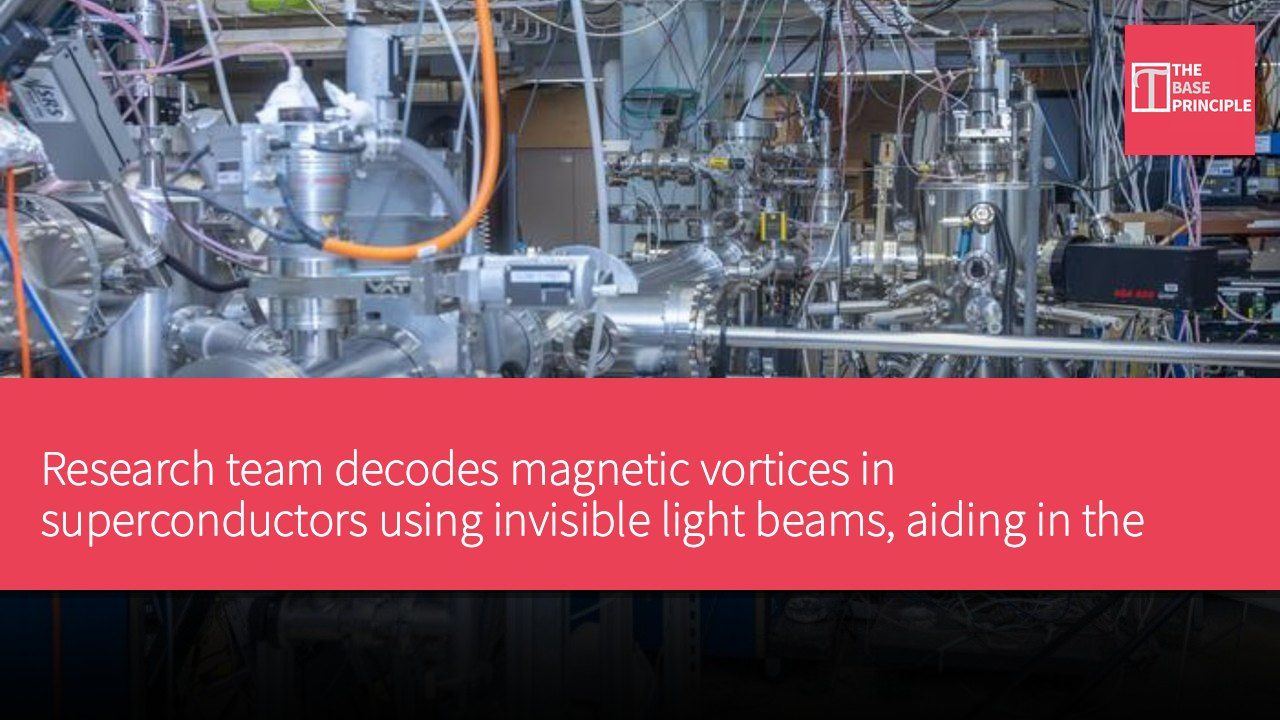
- Researchers decoded magnetic vortices in superconductors using invisible light beams.
- The currents within the vortices rotate around a weakened core, leading to a collapse of superconductivity.
- The team created a perfect crystal film just 40 nanometers thick for experimentation.
- The research shows that superconductors may exhibit different internal dynamics at the same temperature.
Researchers have decoded magnetic vortices formed within superconductors using a beam of invisible light. This discovery will assist engineers in building more resilient components for power grids, magnetic resonance imaging scanners, and particle accelerators. "To improve superconductors, scientists need to understand the contents and behaviors within the vortices," said Girsh Blumberg, distinguished professor of physics and astronomy at Rutgers University and co-author of the study, which has been published in Physical Review Letters. Superconductors are praised for their ability to conduct electricity with zero resistance.
However, when exposed to strong magnetic fields, they generate microscopic disturbances known as vortices. Within each vortex, currents rotate around a weakened core, causing superconductivity to collapse. "It's like Swiss cheese, with many holes," Blumberg added.
Vortices and the Collapse of Superconductivity
Proving a challenging theory, as these vortices move, the material leaks electrical energy in the form of heat. Physicists have long sought to peek into these cores to observe the behavior of trapped particles. Theoreticians had predicted that the particles within each vortex would stabilize at layered quantum energy levels, like rungs on a ladder. However, experimentally demonstrating this has been quite difficult due to the blurred energy levels in most materials. To tackle this challenge, the Rutgers team manufactured an iron-based compound containing tellurium and selenium. Through layer-by-layer atomic deposition, Professors Seongshik Oh, Hee Taek Yi, and their colleagues created a perfect crystal film just 40 nanometers thick, about one-thousandth the width of a human hair.
The narrow core of this compound keeps the quantum layers cleanly separated. The experiment then moved to Tallinn, Estonia, where the film was cooled to minus 438 degrees Fahrenheit in a strong magnetic field. Scientists directed terahertz radiation, a low-frequency invisible light, directly into the ultra-thin sample.
Observing Particle Behavior
Testing two variants, the team manipulated the polarization of the light beam. Light waves can rotate clockwise or counterclockwise as they propagate. Researchers found that the trapped particles cleanly divided into two distinct groups. One group responded only to left-handed helices, while the other group reacted solely to right-handed helices. "This difference allowed researchers to distinguish between the two groups and study each one separately," the press release noted. "Through their optical measurements and mathematical calculations, researchers estimated the size of the vortices and how long the particles' response to the light lasted." They also estimated the vortices' resistance to changes in speed or direction, as well as the magnetic field strength required for each group of particles to significantly disrupt superconductivity.
The team also tested two different chemical formulations with varying selenium content. Although both samples began superconducting at nearly the same temperature, their internal mechanisms were markedly different. The first group of particles produced by one formulation was four times that of the second, while the other formulation resulted in an even distribution. These results indicate that even at the same operating temperature, superconductors may conceal distinctly different internal dynamics. By using polarized light to isolate these trapped particles, researchers now have a precise method to adjust materials for future heavy electrical technologies.
Exploring the Potential of Light Beams in Superconductors
This research demonstrates the potential of using invisible light beams to decode the internal structures of superconductors, which is crucial for enhancing the quality of power infrastructure. The properties of superconductors make them significant for applications in power transmission and magnetic resonance imaging, but the presence of vortices leads to energy loss. By understanding the particle behavior within the vortices, scientists can optimize superconducting materials, further improving their performance and advancing related technologies. These findings not only contribute to fundamental scientific research but may also have far-reaching implications for future electrical technologies.