
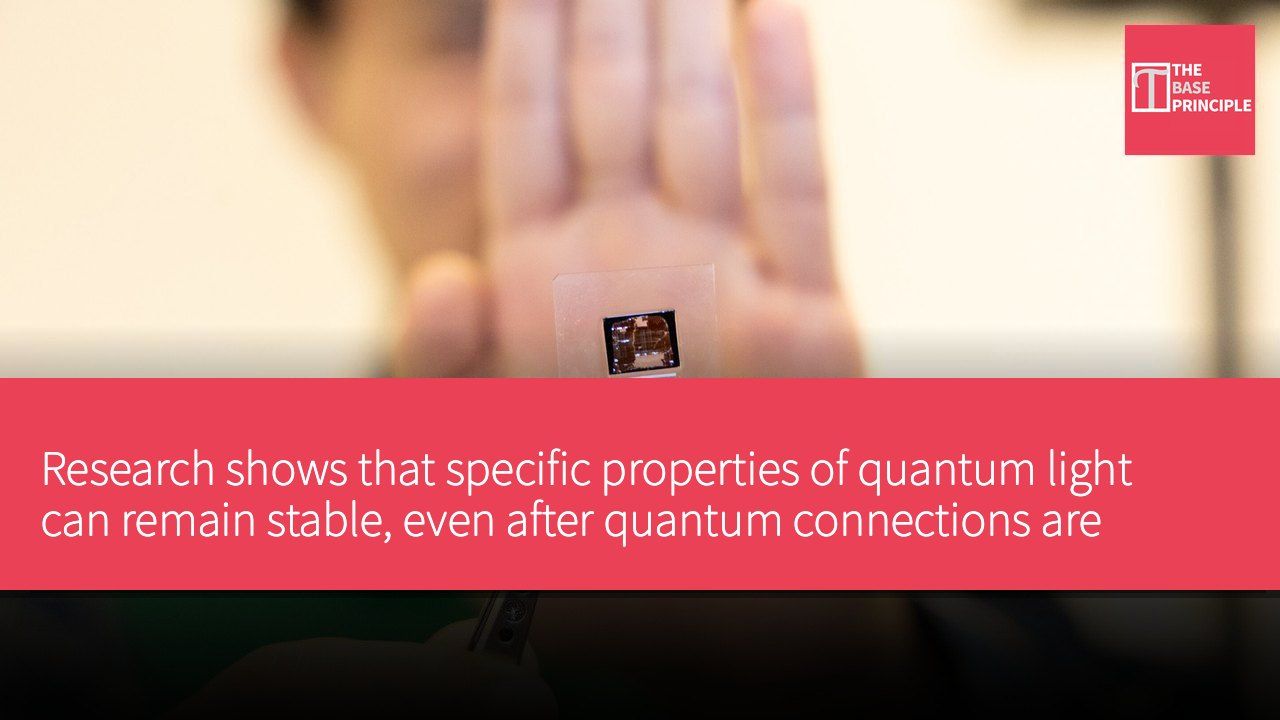
- Research shows that specific properties of quantum light can persist after connections are broken.
- The patterns of quantum skyrmion structures encompass all possible polarization states.
- Experiments demonstrate that the topological number remains stable under perturbations, revealing the complexity of quantum relationships.
- This finding could aid in the protection of information in future quantum networks.
If scientists can connect quantum computers through networks and use photons to share information, these computers will become more powerful. However, there is a significant challenge. The quantum connections that make this possible are extremely sensitive, and even minor disturbances can disrupt the entanglement between photons, interrupting communication between quantum devices. Currently, researchers at the University of Pennsylvania have demonstrated an intriguing method in a new study that allows a specific property of quantum light to be preserved even after such connections are broken. They utilized a mathematical concept known as topology to transfer unique patterns between photons, discovering that this pattern remains intact even when the photons lose their quantum connection (entanglement).
Professor Liang Feng, a senior author of the study from the University of Pennsylvania's Department of Materials Science and Engineering, stated, "It's like a dancer's unique moves suddenly becoming part of a duet and continuing to exist even after the dancers separate."
Properties of Quantum Skyrmions
The secret of this experiment lies in a structure known as a quantum skyrmion. Unlike traditional objects, its defining characteristics are not physical shapes but patterns involving two properties of light: its spin, which relates to polarization, and its orbital angular momentum, which describes how its wavefront is twisted. Haoqi Zhao, the lead author of the study and a postdoctoral researcher at Yale University, explained, "The direction of light's oscillation depends on where you are observing it. It's a bit like how certain areas of your hair grow in different directions."
These variations collectively create a pattern that encompasses all possible polarization states and is fixed in number. Mathematicians describe this characteristic using a topological number. Interestingly, individual parts of the perturbation pattern do not necessarily change this number. Zhao added, "Imagine a swirl in someone else's hair. You can push individual strands aside without changing the overall pattern."
To test whether this mathematical resilience could help quantum information survive perturbations, the research team first needed a method to create and transfer these patterns. The researchers developed an integrated photonic chip made of silicon nitride, a material commonly used in photonic devices. Its components are designed to generate entangled photons and guide them along different paths, imprinting the skyrmion pattern onto one of the photons. The process begins with a femtosecond laser pulse directed at two helical waveguides on the chip. Through a process called spontaneous four-wave mixing, several pairs of photons that share quantum entanglement are generated.
In simple terms, even if the photons are subsequently separated, their quantum states become interlinked. A set of micro-interferometers then directs the photons to different parts of the chip. One of the photons enters a specially designed micro-ring resonator, where the structures at the inner and outer edges are meticulously arranged to produce different polarization and angular momentum components. Combining these components creates the desired skyrmion pattern. The researchers then measured the polarization and momentum of the first photon, known as a Bell-state measurement. This allows the topological pattern encoded in that photon to be transferred to the quantum state shared by the two photons.
The team confirmed the obtained state using quantum state reconstruction techniques, which rebuild the quantum system from measurements. The measured topological number of the original single-photon skyrmion was 1.981, very close to the expected value of 2. The transferred two-photon state exhibited a similar high value, with an average quantum state fidelity of 89%, indicating the degree to which the experimental state matched the expected state.
Refinements in technology over the past five years have made the development of this chip possible, with prototypes manufactured at the University of Pennsylvania's Singh Center for Nanotechnology. "It's a bit like building an entire factory on a micro-scale. One part of the chip generates entangled photons, another part guides them to their desired locations, and yet another part creates the skyrmion pattern. The challenge is to make all parts work together," said Zhang Yi, one of the research authors and a researcher at the University of Pennsylvania. Once the system was functioning properly, the researchers deliberately introduced noise into the photons, including unwanted background light, to observe the resilience of the transferred pattern under interference.
As the perturbations increased, the quantum states gradually deteriorated, and the entanglement between the photons eventually disappeared. However, the topological number of the skyrmion remained roughly unchanged. The pattern only began to collapse when the researchers introduced stronger perturbations. This result was particularly surprising because "previous studies indicated that these structures rely on entanglement. Our findings show that this relationship is more complex than we imagined," Zhao said. The researchers also discovered these residual correlations through a measurement known as quantum discord. Unlike entanglement, quantum discord can capture certain quantum correlations that persist even when two particles are no longer entangled.
The Relationship Between Topology and Quantum Information
Its persistence suggests that topology may be related to broader quantum relationships than scientists previously thought. This finding could ultimately help protect quantum information from noise in future quantum networks. However, this experiment has not yet demonstrated a practical communication system that operates without entanglement. The research has been published in the journal Nature Physics.
Item Specification Topological Number 1.981 Quantum State Fidelity 89%
The Impact of Quantum Light Properties on Future Communications
This study reveals the importance of quantum light retaining specific properties even after connections are broken, demonstrating the stability of the topological number of quantum skyrmions under perturbations. This not only challenges traditional understandings of quantum entanglement but may also provide new insights for the development of future quantum networks. As quantum computing and quantum communication technologies advance, these findings could become key to protecting quantum information from noise, driving the practical realization of quantum technologies.