
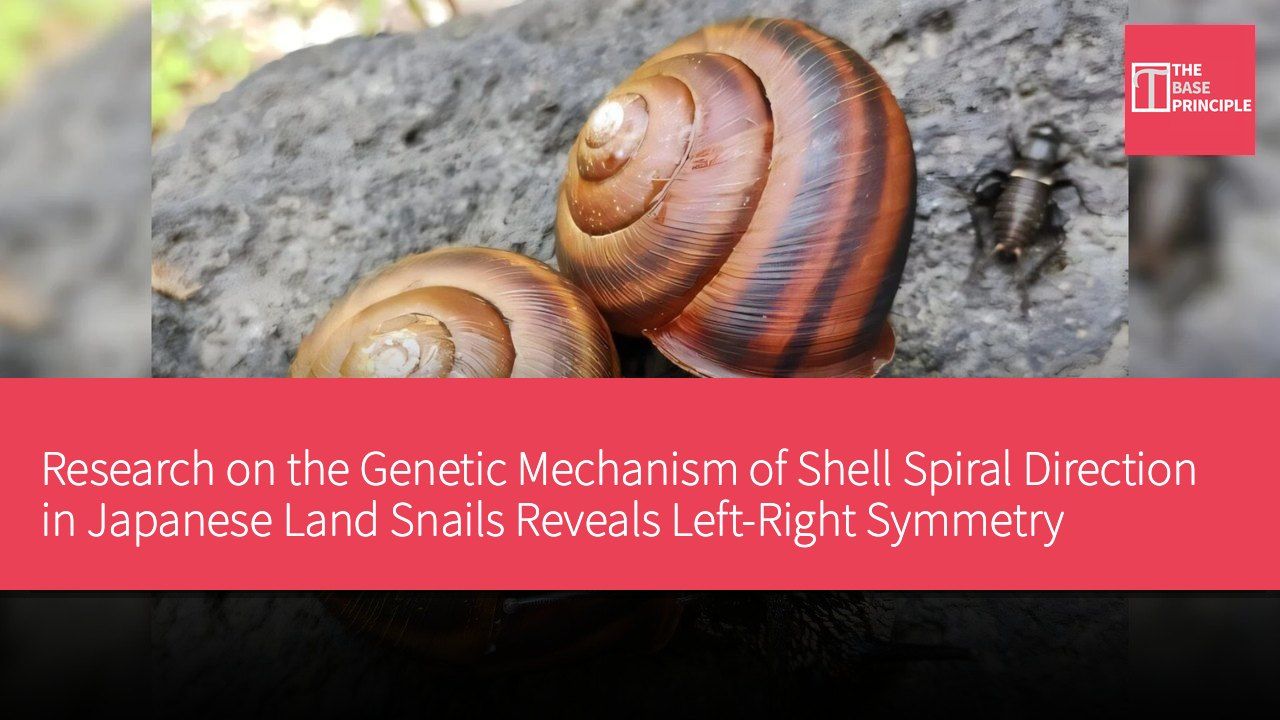
- The study reveals that genetic variation determines the direction of snail shell spirals.
- The same cellular mechanisms produce left-right asymmetry across different species.
- Left-handed and right-handed snails can mate and exchange genes within the same population.
- Myosin variation does not affect normal snail development, suggesting new research directions.
A small genetic difference can transform one snail into a mirror image of another. Researchers studying Japanese land snails have now identified a gene that helps determine whether their shells spiral clockwise or counterclockwise, providing new insights into how animals develop left and right sides. This research, led by scientists from the University of Nottingham and Tohoku University in Japan, examined wild Euhadra snails to understand the biological mechanisms behind this phenomenon, known as chirality. The findings indicate that tiny variations in the gene responsible for producing a protein called myosin can lead to healthy snails having opposite body structures.
Genetic Variation and Biological Asymmetry
This discovery may also help scientists explore a broader biological puzzle: how the same fundamental cellular mechanisms produce consistent left-right asymmetry in most animals while allowing some species to develop into mirror images of each other.
The study, published in the journal Current Biology under the title "An Ancient Polymorphism in Myosin I a/b Determines Chirality Variation in Japanese Euhadra Snails," confirms that naturally occurring myosin gene variations are the basis for the differences. Myosin proteins help cells move, change shape, and interact with the internal structures that support them. Researchers believe that small changes in the protein affect how cells twist during early embryonic development. That initial movement determines the direction of the snail's shell spiral and the development of its internal anatomy.
Most snails have shells that spiral to the right, known as dextral; while left-handed snails are described as sinistral. Although these two shapes appear to be mirror images, the differences are not merely superficial: their internal organs and reproductive anatomies may also be arranged on opposite sides.
Challenges of Mating and Gene Exchange
The research team found that both forms of Japanese Euhadra snails develop normally and do not exhibit abnormalities associated with reversed body asymmetry seen in other species. These two genetic variations are also quite ancient, indicating that this difference has persisted throughout evolutionary history. Researchers also discovered that natural selection has influenced the left-handed form. One challenge in the study is that mirror-image snails may face difficulties in reproduction. Due to their reproductive organs potentially being located on opposite sides, mating becomes challenging. The researchers found a population in a valley in Japan where left-handed and right-handed snails can mate and exchange genes.
This provided the research team with an opportunity to investigate how these two forms can coexist within the same population, rather than studying them as isolated groups.
These findings contrast with observations made by researchers in pond snails. In those animals, mutations in another gene can produce left-handed individuals, but this is also associated with developmental abnormalities. In Japanese Euhadra, myosin variation produces opposite forms without apparent developmental issues. This research offers a useful approach to exploring a long-standing question in biology: how organisms establish consistent left-right body arrangements. For example, the human heart is typically located on the left side, while other internal organs occupy specific positions. Although reversals can occur, these instances are far less common than the natural variations seen in these snails, and some cases are associated with developmental complications.
Understanding how myosin variation produces healthy mirror-image snails may help scientists identify the cellular processes that establish body asymmetry in different animals.
However, this discovery does not imply that the same genetic variations determine the positioning of organs in humans. Researchers note that an important question remains: how can cells produce bodies that develop in opposite directions under the same fundamental molecular chirality? Japanese Euhadra snails provide a rare opportunity to study this dilemma.
The Genetic Significance of Snail Shell Spiral Direction
This research reveals how genetic variation influences the direction of snail shell spirals and provides profound insights into the development of biological left-right asymmetry. By examining Japanese Euhadra snails, researchers found that tiny variations in myosin can lead to mirror-image structures in healthy snails, which holds significant biological implications. This not only aids in understanding the developmental processes of animals but may also provide clues for developmental abnormalities in other species. More importantly, this study opens up possibilities for further exploration of how cells can produce different developmental directions based on the same molecular foundation, having far-reaching implications for biological research.