
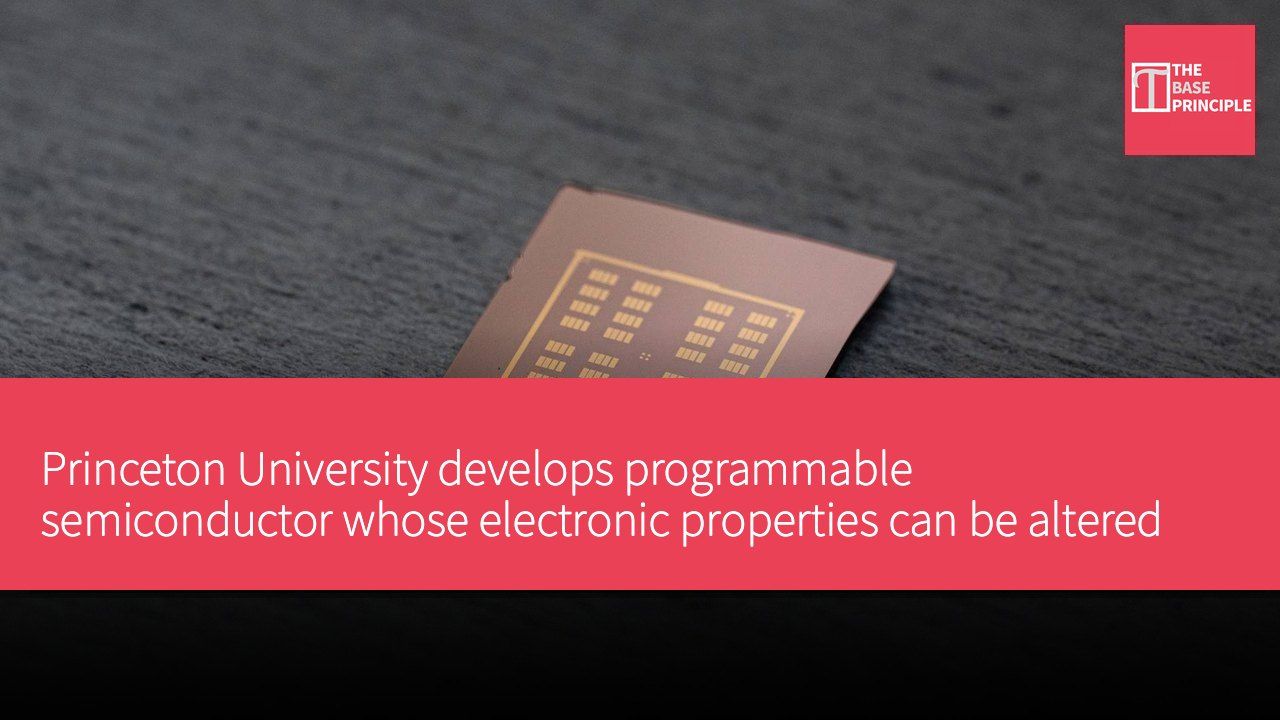
- The semiconductor developed at Princeton University can be programmed and reprogrammed using light.
- The new material's properties can be tuned without rebuilding it, moving beyond traditional binary switching.
- The research team demonstrated arrays of programmable electronic switches, showing the potential of light-controlled behavior.
- Future electronic devices could have their functions modified after manufacture, without redesigning the semiconductor.
Researchers at Princeton University have developed a thin semiconductor that can be programmed, erased and reprogrammed using different wavelengths of light. Unlike conventional semiconductors, whose electrical properties are essentially fixed once manufactured, the new material can be tuned repeatedly. The research team combined a two-dimensional semiconductor with light-responsive molecules. When exposed to specific wavelengths of light, the molecules change their structure. This change alters the semiconductor's electronic and optical properties, allowing its response to be controlled without rebuilding the material.
The researchers say this could ultimately allow electronic devices to change function after manufacture, rather than being permanently determined during fabrication.
A new way to control semiconductors with light
Light offers a new way to control semiconductors. "The first step in creating smart materials is the ability to respond. Living systems are highly intelligent because they constantly sense and react to their surroundings. We want to create a material that can similarly respond to external stimuli, rather than being permanently fixed," said Saien Xie, assistant professor of electrical and computer engineering and lead author of the study. The material also moves beyond the binary behavior of conventional electronic switches. Its response is not limited to representing on or off states; instead, it can be adjusted gradually and then reversed using light.
"We can gradually tune the material's response and then reverse the process," said Ji. This capability comes from the interaction between the semiconductor and the molecules attached to it. Changing the molecular structure alters the semiconductor's conductivity and its response to light, giving researchers a way to dynamically tune its properties.
The potential of programmable electronics
The work is particularly useful for programmable electronic devices, where changing a device's behavior typically requires different hardware or circuits. The team has fabricated a uniform sheet of the semiconductor measuring 1 inch square. Using this material, the researchers built arrays of programmable electronic switches, demonstrating that light-controlled behavior can be incorporated into functional structures and is not limited to small laboratory samples. The next step is to connect these switches into circuits. Circuits are the basic building blocks of more complex electronic systems, so demonstrating a working circuit would bring the technology closer to practical devices.
The researchers envision electronic devices that can be modified after leaving the fabrication process. This would allow the same hardware to take on different functions, without designing an entirely new semiconductor for each application. "Our long-term vision is to build electronic devices whose functions are no longer fixed during fabrication. We want to design devices whose properties can be dynamically reconfigured after manufacture. This work represents an important step toward that goal," said Xie. The approach is still at an early research stage. Current demonstrations show programmable semiconductor switches, while larger-scale integrated circuits and complete electronic devices remain future goals.
If the technology can be scaled up, light could offer a new way to control semiconductor properties without physically modifying the underlying material. This would pave the way for electronic devices that are more adaptable than today's fixed-function chips.
Titled "Large-area, optically programmable 2D semiconductors functionalized with photochromic molecules," the study was published in the journal Science Advances.
Outlook for light-programmed semiconductors
The research demonstrates the potential of controlling semiconductor properties through light, which could not only increase the flexibility of electronic devices but also reduce the need for new hardware. As the technology advances, future electronic devices may become more intelligent, able to dynamically adjust their functions in response to environmental changes. For a rapidly changing technology market, this means greater adaptability and efficiency, and could alter the fundamental understanding of how electronic devices are designed.