
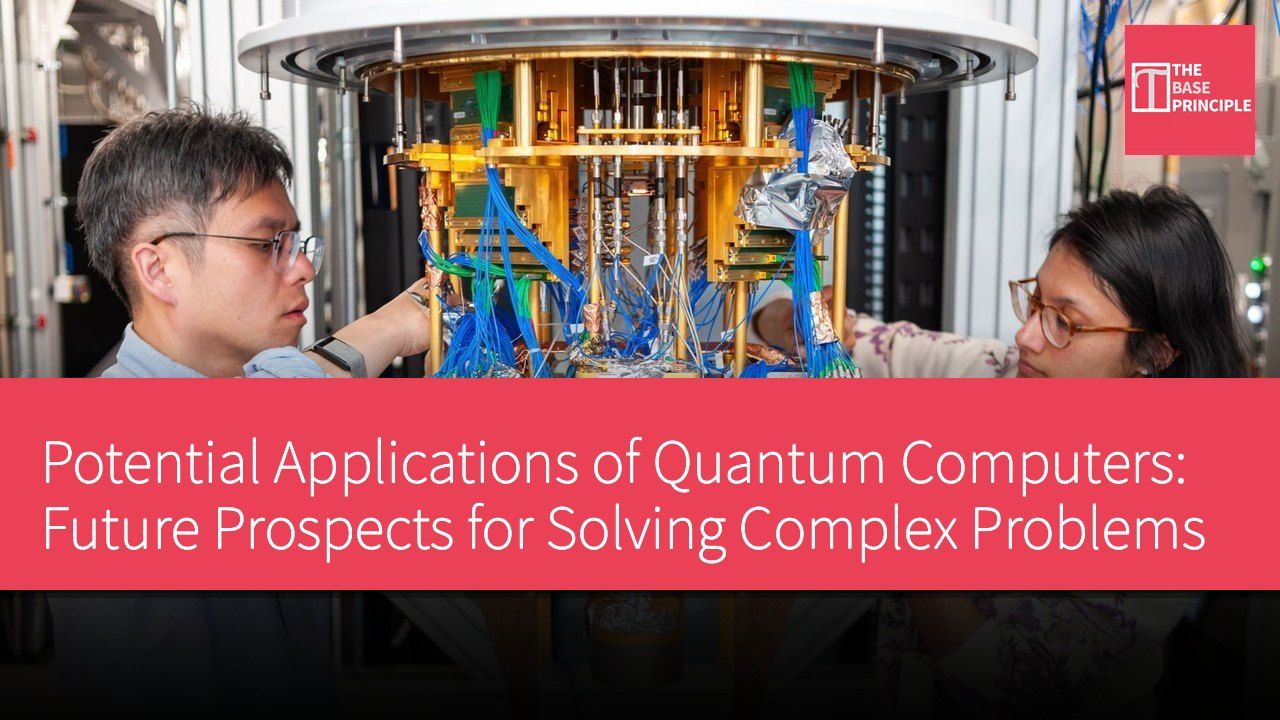
- Quantum computers can help solve complex scientific problems but will not replace traditional computers.
- The fragility of qubits requires complex error correction systems to ensure computational reliability.
- Quantum computers have broad application prospects in quantum chemistry and materials science.
- Quantum algorithms may optimize certain combinatorial problems, but there is currently no established evidence showing their advantages.
Designing optimized batteries, discovering new drugs, or developing materials that can withstand extreme temperatures are challenges currently facing the tech industry. Even the world's most powerful supercomputers struggle to accurately simulate the behavior of complex molecules and materials. Quantum computers have the potential to help solve these problems, possibly opening doors to discoveries that are currently difficult or too expensive to achieve. However, one should not expect quantum computers to replace laptops or to immediately solve all problems that traditional computers cannot handle. Their potential is more specialized. Despite companies racing to build increasingly powerful machines, the most important applications are still in development.
So, what problems can quantum computers actually solve? And how long will it take to see these solutions?
First, how do quantum computers differ from traditional computers? Traditional computers use bits to process information, which can only represent 0 or 1. In contrast, quantum computers use qubits, which can leverage phenomena such as superposition and entanglement to perform certain calculations in fundamentally different ways. This does not mean they will try every possible answer simultaneously. As explained in the quantum computing guidelines by the National Institute of Standards and Technology (NIST), extracting useful information from quantum computing requires carefully designed algorithms. Their advantage lies in their ability to manipulate complex quantum states, making the processing of certain problems simpler than traditional computing.
However, the issue is that qubits are very fragile. Minor disturbances can introduce errors, so researchers need increasingly complex error correction systems to enable quantum computers to reliably perform long calculations.
Applications of Quantum Computers in Chemistry
One of the most promising applications is quantum chemistry. The behavior of molecules follows the principles of quantum mechanics, making quantum computers potential natural tools for simulating molecules. Even powerful traditional computers struggle to accurately simulate certain complex chemical interactions, especially in systems involving strongly correlated electrons. Quantum computers could ultimately simulate these interactions more directly, helping researchers understand the behavior and reactions of molecules, which could have significant implications for drug discovery, chemical manufacturing, and the development of more efficient catalysts. For example, researchers could investigate molecular structures and reaction pathways to identify promising compounds or chemical processes.
One particularly interesting possibility is the development of better catalysts for ammonia production, a key component in fertilizer manufacturing. More efficient chemical reactions could also help reduce the energy required for industrial production.
According to a perspective published in the Journal of Chemical Theory and Computation in 2025, researchers from multiple national laboratories and universities have identified potential applications using early fault-tolerant systems (approximately 25 to 100 logical qubits), including photochemistry and materials design. When will this be realized? With the availability of fault-tolerant systems in the coming years, early demonstrations of significant scientific relevance may emerge. However, broader applications in drug development and industrial chemistry may take longer, possibly extending into the 2030s.
What if researchers could simulate the properties of materials before spending years developing and testing them? Quantum computers could help study the behavior of electrons in complex materials, thereby improving the search for better battery components, superconductors, solar cells, and industrial materials. This is closely related to chemical problems, but its impact extends to energy and manufacturing sectors. Better simulations could help researchers understand why certain materials conduct electricity, store energy, or exhibit unusual magnetism. The U.S. Department of Energy's Quantum Genesis Initiative specifically highlights chemistry, materials science, plasma physics, and high-energy physics as potential application areas.
Research applications may begin to make progress by the late 2020s, while more substantial material discovery applications may emerge in the 2030s. These are predictions, not guaranteed delivery dates.
Not all potential quantum applications are promising. Many widely used encryption systems rely on mathematical problems that are extremely difficult for traditional computers. For instance, the factorization of large numbers underpins the security of RSA encryption. In 1994, mathematician Peter Shor developed a quantum algorithm that could theoretically solve this problem efficiently. If sufficiently powerful quantum computers could run this algorithm, it could pose a threat to RSA and other public-key encryption systems. However, this does not mean that current quantum computers can crack bank accounts or unlock encrypted internet traffic.
Their current capabilities fall far short of what is needed. However, this threat is serious enough that governments and tech companies are preparing alternatives. NIST has released post-quantum encryption standards designed to resist attacks from both traditional and future quantum computers. The U.S. Government Accountability Office reported in October 2026 that experts believe quantum computers related to encryption could emerge in the 2030s, although predictions vary. This threat is a concern for the 2030s, not a reflection of current capabilities. As sensitive information collected today may still hold value in the coming decades, the transition to quantum-resistant encryption has already begun.
Optimization Potential of Quantum Computers
Quantum computers can also help solve problems involving vast numbers of possible combinations. Consider scheduling airline flights, optimizing industrial supply chains, managing power grids, or coordinating complex manufacturing operations. The computational cost of finding the best solution among countless possibilities can be very high. Quantum algorithms may ultimately help explore certain optimization problems more efficiently, especially when used in conjunction with traditional computers. However, this is an area that requires cautious expectations. There is currently no established evidence that quantum computers will frequently surpass the best traditional methods in everyday business optimization problems.
Some optimization problems may benefit in the late 2020s or 2030s, while others may never provide valuable quantum advantages.
So, when does the quantum era actually begin? There is no single arrival date. IBM's current quantum roadmap aims to achieve large-scale fault-tolerant systems by 2029, while the U.S. Department of Energy's Quantum Genesis Initiative hopes to demonstrate scientifically relevant fault-tolerant systems by 2028. These are ambitious development goals and do not guarantee that commercially useful breakthroughs will follow immediately. The future possibility is not that quantum computers will replace traditional machines, but rather that they will work alongside traditional supercomputers and AI systems to tackle specialized computations that are particularly challenging for traditional hardware.
The first significant breakthroughs may not appear as shiny new consumer products but may manifest as better batteries, more efficient industrial chemical processes, or new understandings of complex molecular behavior.
Development and Challenges of Quantum Computers
The potential of quantum computers lies in their ability to tackle complex problems that are difficult for traditional computers, particularly in the fields of quantum chemistry and materials science. As technology advances, quantum computers may have a significant impact on drug discovery and industrial chemistry. However, the fragility of qubits and the challenges of error correction remain major obstacles to technological development. Additionally, while there is potential for quantum algorithms in optimization problems, current evidence is insufficient, and their practical application prospects should be approached with caution.