
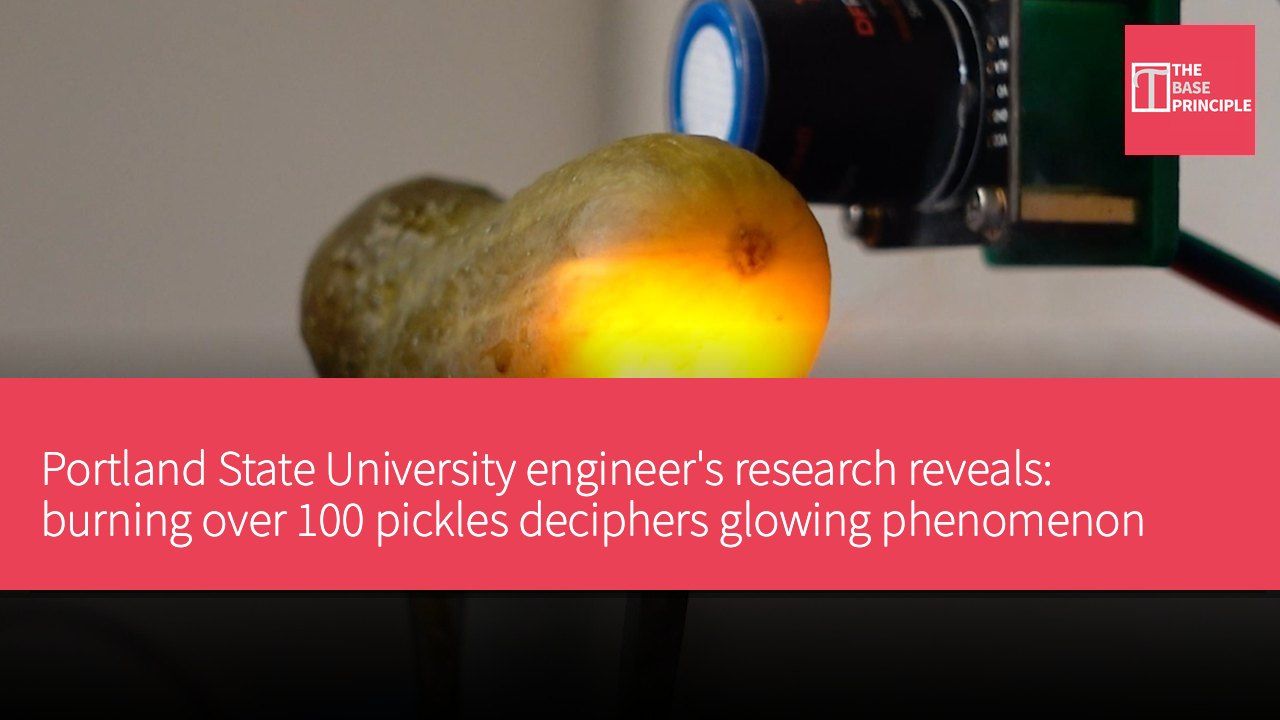
- The pickle's glowing phenomenon is related to electrostatic issues.
- Two theories explain the pickle's glow: spark discharge and hydrogen ignition.
- Research shows the cause of the glow combines elements of both theories.
- Experiments find brine accumulates at the bottom of the pickle, affecting the glow location.
A Portland State University engineer is close to explaining a classic classroom experiment that has long puzzled scientists. Impale a pickle on two metal forks and plug it into a wall outlet, and one end of the pickle emits a bright orange glow. The school's assistant professor of electrical engineering, Josh Méndez, was surprised to discover that this glowing pickle remains an unsolved electrostatic problem. Intrigued by these obscure electrostatic puzzles, he began researching, and has since burned through more than 100 pickles.
Two theories explain the glow
Pickles are soaked in brine, so they conduct electricity, and there are typically two competing theories to explain why they glow: spark discharge or hydrogen ignition. The first theory relies on steam sparks. When current heats the pickle, liquid evaporates and forms bubbles, accompanied by the acrid smell of scorched pickle and hot metal. These bubbles block the current, causing the pickle to cool, the bubbles to shrink, and the conductive brine to flow back to the electrodes. Then a small arc jumps between the liquid and the electrode, like a static shock from a doorknob, Méndez says. However, this explanation remains insufficient because it cannot explain why only one end of the pickle glows.
The second theory points to electrolysis, in which current drives a chemical change that splits the brine's water into oxygen and volatile hydrogen. Hydrogen forms only at the negative electrode, which can explain the one-sided glow. In this scenario, the intense heat generated by the electrode triggers tiny hydrogen explosions inside the pickle, producing light.
Research reveals cause of glow
Méndez's research indicates the true cause merges the two theories: an electric spark ignites the hydrogen, but heat does not trigger the process. The principle is the same as the warning against lighting a cigarette at a gas station, because a spark ignites the gas. The color's source is chemical: excited sodium ions in the brine produce the characteristic orange glow. Excited atoms release excess energy as light of a specific color, which is why each element has its own unique emission hue. Méndez says if you pickle in different salts, the glow color will reflect those elements' unique properties.
Science News reports that the team monitored pickles in the lab with high-speed cameras and hydrogen sensors. They also found that vertically oriented pickles always glow at the bottom, because brine accumulates there. For K-12 classroom demonstrations, this explanation involves sparks, hydrogen, and salt, not any anomalous phenomenon.
Scientific explanation of the glowing pickle phenomenon
The glowing pickle phenomenon is not just an amusing experiment; it also reveals the relationship between electrostatics and chemical reactions. This research combines the theories of spark discharge and hydrogen ignition, providing a more comprehensive explanation that demonstrates the complexity of scientific inquiry. Through experiments, researchers were able to observe how brine accumulation affects the glow location, which has important implications for education and scientific demonstrations, helping students understand electric current, chemical reactions, and their applications in daily life.