
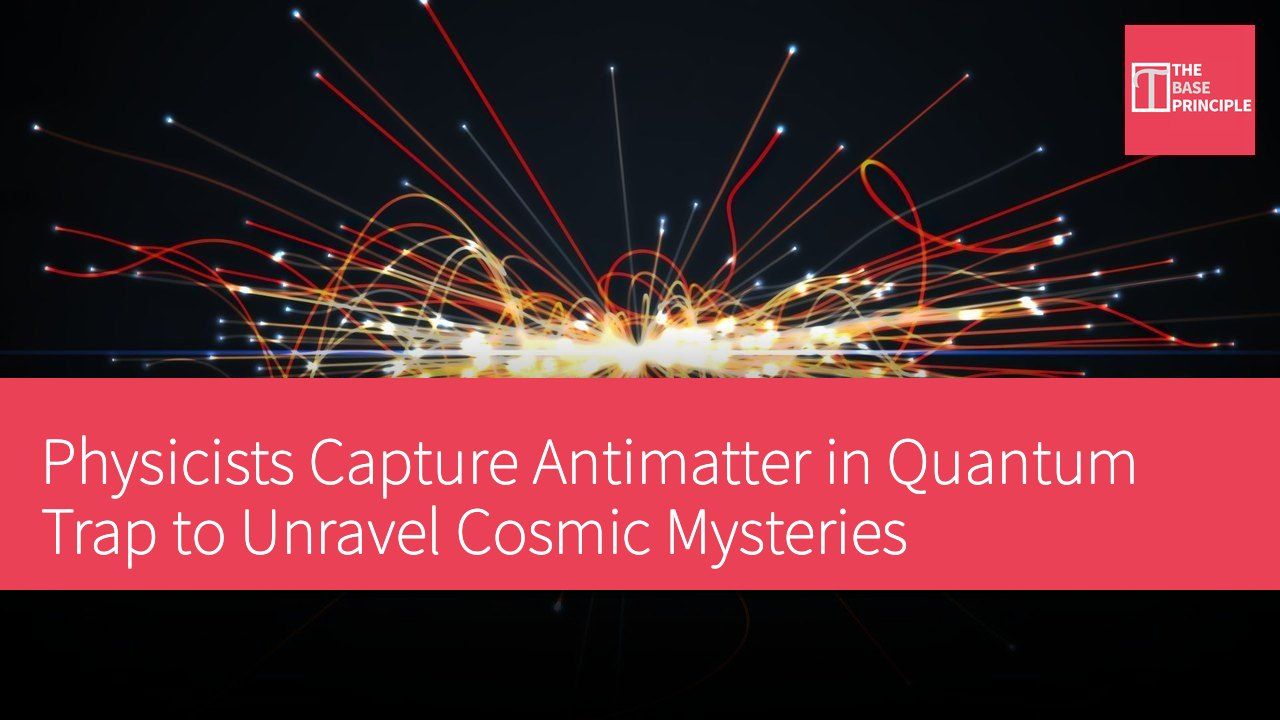
- The Northwestern University team has captured and cooled a positron for the first time, creating a quantum cyclotron.
- Positrons cannot be stored in containers as they annihilate upon contact with matter.
- Researchers have precisely measured the magnetic moment of the positron, searching for differences between matter and antimatter.
- If the measurements differ, it could challenge the existing standard model.
If the Big Bang created equal amounts of matter and antimatter, everything that exists should have annihilated each other billions of years ago. Yet, our world still exists. Now, physicists at Northwestern University may have found the reason. Led by Professor Gerald Gabrielse and his doctoral student Thomas Myers, the team captured, cooled, and trapped a single positron (the antimatter counterpart of an electron) and placed it in a "highly controllable quantum state." Notably, this marks the first creation of "a positron quantum cyclotron."
Quantum Control of Positrons
Ordinary matter is composed of electrons, protons, and neutrons, while the antimatter universe consists of positrons, antiprotons, and antineutrons. However, studying antimatter is extremely challenging. When an antimatter particle comes into contact with ordinary matter, they annihilate each other almost instantaneously, releasing energy. Positrons cannot be stored in containers because contact with normal matter would immediately destroy them. Therefore, studying these particles requires careful handling, although the small amounts used do not pose a real explosion risk. Gabrielse stated, "If we want to study antimatter, we must handle it carefully. To be clear, this is not dangerous.
We do not have enough antimatter to create an explosion."
Quantum Control of Positrons
In this research, physicists captured a single positron from radioactive decay, cooled it to near absolute zero, and used magnetic and electric fields to trap it in a vacuum. This state created a positron quantum cyclotron, allowing the particle to operate like a "man-made atom," with energy levels that can be precisely controlled without contact with ordinary matter, which would lead to annihilation. In this study, researchers captured a high-energy positron released during the radioactive decay of sodium-22, slowing it down and guiding it into a custom-designed electromagnetic trap.
Once inside, the internal temperature was lowered to a frigid 300 milliKelvin (just 0.3 degrees above absolute zero). The positron floated in an almost perfect vacuum, never touching any walls. After eliminating external noise, it stabilized in its lowest energy state, essentially behaving like a man-made atom that scientists could manipulate for months. Gabrielse remarked, "We cooled it to such a low temperature that it entered the quantum ground state. We actually guided this very fast positron to sit there and behave for months."
Searching for Cracks in the Model
Searching for Differences Between Matter and Antimatter
The standard model describes fundamental particles and three of the four fundamental forces of the universe, but physicists know it is incomplete because it cannot explain why matter predominates over antimatter. Researchers at Northwestern University demonstrated how they used precisely tuned microwave pulses to trigger and observe individual quantum transitions of the trapped positron. This level of control allows for extremely precise measurements of the positron's magnetic moment, replicating previous experiments measuring the electron's magnetic moment with an accuracy of one part in ten trillion. Comparing these two measurements will help physicists search for subtle differences between matter and antimatter.
Gabrielse stated, "Current theories suggest there will be no difference between these two measurements. If the results are not equal, that would be the biggest discovery in physics in the past century."
If a difference is found between these two measurements, it could potentially break the standard model and ultimately provide clues as to why matter triumphed in the cosmic tug-of-war, allowing our universe to exist. The results of this research were published on October 21 in Physical Review Letters.
The Impact of Positron Research on Physics
This research demonstrates how to control antimatter under extreme conditions, opening new avenues for exploration in physics. The quantum control of positrons not only enhances our understanding of antimatter but may also reveal why matter dominates the universe. If the measurements indicate a difference between matter and antimatter, it would challenge the existing standard model and could change our understanding of the universe's fundamental structure. These findings not only contribute to fundamental science but may also have far-reaching implications for future technological applications.