
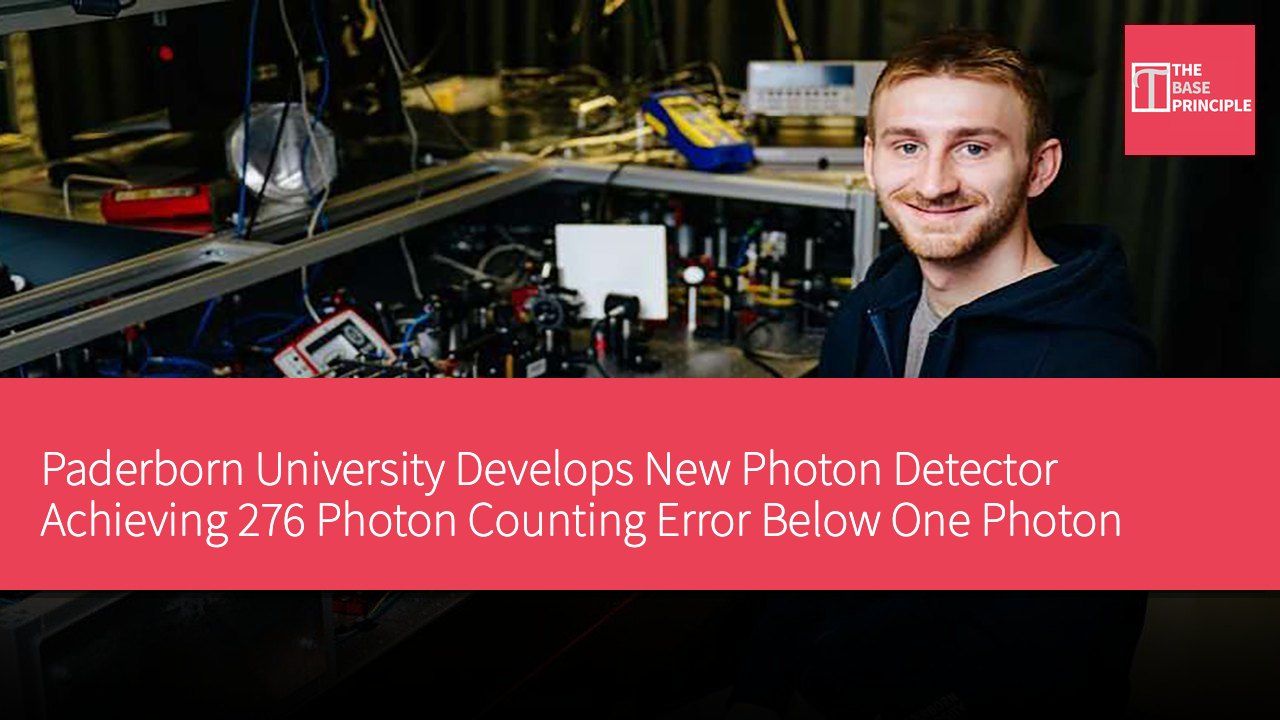
- The photon detector developed by Paderborn University can count pulses from over 9,000 photons.
- The system can measure up to 276 photons with an uncertainty of less than one photon.
- The research team combined superconducting nanowire single-photon detectors with multiplexing technology.
- The accuracy of the detector is limited by temporary blindness issues in certain bins.
The research team at Paderborn University has developed a photon detector capable of counting pulses from over 9,000 photons and measuring up to 276 photons with an uncertainty of less than one photon, according to a press release from Optica. As the number of photons increases, the challenge of counting them also rises. Many single-photon detectors, including semiconductor avalanche photodiodes, can only indicate whether light has arrived, but cannot quantify how many photons are present. Detectors designed for brighter light increase electrical noise, which obscures counting, the report states.
Technical Breakthrough of the New Detector
The team combined superconducting nanowire single-photon detectors (SNSPDs) with multiplexing technology, which allows signals to be divided into multiple channels. The end result is 1,024 detection bins.
Timon Schapeler from Paderborn University stated that no previous demonstration has simultaneously used both methods at such a scale, describing this achievement as an order of magnitude larger than previous multiplexed single-photon counting systems. The system splits each laser pulse into 128 smaller time-separated pulses, which are then sent to eight detectors, resulting in 1,024 shared pulses of the original photons, according to the report. Tim Bartley from Paderborn University noted that low-loss optical technology ensures that light is evenly distributed across the bins.
The team established a model early on with Mariia Sidorova from the German National Metrology Institute that describes each detector component.
Test Results and Accuracy Challenges
According to the team's preprint, SNSPDs alone can resolve only a few photons, typically up to five. A physicist from Leiden University recently reported a similar superconducting detector capable of separating one, two, or three or more photons. To test the system, the team sent laser pulses averaging between one and 15,000 photons into it. Researchers indicated that the detector measured pulses of up to 276 photons with an uncertainty of less than one photon. They calculated that a traditional multiplexing system would require about 37,000 detector components to achieve this level of precision.
However, beyond 276 photons, the uncertainty exceeds one photon. The preprint notes that it remains below the Poisson noise limit at 4.1 decibels, which is the inherent noise of laser light, where the uncertainty equals the square root of the number of photons. This means that the figure of 9,000 refers to counts exceeding this limit, rather than being accurate to a single photon. The authors also stated that accuracy is limited by defects in the detector, particularly temporary blindness in certain bins, which accounts for deviations of about 1,000 photons.
Efficiency varies significantly with light intensity, and this test used only laser pulses.
The team also utilized quantum detector imaging technology to reconstruct the entire response of the detector, a calibration method based on earlier high-performance computing work. Other teams are also expanding SNSPD systems, including a 100-channel detector being built in Shanghai. Researchers plan to apply these detectors to bright quantum light states, which the report indicates will enable them to reveal large-scale quantum effects. The research paper is published in Volume 13 of the Optica journal.
Application Potential of the New Photon Detector
The breakthrough in photon detector technology at Paderborn University demonstrates precise measurement capabilities at high photon counts, which is significant for fields such as quantum communication and quantum computing. This detector can perform measurements with an uncertainty of less than one photon, showcasing its potential applications in quantum light states. Although accuracy may be affected beyond 276 photons, the development of this technology lays the groundwork for future quantum technologies and may facilitate the study of larger-scale quantum effects.