
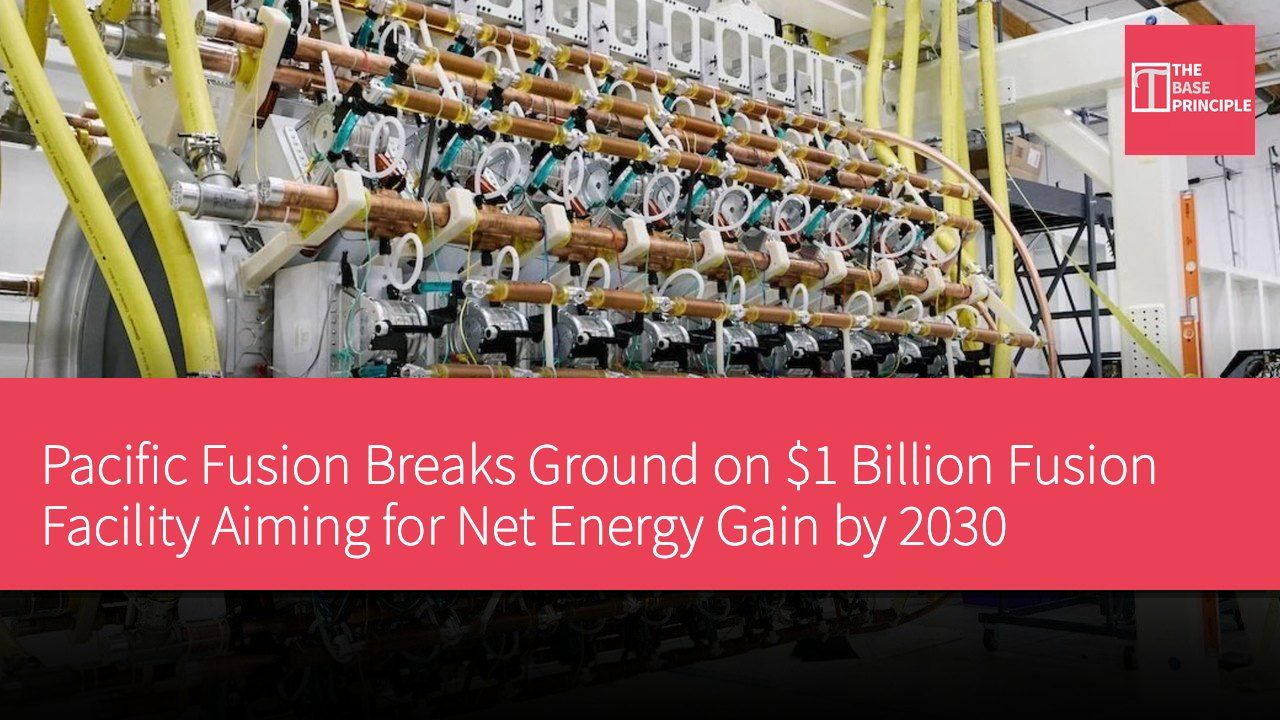
- Pacific Fusion is building a fusion facility in New Mexico with a cost of $1 billion.
- The facility aims to achieve net energy gain, surpassing previous experiments in energy efficiency.
- The technology is based on pulsed power inertial confinement, eliminating the need for large laser arrays.
- The U.S. Department of Energy has signed a collaboration agreement with Pacific Fusion, covering multiple research areas.
U.S. startup Pacific Fusion has broken ground in Albuquerque, New Mexico, on a $1 billion (approximately HK$7.8 billion) manufacturing and research facility. Engineers plan to test a new type of pulsed power device at the site by 2030, targeting two long-standing technical benchmarks in nuclear physics. Dr. Keith LeChien, co-founder and Chief Technology Officer, stated that with the U.S. leading the way in making controlled fusion technology feasible, Pacific Fusion's mission is to translate this scientific advantage into industrial strength and infrastructure, bolstering America's energy leadership and national security.
Facility's Core Objective
The facility's core objective is to demonstrate "facility-level net energy gain." Previous laser and magnetic confinement fusion experiments only measured the ratio between the energy directed at the fuel capsule and the fusion output. Pacific Fusion's pulsed power inertial confinement approach expands the efficiency measurement to encompass the entire facility. Facility-level net gain means the energy produced by the fusion reaction must exceed the total electrical energy stored within the device prior to firing. No laboratory has yet achieved this level of overall electrical efficiency.
The system is based on the principle of pulsed power inertial confinement, eliminating the need for large laser arrays or magnetic field coils like those used in tokamak devices. Instead, it directly injects intense current pulses into the target. These high-current pulses generate extreme magnetic pressure, rapidly compressing small fuel capsules to initiate fusion reactions. To control costs, the company uses widely available industrial materials and assembles the power system with modular standard electrical components.
The technology is rooted in decades of research from national laboratories such as Sandia, Los Alamos, and Lawrence Livermore. Pacific Fusion previously completed tests on a prototype driver, Sirius, under a joint agreement with Lawrence Livermore. Sirius uses an impedance-matched Marx generator to deliver brief high-voltage pulses to the load. During testing, the prototype device successfully completed over 3,000 firings, providing engineers with data on voltage stability, switching losses, and circuit timing to design the full-scale pulsed modules for the Albuquerque facility.
The Albuquerque demonstration device is also planned to produce high-yield fusion reactions with single pulses exceeding 100 megajoules. This level of output creates an extreme temperature and pressure environment known as a high-energy density state, allowing physicists to study the behavior of materials and radiation in the internal environment of nuclear weapons. The U.S. government identified the need for such experimental platforms around thirty years ago when underground nuclear testing ceased.
U.S. Government Collaboration
Based on these capabilities, the National Nuclear Security Administration of the U.S. Department of Energy has signed a formal collaboration agreement with Pacific Fusion, covering areas such as high-energy density physics, computer modeling, advanced materials, and pulsed electrical networks. Additionally, the company is opening a hardware assembly facility in Los Lunas to mass-produce the modular pulsed power components needed for the demonstration system. Public Service Company of New Mexico is also studying how the future pulsed power facility can provide baseload power to the regional grid as electricity demand rises.
In conclusion, LeChien stated that today's groundbreaking ceremony proves that the U.S. still has the capability to undertake difficult engineering projects, and can do so faster than any other country, including China.
Pacific Fusion's fusion facility marks a significant advancement in controlled fusion technology for the United States. As global demand for renewable energy increases, fusion is seen as a crucial solution for future energy needs. Through its innovative pulsed power inertial confinement technology, Pacific Fusion not only enhances energy efficiency but also provides a necessary experimental platform for nuclear weapons-related research. The collaboration with the U.S. Department of Energy further underscores the potential of this technology, demonstrating America's continued leadership in this field and potentially influencing the direction of global energy policy.
Item Specification Facility Location Albuquerque, New Mexico, USA Construction Cost $1 billion (approximately HK$7.8 billion) Target Test Year 2030 Technical Route Pulsed Power Inertial Confinement Single Pulse Output of Demonstration Device Over 100 megajoules Prototype Driver Sirius Number of Continuous Firings of Prototype Over 3,000 Hardware Assembly Facility Los Lunas, New Mexico U.S. Leadership in Fusion Technology