
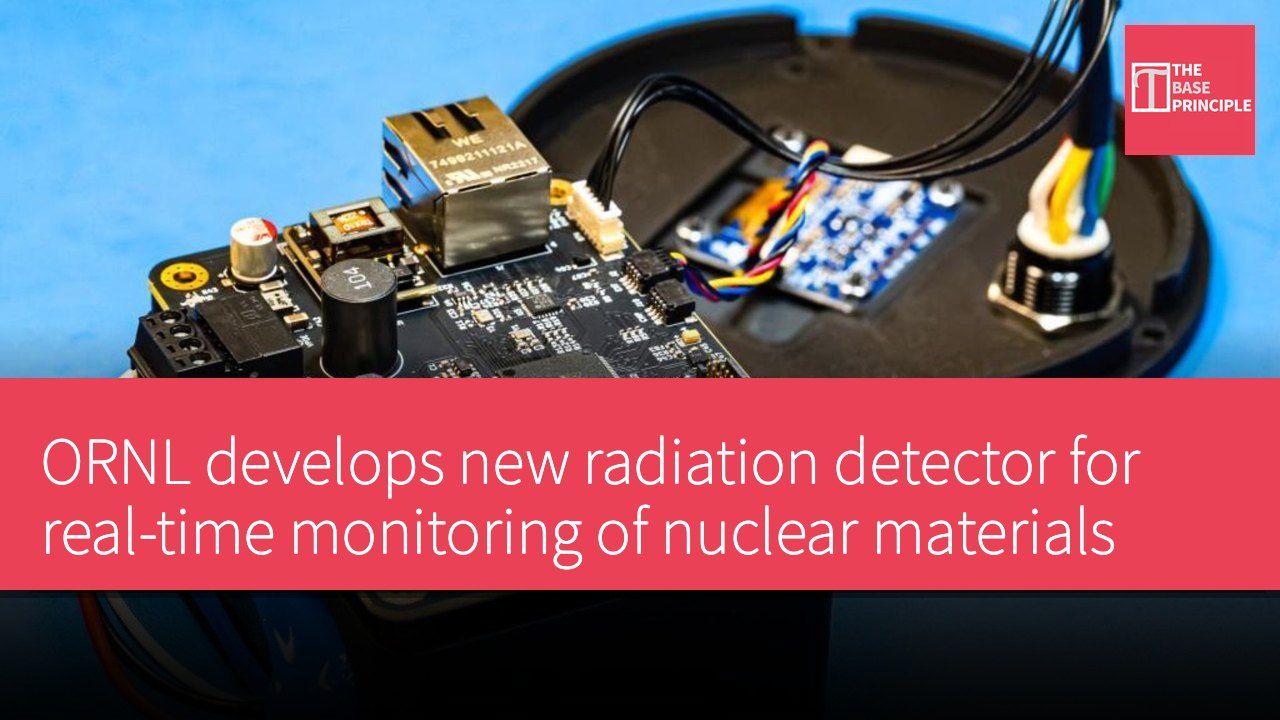
- The radiation detector developed by ORNL enables real-time monitoring of nuclear materials.
- The device can be installed in air conditioning ducts to provide continuous, real-time radiation monitoring.
- The use of low-cost plastic crystals lowers the overall cost of the detector.
- The monitor also prevents illicit actors from collecting nuclear materials, bolstering national security.
Oak Ridge National Laboratory (ORNL) has developed a compact, low-cost radiation detector designed to continuously monitor nuclear material buildup inside facility air conditioning ducts in real time. The device is intended to replace slow, manual inspection methods with an affordable, automated system. Essentially an automated cylinder, the device mounts directly onto ventilation ductwork to deliver continuous, real-time radiation monitoring. This monitoring approach will help nuclear facilities improve safety, environmental protection and national security.
In nuclear fuel processing facilities, air conditioning ducts serve as overhead ventilation channels that continuously circulate, filter and exhaust room air. Although these facilities handle radioactive materials within strictly enclosed processing areas protected by high-efficiency particulate air filters, tiny dust particles such as uranium can still escape into the airflow. Over time, these minute radioactive particles settle on the inner walls of the metal ductwork. Allowing unmonitored nuclear dust to accumulate inside these overhead ventilation ducts creates an unshielded radiation source that endangers worker health and poses a serious national security risk through the theft or diversion of unaccounted-for material.
How the new monitor works
The new monitor scans ventilation ducts every minute, providing continuous surveillance to detect nuclear material buildup and uphold the highest safety and security standards.
The 12-inch device operates in two simple modes depending on facility needs. It can be battery-powered for up to one month, capturing and storing data samples every minute. When connected via Power over Ethernet, it streams and saves data every second for real-time tracking. Ethernet replaces the older USB connection, allowing longer cable runs between the overhead air conditioning ductwork and a central monitoring station. To make the system truly seamless, the researchers paired the hardware with advanced software. AI-enhanced algorithms were trained on real-world facility data collected during live testing at ORNL.
Once integrated, the smart software will automatically analyze radiation signatures and trigger an alert the instant hazardous material reaches unsafe buildup levels.
Cost effectiveness and improved safety
Overall, the system is also relatively inexpensive. A typical detection element costs more than US$10,000 (about HK$78,000). The ORNL team built the device around an inexpensive plastic scintillation crystal costing just one or two dollars. When radiation strikes the detector, this low-cost plastic crystal emits flashes of light as photons. A silicon photomultiplier then converts these light pulses into electrical signals. Materials such as uranium produce distinctive energy signatures. As a result, the system is programmed to count specific electrical pulses and immediately flag unsafe radiation levels.
Project lead Brett Witherspoon explained that the device combines low-power, historically analogous processing with a secure modern digital microcontroller. Replacing bulky vacuum tubes with compact silicon photomultipliers makes the detector more temperature-tolerant while reducing its overall size and cost.
Choosing plastic crystals priced at just one or two dollars rather than alternatives costing 1,000 to US$10,000 (about HK$78,000) lets nuclear facilities deploy radiation monitoring more economically across their sites. "This is a thousand times cheaper than current technology, and a purpose-built device gives nuclear facilities a more accurate, user-friendly and cost-effective alternative," said overall project lead Kelly Goetz. "These devices will make nuclear facilities safer and more efficient because they reduce the regulatory burden." In addition to shielding against unshielded radiation, the monitor addresses a major national security concern: preventing illicit actors from secretly collecting unaccounted-for nuclear material trapped inside ductwork.
Potential for future applications
The application is not limited to fuel plants; the researchers are currently stress-testing the electronics under extreme high temperatures, with the goal of deploying the monitor in next-generation molten salt reactors, small modular reactors (SMRs) and even outdoor perimeter entry points to deter theft in harsh environments.
Item Specification Display size 12 inches Battery-powered operation Up to one month Data capture frequency Every minute Data streaming frequency Every second
Impact and application prospects of the new radiation detector
The development of this new radiation detector marks a significant advance in safety monitoring technology for nuclear facilities. By offering a low-cost and highly efficient monitoring solution, the technology not only reduces operational burdens but also effectively prevents the illicit collection of radioactive materials, thereby strengthening national security. As future applications expand, including use in molten salt reactors and small modular reactors, the technology has the potential to play a critical role across multiple fields, supporting the safe development of nuclear energy.