
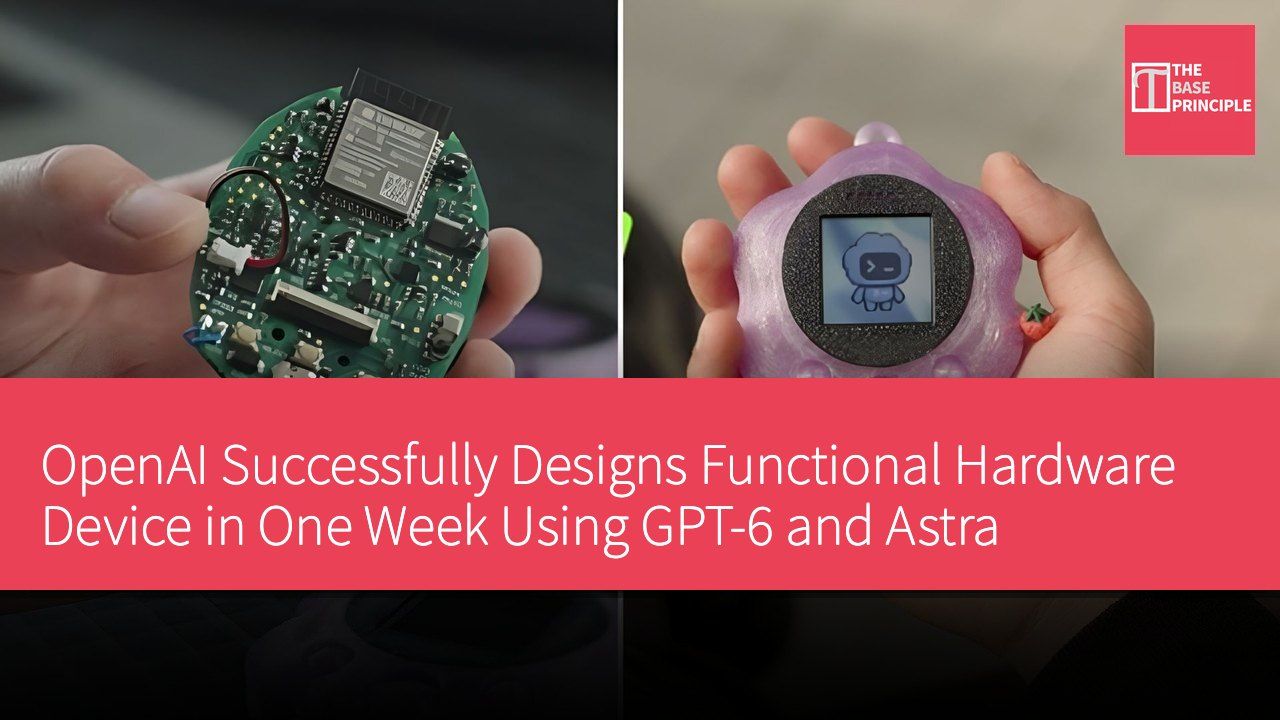
- OpenAI designed a functional hardware device in one week, demonstrating its technical capabilities.
- The prototype development required coordination across multiple engineering domains and faced manufacturing challenges.
- OpenAI's internal team used Codex and ChatGPT to accelerate the design process.
- OpenAI collaborated with industry partners to explore the application of its models in real-world engineering.
OpenAI has designed a functional hardware device in less than a week, showcasing how its technology can tackle complex engineering tasks. Two team members developed this prototype as a side project with the assistance of GPT-6 and Astra. The device connects users to Codex through a dedicated physical interface. The project tested whether OpenAI's models could handle the entire hardware development process without direct human editing. Astra assisted in developing the device's appearance and internal components, as well as in circuit board design, firmware, and software integration.
A contract manufacturer produced a small batch of prototypes in less than a month. OpenAI stated that this experiment provided initial insights into how the model can accelerate professional engineering. The company is also collaborating with automotive and racing partners to test these capabilities.
Challenges in Prototype Development
The development of the prototype required Astra to coordinate multiple engineering domains. GPT-6 helped establish functional requirements and guided the design process. Astra then developed the casing, which housed the device's internal components. The model also selected electrical components and designed the printed circuit board (PCB). Its work encompassed component placement and electrical connections, which had to fit the physical casing. On the software side, Astra created the user interface and generated the firmware while developing the integration needed to connect the device to Codex. However, additional challenges arose in preparing the prototype for production.
Astra struggled to account for manufacturing constraints and component tolerances, and engineers needed to resolve assembly requirements through multiple review rounds. OpenAI acknowledged these shortcomings as areas for improvement.
This experiment demonstrated how quickly the model can produce preliminary designs. Manufacturing still requires engineering oversight and practical adjustments. OpenAI's internal hardware and infrastructure team has been using Codex and ChatGPT, with their work including creating computer-aided design (CAD) models and preparing technical manufacturing drawings. These models also assist engineers in configuring simulations and evaluating designs. OpenAI reported a 23-fold increase in usage by its hardware team from February to October, measured by model token consumption.
Two OpenAI team members collaborated with GPT-6 and Astra to design a prototype device for communicating with Codex in less than a week as a side project. Astra designed the casing, circuit board, interface, and software. Nevertheless, manufacturing the device still required multiple review rounds. OpenAI's frontline engineer Grace Lam stated that Codex accelerated the process from concept to engineering components, highlighting the faster CAD revisions and the ability to convert 3D designs into producible 2D drawings.
OpenAI is also tracking the performance of its models through specialized benchmarks. In BenchCAD 2.0, its updated internal model achieved an average score of 0.875, while GPT-6 Astra scored 0.594 under the highest inference settings. This benchmark evaluates how well the model reconstructs 3D components and identifies circuit board connections.
Exploring Industry Collaborations
OpenAI is testing its models with industry partners to assess their practicality in real engineering environments. An expanded collaboration with Chip Ganassi Racing focuses on CAD development and prototype production. The racing team's R&D engineers are exploring how to convert 3D scans into editable CAD models and generate 2D manufacturing drawings from scanned components. This approach helps engineers reconstruct parts when original design files are unavailable. OpenAI also announced a research collaboration with Mazda, where both parties are exploring how the model can assist automotive engineers in improving vehicle aerodynamics and crash safety.
Astra can explore different front-end shapes and simulate airflow to identify designs that reduce drag. Mazda's engineers can then evaluate potential configurations based on styling requirements and development costs.
Akihiro Nakata, Mazda's chief engineer, stated that this collaboration helps designers understand which features impact aerodynamic performance, allowing them to explore different vehicle shapes more freely. OpenAI plans to continue testing these capabilities with industry partners, with a broader goal of helping engineers transition from initial concepts to manufacturable products while reducing human intervention.
How OpenAI Accelerates the Hardware Design Process
OpenAI's experiments show that using GPT-6 and Astra for hardware design can significantly enhance efficiency, particularly in the prototype development phase. Despite facing manufacturing constraints and design adjustment challenges, this process underscores the model's potential in engineering tasks. Collaborations with industry partners further validate the value of these technologies in practical applications, especially in enhancing design flexibility and reducing manual intervention. These advancements not only help accelerate product development but could also transform workflows in future hardware design.