
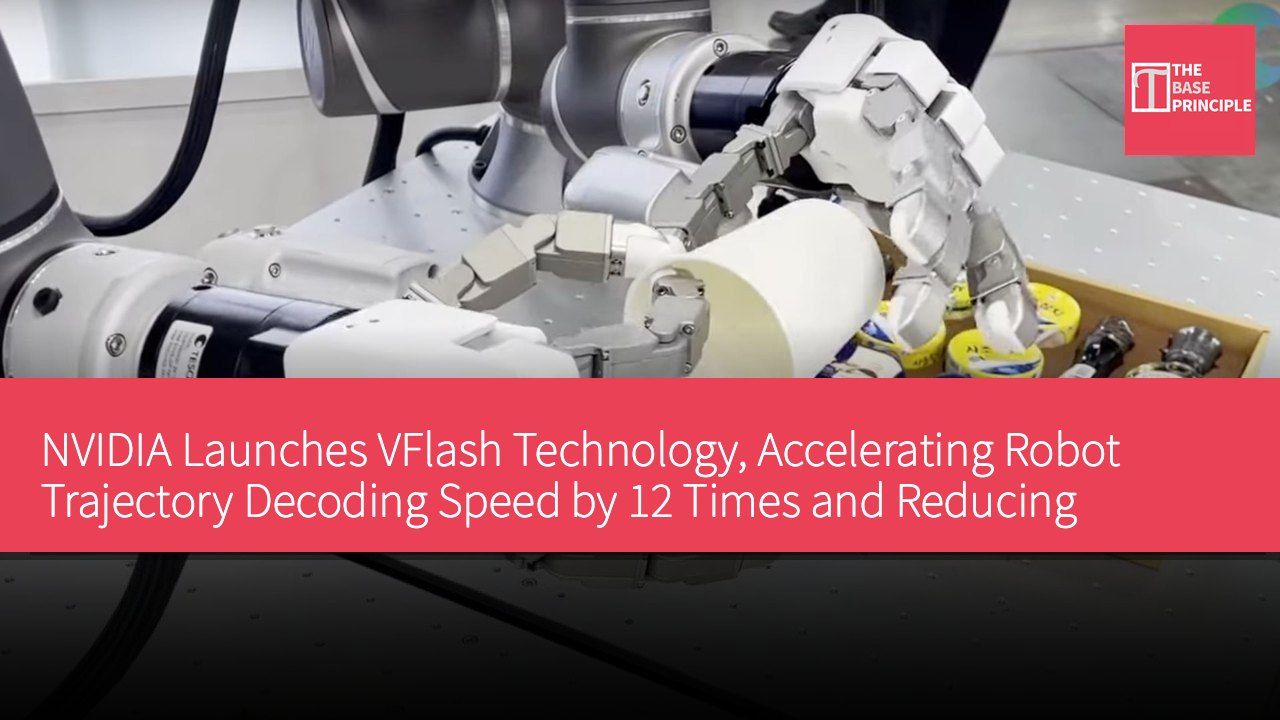
- VFlash technology can accelerate robot trajectory decoding by up to 12 times, with a 61% reduction in prediction error.
- VFlash allows for the generation of complete robot trajectories in a single pass, enhancing efficiency.
- In tests, VFlash significantly reduced inference latency, improving robot response speed.
- The research also explores VFlash's applications in autonomous driving, demonstrating its potential.
NVIDIA researchers have developed a new visual planning method that can accelerate robot trajectory decoding by up to 12 times while reducing three-dimensional trajectory prediction error by as much as 61% in specific tests. This method, called VFlash, allows visual language models (VLMs) to generate complete robot trajectories and other spatial predictions in a single process, rather than producing coordinates sequentially. In robot operation tests, VFlash also reduced overall inference latency on NVIDIA Jetson Thor and DGX Spark platforms by approximately 80%, with the potential to help robots respond more quickly to changing environments.
Advantages of VFlash Technology
This research addresses a limitation of traditional VLMs, which typically generate spatial predictions one coordinate at a time. As robots need to predict longer trajectories, track more objects, and handle more detailed spatial information, this sequential processing approach can increase processing time. VFlash leverages known visual prediction structures to generate entire geometric objects or trajectories in a single forward pass.
In tests of robot operation, researchers reported that VFlash reduced inference latency on the NVIDIA Jetson Thor platform from 3,552.7 milliseconds to 703.3 milliseconds. This represents an approximately 80% reduction in latency compared to traditional autoregressive decoding. On DGX Spark hardware, latency decreased from 3,356.5 milliseconds to 649.9 milliseconds. VFlash operates by first identifying the structure of the requested visual prediction and then generating its coordinates.
For example, bounding boxes have fixed coordinate layouts, while trajectories can contain a variable number of two-dimensional and three-dimensional points. The model uses a lightweight diffusion-based draft generator to jointly predict these coordinates in a single forward pass. Unlike traditional generative decoding, which requires checking each generated label against the target model one by one, VFlash can accept structurally valid visual predictions without the need for consistency across individual labels.
Researchers evaluated VFlash across multiple two-dimensional and three-dimensional robot trajectory prediction tasks. Compared to autoregressive baseline methods, VFlash reduced prediction error in several tests. In three-dimensional trajectory tests, depending on the dataset and training configuration, it lowered the average displacement error by as much as 61%. Researchers also tested VFlash in 3D point motion prediction, where it forecasted the future motion of objects in video frames. Preliminary single-pass rolling measurements indicated that generation speed was approximately 25 times faster than autoregressive decoding.
Applications of VFlash in Autonomous Driving
Researchers also explored whether faster visual predictions could improve the performance of downstream robot control systems. They connected trajectories generated by VFlash to a world action model evaluated on MolmoSpaces, which achieved an average success rate of 70.2% across four task suites, compared to a baseline system success rate of 62.6%. The most significant improvements were observed in pick-and-place and object closing tasks, with success rates increasing by 11.6 and 12.8 percentage points, respectively. In addition to robotics, researchers tested VFlash's applications in autonomous driving using the NAVSIM and Waymo datasets.
The driving trajectories generated by the model were competitive in benchmark performance, and reinforcement learning further improved its planning outcomes. These findings suggest that generating detailed visual plans more efficiently could help physical AI systems respond more quickly to changing environments while maintaining spatial accuracy. This research, titled "VFlash: Fast, Accurate Visual Planning via Flash Primitive Decoding," was published in November 2026 by NVIDIA researchers and their collaborators.
Impact of VFlash on Robotics Technology
The launch of VFlash technology marks a significant advancement in robotic visual planning, enabling robots to respond more effectively to their environments. As the demand for robotic applications continues to grow, the ability to generate trajectories quickly and accurately is crucial for enhancing robot performance. VFlash demonstrates exceptional performance not only in robotic operations but also shows potential application value in autonomous driving, potentially transforming the design and implementation of future autonomous driving systems.