
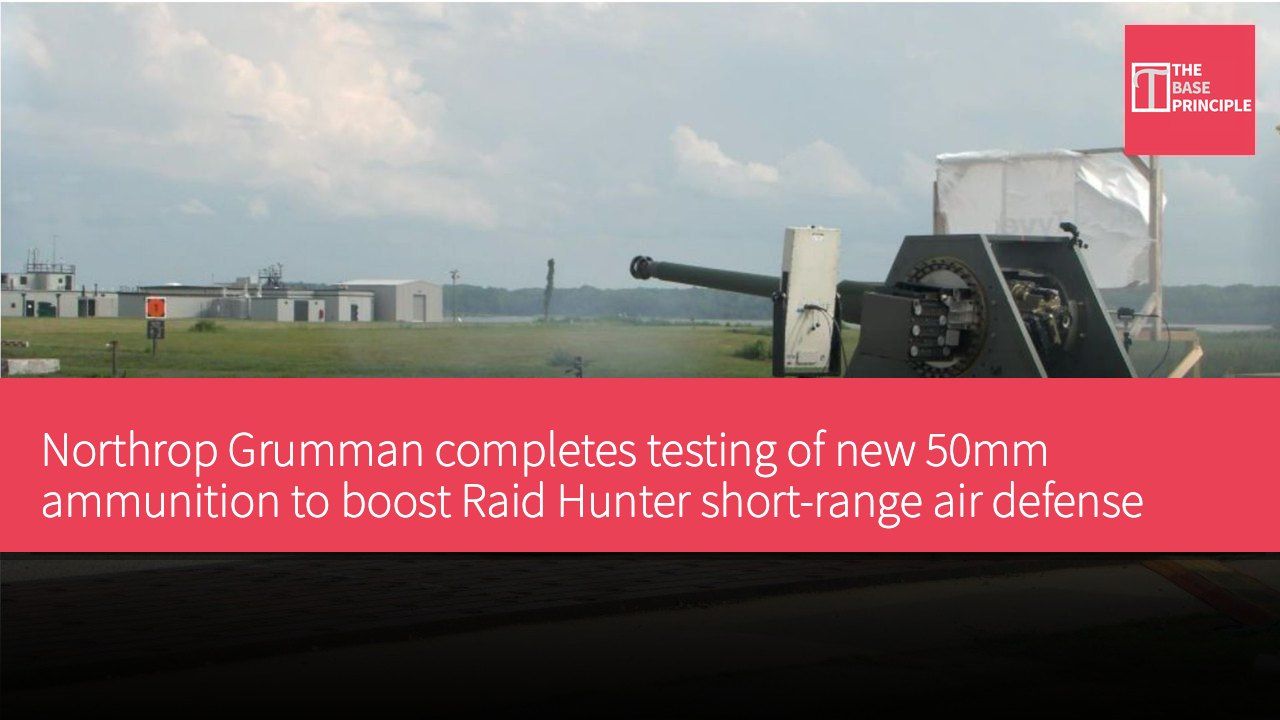
- Northrop Grumman completes air-ballistic testing of a new 50mm ammunition round.
- Test results met expectations, providing a real-world check on the ammunition's design.
- The new round will be combined with Bushmaster chain gun technology to enhance defensive capability.
- The Raid Hunter system features a platform-agnostic design that adapts to different operational needs.
Northrop Grumman has completed an air-ballistic test of a new 50mm ammunition round, further advancing development of its gun-based short-range air defense system, "Raid Hunter." The round was fired from an XM913 chain gun during a test aimed at validating its performance and gathering flight data. The information collected will support development of guided, proximity-fuzed ammunition for "Raid Hunter." The system is designed to counter large-scale coordinated attacks involving cruise missiles, unmanned aerial systems, short-range ballistic missiles and drone swarms.
Test results align with expectations
According to Northrop Grumman, nearly every round fired during the test produced high-fidelity data. The results aligned with the company's pre-test predictions and expectations for the round's performance. As a result, the test provided a real-world check on the ammunition's design while giving engineers information for the next stage of development. Follow-on work will focus on adding guidance and proximity fuzing to the 50mm round. Guided rounds will give "Raid Hunter" the ability to precisely engage aerial targets, while proximity fuzes are intended to support intercepts without requiring a direct hit.
Northrop Grumman is pairing the round with its Bushmaster chain gun technology to create a high-rate-of-fire defensive system. The combination is intended to handle the variety of aerial threats defenders may face, rather than being limited to a single target class, with "Raid Hunter" designed to counter mixed attacks involving missiles and drones.
System design offers flexibility
Northrop Grumman positions "Raid Hunter" as a scalable and cost-effective way to fill short-range air defense gaps. Its combination of precisely guided 50mm rounds and a rapid-firing design is intended to defeat high-volume attacks that could pressure existing defense systems. A networked system controller connects "Raid Hunter" to sensors and the broader air defense architecture, an integration intended to support the flow of target information and coordinate the system's response with other defensive assets.
"Raid Hunter" also features a platform-agnostic design that allows it to adapt to different host vehicles and operational needs. This flexibility could enable the system to protect military bases, airfields and critical infrastructure without being tied to a single vehicle configuration. Its broader goal is to strengthen layered defense by offering another option for engaging threats at short range. The architecture likewise leaves room for upgrades as aerial threats and mission requirements evolve.
Previously known as the 50mm gun-based air defense system, "Raid Hunter" is now part of Northrop Grumman's broader "Raid Defense Solutions" portfolio, which combines kinetic interceptors, AI-enabled command and control, sensor fusion and high-rate-of-fire weaponry. The portfolio is intended to accelerate threat detection, decision-making and coordinated engagement during complex aerial attacks. By linking sensors, control systems and weapons, Northrop Grumman aims to give defenders a more integrated response to mass incoming threats.
Completion of the ammunition test marks another step toward that goal.
Strategic significance of the new air defense system
Northrop Grumman's "Raid Hunter" system combines new 50mm ammunition with existing technology to address increasingly complex aerial threats. As drone and missile attacks grow, traditional defense systems face challenges, making the development of cost-effective and scalable solutions particularly important. The system's flexibility and precision-engagement capability can not only enhance the security of military bases and critical infrastructure but also improve the coordinated作战 capability of the overall defense network, carrying important implications for future air defense strategy.