
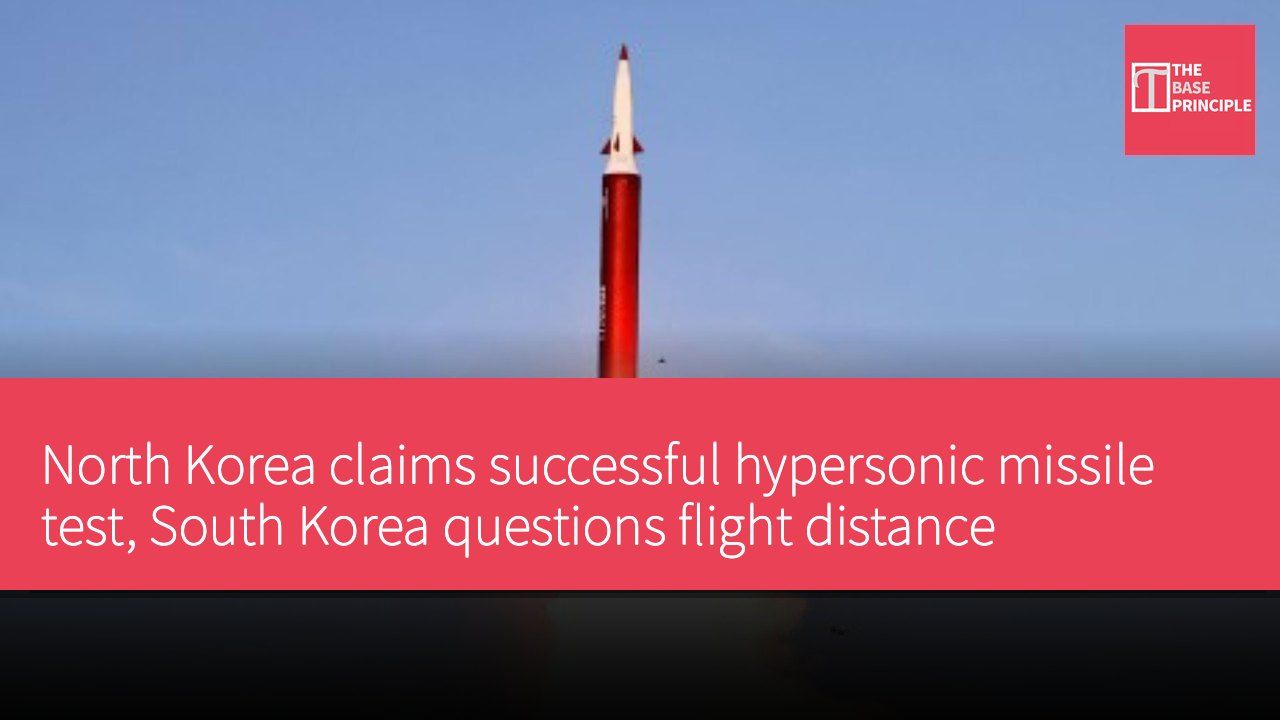
- North Korea announces successful hypersonic missile test, demonstrating nuclear deterrent reliability.
- Kim Jong Un emphasizes development of strategic attack weapons is vital to national security.
- South Korea questions North Korean missile's flight distance and tracking capability.
- This test may indicate North Korea is expanding its strategic missile capabilities.
North Korea announced on Sunday that it successfully tested a hypersonic missile under the guidance of leader Kim Jong Un, using the launch to demonstrate the reliability of its nuclear deterrent. According to state media Korean Central News Agency (KCNA), the missile was launched on Saturday from eastern North Korea, flying approximately 621 miles (1,000 kilometers) before striking a target on the country's east coast. KCNA described the weapon as an intermediate-range strategic missile, part of a hypersonic strategic weapons system. The test aimed to train missile units and assess the effectiveness and mobility of North Korea's deterrent forces.
Kim Jong Un emphasizes importance of weapons development
Kim Jong Un oversaw the launch and stated that North Korea should continue developing weapons capable of forcing adversaries to recognize the "reliability and lethality" of its strategic attack weapons. KCNA quoted Kim as viewing such efforts as a means of deterrence. He also reiterated that developing North Korea's nuclear war deterrent is vital to national security. The report noted that Pyongyang will make no change in maintaining its nuclear deterrence policy. This test is the latest in more than ten missile tests conducted by North Korea this year, at a time when tensions on the Korean Peninsula are rising due to a landmine explosion in the Demilitarized Zone last month that injured South Korean soldiers.
KCNA reported that Kim Yo Jong, Kim Jong Un's sister and a senior Workers' Party official, provided more details about the launch after disclosing the test on Saturday. Kim Yo Jong claimed that South Korea and Japan failed to correctly track the weapon. She said the missile flew along a unique "wave-like trajectory pattern," exposing weaknesses in their tracking capabilities. South Korea rejected this assessment, with the Ministry of National Defense stating that its military monitored during launch preparations and tracked the missile's flight after launch. South Korea also said the missile's flight capabilities fall within the detectable and interceptable range of South Korean and U.S. missile defense systems.
The South Korean military earlier assessed that the weapon flew more than 435 miles (700 kilometers), heading toward the country's eastern waters.
South Korea questions missile capabilities
KCNA released unusually detailed test information, including precise impact coordinates. Hong Min, a senior researcher at the Korea Institute for National Unification, said the disclosure appears aimed at supporting Pyongyang's claim that the missile flew approximately 621 miles. Hong said the missile appears to be a conical hypersonic system first tested by North Korea in 2022. This latest launch may indicate Pyongyang is shifting from development work to operational deployment of the weapon. As a result, this test provides further evidence that North Korea is expanding its strategic missile capabilities while refining designs to complicate regional missile defense systems.
The launch comes after a heated dispute between North and South Korea over a landmine explosion in the Demilitarized Zone. Kim Yo Jong issued a statement on Friday rejecting Seoul's demand for an apology. She called South Korea's accusations "groundless" and said North Korea did not intentionally place landmines targeting South Korean troops. This missile test adds another layer to the dispute as Pyongyang continues to advance its weapons program. North Korea's latest launch also reinforces Kim Jong Un's message that the country intends to maintain its nuclear deterrent as a core part of its national security strategy.
Impact of North Korea's weapons tests on regional security
North Korea's hypersonic missile test not only demonstrates its technological progress but also reflects the country's hardline stance in the face of external pressure. Kim Jong Un's remarks show that North Korea views nuclear deterrence as a core strategy for maintaining national security, which could further escalate tensions on the Korean Peninsula. South Korea's questioning of the missile's flight distance demonstrates mutual monitoring and distrust of military capabilities between the two sides, further complicating the regional security situation. As North Korea continues to advance its weapons program, neighboring countries will have to reassess their defense strategies.