
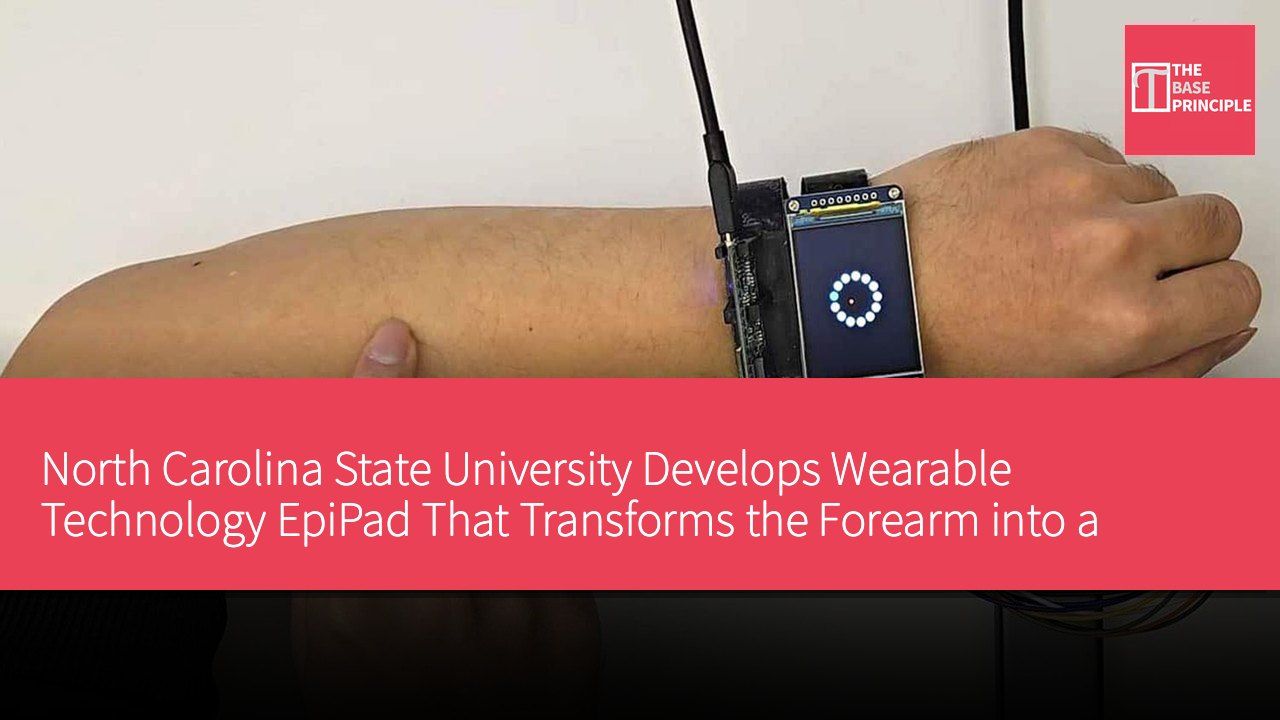
- EpiPad transforms the forearm into a touchpad without needing to touch the smartwatch screen.
- The sensor array measures approximately 5 mm x 4 mm and can detect subtle changes.
- EpiPad outperforms traditional methods in gesture recognition and force detection accuracy.
- This technology can be used for screenless wearable devices, expanding its application potential.
Researchers at North Carolina State University have developed a wearable technology that transforms the forearm into a touchpad, allowing smartwatch users to scroll, zoom, and click without touching the device's small screen. This system, named EpiPad, utilizes compact millimeter-wave (mmWave) radar sensors to track finger movements and measure the pressure applied to the skin by the user. This enables multi-finger gestures and pressure-sensitive controls, similar to a laptop's touchpad. The researchers state that this method can provide a larger input area for smartwatches without increasing the screen size and can also be used to control screenless wearable devices, such as smart glasses.
Technical Features of EpiPad
The sensor array of EpiPad measures approximately 5 mm x 4 mm and is installed on the wristband, capable of detecting subtle changes in the skin when fingers press against the forearm. Unlike traditional touchscreens, EpiPad does not require users to touch the display. Its radar system detects movements and pressure through changes in reflected signals. The researchers developed a signal processing method based on millimeter-wave phase dynamics to estimate the applied force. A lightweight machine learning model then helps identify gestures and interpret user input. Users must first complete a short calibration procedure to adapt the system to their individual movements.
According to the research paper, this process takes 3 minutes and 54 seconds.
Evaluation Results of EpiPad
The current prototype resembles a wristband with exposed circuit boards. However, the researchers indicate that its components could eventually be integrated into traditional smartwatch designs. The research team evaluated EpiPad with 20 participants, achieving a gesture recognition accuracy of 92.8% and a force detection accuracy of 90.2%. For users not included in the training data, the range accuracy was 10.2 mm. In a separate real-time evaluation, participants performed smartwatch input tasks using three methods: traditional touchscreen, tilt-based cursor, and EpiPad.
The researchers reported that EpiPad outperformed the other two methods in terms of error rate and efficiency. The results indicate that using the forearm as an input surface can make controlling small wearable devices easier.
Future Application Potential
However, these findings are based on a proof-of-concept prototype and a relatively small user study, rather than a commercial product. The researchers estimate that the cost of functional components, including the radar sensor array, may be less than US$10 (approximately HK$78). This figure is an estimate from the research team and not the price of a finished product. The technology could ultimately extend beyond smartwatches. The researchers suggest that screenless wearable devices, such as smart glasses, could utilize the skin as an interaction surface, allowing users to issue commands without relying on a display or physical buttons. The details of this research are published in the paper "EpiPad: Realizing Multi-Finger and Pressure-Sensitive Skin Interfaces for Smartwatches" in the Proceedings of the ACM on Interactive, Mobile, Wearable and Ubiquitous Technologies, and will be presented at the UbiComp/ISWC conference in Shanghai in 2026.
It will be showcased at the UbiComp/ISWC conference in Shanghai in 2026.
Item Specifications Sensor Array Size 5 mm x 4 mm Gesture Recognition Accuracy 92.8% Force Detection Accuracy 90.2%
Impact of EpiPad on Wearable Technology
The development of EpiPad marks a significant advancement in wearable technology, providing users with greater operational flexibility by transforming the forearm into a touchpad. This technology not only enhances the user experience of smartwatches but could also extend to screenless wearable devices, changing the way people interact with technology. As accuracy and efficiency improve, the application range of EpiPad is likely to expand, fostering innovation and development in wearable technology.