
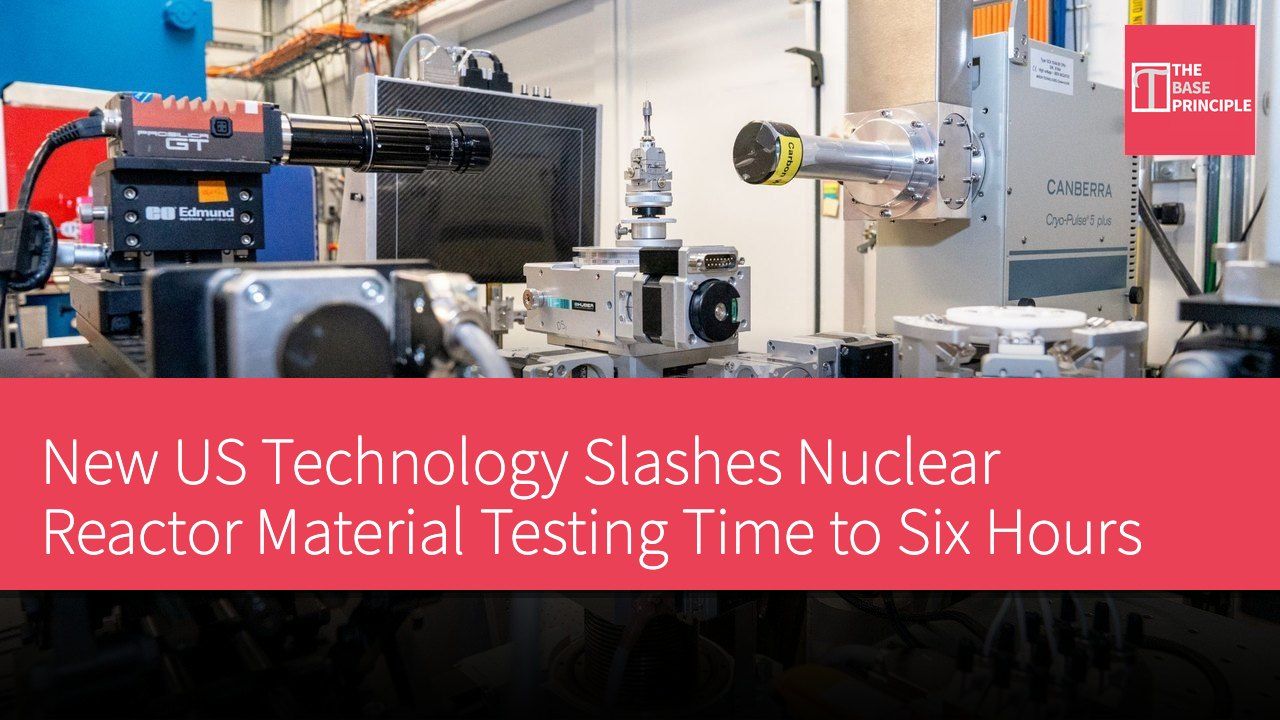
- New technology reduces nuclear reactor material testing time to about six hours.
- The new system can simultaneously observe physical shape, elemental composition, and atomic arrangement.
- Four imaging modes can record different physical characteristics simultaneously.
- Researchers plan to reduce scanning time to under 30 minutes.
With the launch of an integrated X-ray testing station, the time needed to evaluate materials for next-generation nuclear reactors has been reduced to about six hours, down from several days. The system and its performance data have been detailed in the Journal of Synchrotron Radiation. Engineers deployed this setup at the X-ray Powder Diffraction beamline of Brookhaven National Laboratory's National Synchrotron Light Source II. The device consolidates four distinct computed tomography modes into a single testing phase. As a result, researchers can simultaneously observe an object's physical shape, elemental composition, and atomic arrangement without cutting or damaging the target material.
Nuclear components must remain intact for decades under demanding operating pressures. High radiation fields, mechanical stress, high temperatures, and chemical corrosion gradually degrade fuel elements and containment vessels. Understanding these microscopic structural changes is essential for engineers before certifying new reactor designs.
Testing Capabilities of the New Technology
Computed tomography can construct three-dimensional views of internal structural patterns without physical cutting. Historically, obtaining a complete analytical image required operators to transfer samples to several different instruments for individual tests. This logistical friction extended experiments to several days and made it difficult to examine exactly the same region under different testing conditions. The new station solves this problem by focusing high-energy or "hard" X-rays into a narrow beam just 15 microns wide, equivalent to a quarter of the thickness of a human hair. Hard X-rays have the ability to penetrate dense, heavy materials, including structural reactor steels and radioactive actinide fuels like uranium.
The narrow beam provides the spatial resolution needed to measure highly ordered and irregular regions within a single sample.
During the testing cycle, the instrument's four imaging modes can simultaneously record different physical characteristics. X-ray absorption tomography records density variations within the sample, revealing the formation of internal voids, cracks, and gaps. Meanwhile, X-ray fluorescence tomography tracks elemental signatures and maps the location of specific chemical elements within the sample volume. X-ray diffraction tomography targets ordered crystalline regions, measuring the geometric patterns formed by the internal atomic lattice. Pair distribution function tomography analyzes disordered, amorphous regions, providing a detailed description of the atomic-level structure lacking a regular crystalline pattern.
Simerjeet Gill, Deputy Director of Nuclear Science and Technology at Brookhaven and co-author of the new paper, said, "By conducting these four techniques simultaneously, we can accurately determine where these chemical changes are occurring and link them to changes in material strength and brittleness. This structure-composition-property relationship is what we aim to understand when studying nuclear materials."
Future Directions
To validate the station's capabilities, researchers created an evaluation sample combining metal wires and powders of different diameters and chemical compositions. The trial demonstrated that the station could simultaneously record atomic positions, elemental distribution, and physical boundaries within six hours. Development work is currently underway to equip the station with updated detectors, aiming to reduce the overall scanning time to under 30 minutes. In addition to reactor materials, scientists are utilizing the system to study porous filtration media for environmental water treatment and assess changes within batteries during charging cycles.
Efficiency Improvement and Application Prospects of Nuclear Material Testing
With the advancement of nuclear reactor material testing technology, the testing time has been significantly reduced to six hours, which is crucial for the safety and efficiency of the nuclear energy industry. The versatility of the new system enables researchers to obtain multiple types of data simultaneously, which not only improves the accuracy of testing but also reduces the sample processing time required. As the technology continues to develop, it is expected that the scanning time will be further reduced to 30 minutes, which will provide more possibilities for the rapid evaluation of nuclear materials and environmental research, thereby further promoting the development of nuclear energy and related technologies.