
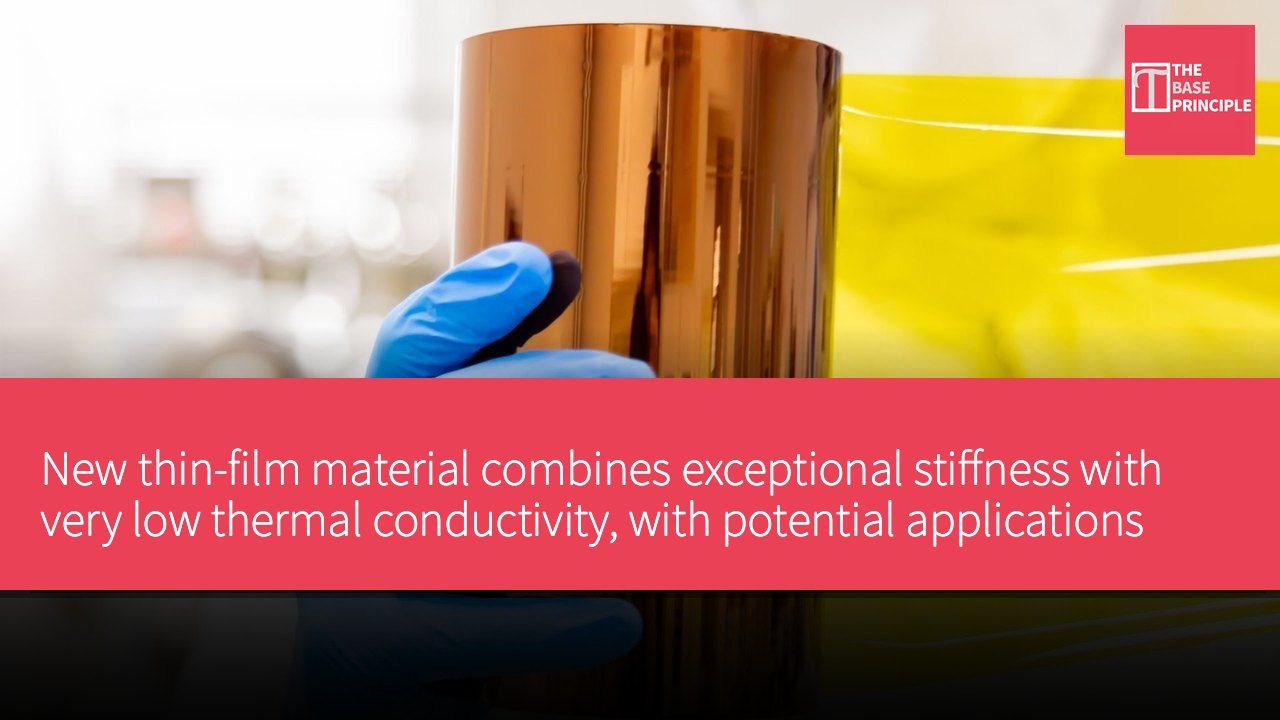
- A new thin-film material combines extremely high stiffness with very low thermal conductivity, resolving the contradiction that rigid materials tend to conduct heat well.
- The research team used two-dimensional hybrid organic-inorganic perovskites to successfully design the new thin-film material.
- The material provides five times better insulation than soft silicone, with broad application prospects.
- The manufacturing process is easily scalable and can be printed over large areas or applied as an industrial coating.
A newly designed non-porous thin-film material combines exceptionally high stiffness with extremely low thermal conductivity, resolving the long-standing contradiction that rigid materials typically conduct heat well. The film was designed by researchers at North Carolina State University and has a thermal conductivity of approximately 0.04 W m⁻¹ K⁻¹ at room temperature, making it five times better at insulating than standard silicone while being up to 10,000 times stiffer. Dali Sun, a professor of physics at North Carolina State University, said: "A rigid material serving as an excellent thermal insulator would have significant potential in a wide range of applications, from cookware to electronics to space travel."
He added: "But this is quite a challenge, because generally speaking rigid materials conduct heat well, while non-rigid materials are good thermal insulators. We have created a very rigid and extremely effective thermal insulating material, surpassing anything that exists in nature."
Breaking Conventional Material Properties
Materials science has long linked structural strength with thermal conductivity: rigid materials transfer heat quickly, while flexible materials trap it. Metal cookware heats up rapidly, while soft rubber prevents burns. Now, this new result breaks that paradigm, delivering a thin-film material that combines powerful structural rigidity with unmatched thermal insulation. This new non-porous material is engineered at the molecular level to remain rock-hard while blocking heat transfer with five times the efficiency of soft silicone.
To achieve this, the research team employed two-dimensional hybrid organic-inorganic perovskites, stacking organic and inorganic layers into a precise crystalline arrangement. By replacing standard carbon chains with custom phenyl rings, the material was made to trap thermal vibrations without sacrificing its structural backbone. Tests on the newly created azobenzene ethylammonium lead iodide thin film showed a thermal conductivity of approximately 0.04 W m⁻¹ K⁻¹ at room temperature. For reference, this rigid material insulates five times better than soft silicone, which has a thermal conductivity of 0.2 W m⁻¹ K⁻¹.
Silicone sets the benchmark for thermal resistance in everyday items such as oven mitts, so achieving the same insulating capability in a rigid coating marks a significant advance.
Broad Application Potential
Jun Liu, an associate professor of mechanical and aerospace engineering at North Carolina State University, said: "If we want to compare this material to silicone, the material we made is 700 to 10,000 times stiffer than silicone, and also insulates five times better." The material's application prospects are wide-ranging and urgent. Modern microchips are throttled by overheating, spacecraft burn precious fuel carrying heavy ceramic heat shields, and next-generation electronics are constrained by their own thermal limits. This printable, scalable thin-film coating, approaching the theoretical limit of insulation, could transform all of that.
Better still, it is not confined to the laboratory. According to co-author Liu, the manufacturing process is easily scalable, capable of being printed over large areas as a thin film, or applied directly as a protective industrial coating.
Beyond the new material itself, another advantage is that it demonstrates how molecular engineering can customize layered materials to combine features that were previously impossible to mix, such as rock-solid strength and extreme thermal insulation.
Implications of the New Material for Electronics and Space Travel
The emergence of this new thin-film material marks a significant breakthrough in materials science. Traditionally, there has been a contradiction between rigidity and thermal conductivity, and this research has successfully combined the two, offering a solution to thermal management challenges in electronics. In addition, the material's scalability gives it potential for industrial applications, particularly in space travel, where it could reduce equipment weight and improve performance—factors that are crucial to the future of technology.