
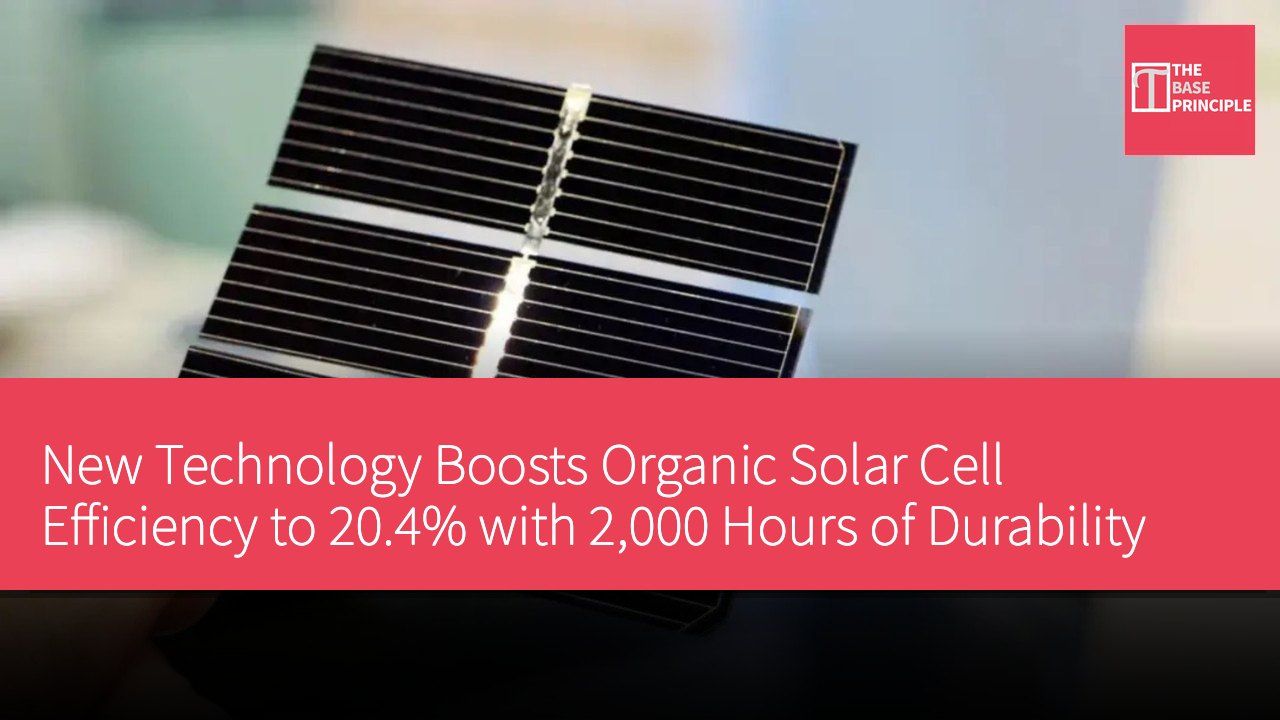
- The new technology achieves an efficiency of 20.4% for organic solar cells.
- The technology introduces an intermediate layer to enhance stability and durability.
- After 2,000 hours of operation, the cells retain over 85% of their output.
- This strategy provides a new pathway for the commercial future of organic photovoltaics.
A novel molecular locking strategy promises to overcome the challenges of efficiency, stability, and scalability in organic solar cells (OSCs). Organic solar cells offer a lightweight, flexible carbon-based alternative to silicon materials, with significant commercial application potential. However, the delicate layers of these cells often degrade rapidly under high temperatures and continuous sunlight. A research team from the Ningbo Institute of Materials Technology and Engineering (NIMTE) of the Chinese Academy of Sciences is working to address this stability issue by employing a molecular locking strategy to securely bind the delicate solar layers together.
Specifically, the strategy introduces a specialized intermediate layer that chemically anchors the solar materials to the electrodes. This structure forms strong molecular bonds, enhancing energy efficiency and long-term durability, making it suitable for large-scale panels.
New Technology Enhances Efficiency and Stability
According to the research paper, we achieved a small-area efficiency of 20.4% and an active area module efficiency of 18.8%. To understand this development, it is essential to grasp why flexible solar cells fail. Organic solar cells capture sunlight through ultra-thin self-assembled monolayers (SAMs) that are laid on transparent electrodes. The connection between the electrodes and the organic films is very tenuous. Under high temperatures and continuous light exposure, the chemical bonds can slip and separate, leading to layer detachment and ultimately causing cell failure. This presents a triple challenge for solar cell experts: finding the optimal balance between high efficiency, long-term stability, and commercial scalability.
So far, optimizing one metric often meant sacrificing others.
Durability Tests Show Outstanding Performance
To strengthen the problematic solar cell interface, the NIMTE research team inserted a thin layer of indium chloride as an intermediate layer, which undergoes localized reactions when heated. This process expels loose chloride ions, forming a dense network of bonds made of indium, oxygen, and phosphorus. This chemical network provides a strong anchoring effect, securely locking the solar molecules in place rather than allowing them to loosely adhere.
During durability testing, heating the materials triggers chemical reactions that remove loose chloride ions and form strong bonds between indium, oxygen, and phosphorus. This process establishes a durable protective network on the surface. The newly formed layer tightly secures the solar cell materials, significantly improving overall stability. The researchers noted in a press release, "The intermediate layer triggers ligand exchange, forming a robust, multi-coordinated indium-oxygen-phosphorus coordination network that densely and uniformly anchors the SAM." This strategy immediately improved performance across all key testing metrics.
Small laboratory-scale cells achieved an impressive energy conversion efficiency of 20.4%, while large modules with an area of 15.6 square centimeters set a record efficiency of 18.8%.
Interestingly, these devices demonstrated exceptional durability, retaining over 85% of their initial output after 2,000 hours of continuous exposure. Professor Liu Quan, the corresponding author of the study, stated, "We extended this technology to large modules with an aperture area of 15.6 cm², achieving a record of 18.8% active area PCE." This universal chemical locking strategy paves the way for the commercial future of organic photovoltaics. Overcoming the triple challenge of efficiency, stability, and scalability could bring flexible solar technology closer to mass production.
In the future, surfaces such as skyscraper windows, car roofs, and smart watch casings may quietly harness these tiny chemical locks for power generation. The research findings were published on October 21 in the journal Joule.
How New Technology Affects the Future of Organic Solar Cells
The development of organic solar cells faces a triple challenge of efficiency, stability, and scalability. The new technology, through a molecular locking strategy, successfully enhances the energy conversion efficiency and durability of the cells, providing an effective solution to these issues. As this technology matures, it is expected to enable large-scale production across various applications, thereby promoting the adoption and application of renewable energy, particularly in scenarios where flexibility and lightweight characteristics are advantageous, such as in buildings and vehicles.