
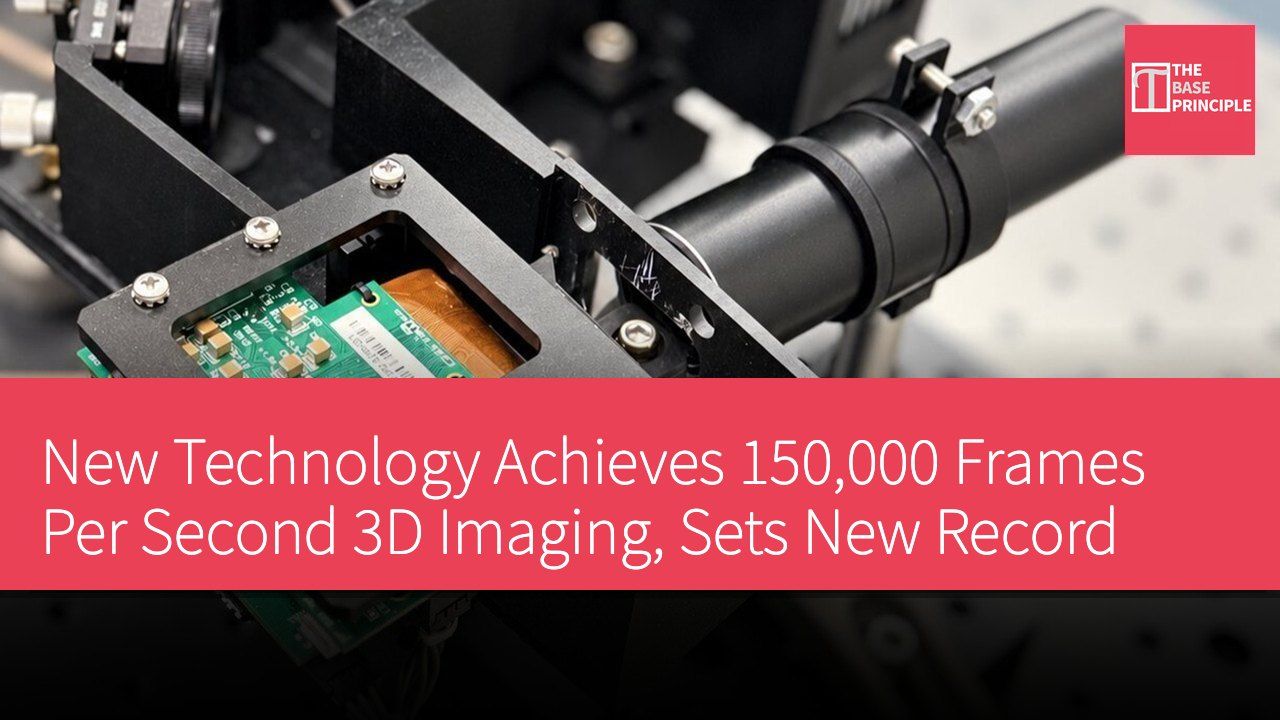
- The C-BLIP technology can capture 3D images at 150,000 frames per second, setting a new record.
- This technology can observe fast and non-repetitive phenomena, such as object collisions and vibrations.
- Researchers have enhanced the accessibility of the technology by combining affordable design with LED lighting.
- C-BLIP has potential applications in various fields, including mechanical engineering and additive manufacturing.
A new imaging technology can capture the three-dimensional shape of moving objects at speeds of up to 150,000 frames per second, fast enough to track projectiles striking turbine fan blades, falling maple seeds, or the vibrations of speakers. Researchers say this technology has set a new world record for 3D profiling measurement. The method, named C-BLIP, which stands for Color-Band-Limited Illumination Profilometry, was developed by a team led by Jinyang Liang at the National Institute of Scientific Research (INRS) in Quebec, and was announced on November 12.
Profilometry is used to measure the surface shape of objects, and C-BLIP applies it to events that occur too quickly and unpredictably.
Innovations in C-BLIP Technology
The challenge of rapid 3D imaging In many fast events, such as collisions, it is not possible to repeat them at will, so cameras must capture each event in a single shot. Most 3D profiling measurements involve projecting patterns of light onto an object and reconstructing its shape based on the deformation of the patterns. Researchers noted that this method is limited by two factors: the operating speed of the projector and camera, and the number of patterns required for each 3D frame. The INRS team added that existing ultra-fast 3D systems are often constrained by slow acquisition, computationally intensive image reconstruction, or the high costs of specialized equipment.
A cheaper and more portable approach To overcome these limitations, the team combined affordable optical design with safe LED lighting and lightweight reconstruction methods. Researchers stated that this combination makes ultra-fast 3D imaging more practical and accessible in a wider range of research environments, rather than being limited to specialized laboratories.
Potential Applications of the Technology
Results captured by C-BLIP In experiments, C-BLIP recorded the impact of projectiles with turbine fan blades, the aerodynamics of falling maple samaras, and the vibrations of speaker membranes. The team also detected ultrasonic vibrations on the surface of objects and extracted acoustic information, recovering a voice message. "What excites us the most is the ability to observe phenomena that were previously invisible," said Cheng Jiang, a postdoctoral researcher at INRS and the first author of the study.
Context for 150,000 This record claim specifically refers to 3D profiling measurements. In this field, earlier ultra-high-speed systems reported frame rates of about 100,000 frames per second, including the previous color-band-limited illumination system proposed by Liang and another group's deep learning method from 2025. Imaging methods for other applications, such as capturing light in flight, operate at billions or trillions of frames per second, but they measure surface shapes in different ways.
Potential applications Researchers believe the technology has broad applications in mechanical engineering, aerodynamics, microfluidics, high-speed material testing, and additive manufacturing. "With C-BLIP, we can continuously capture fast and non-repetitive 3D phenomena that were previously difficult to observe and quantify," said Liang, who holds the Canada Research Chair in Ultra-Fast Computational Imaging. The team is currently optimizing the system by adding GPU-accelerated processing, which could ultimately enable real-time visualization of these fast events.
Broad Application Prospects for C-BLIP Technology
The breakthrough advancements of C-BLIP technology lie not only in its high frame rate but also in its ability to capture fast and non-repetitive 3D phenomena, which was challenging to achieve with previous technologies. The affordable design of this technology allows it to be applied in various research environments, thereby expanding its range of use. With system optimization and the potential for real-time visualization, C-BLIP is expected to play a significant role in mechanical engineering, aerodynamics, and other fields, driving the development of related research.