
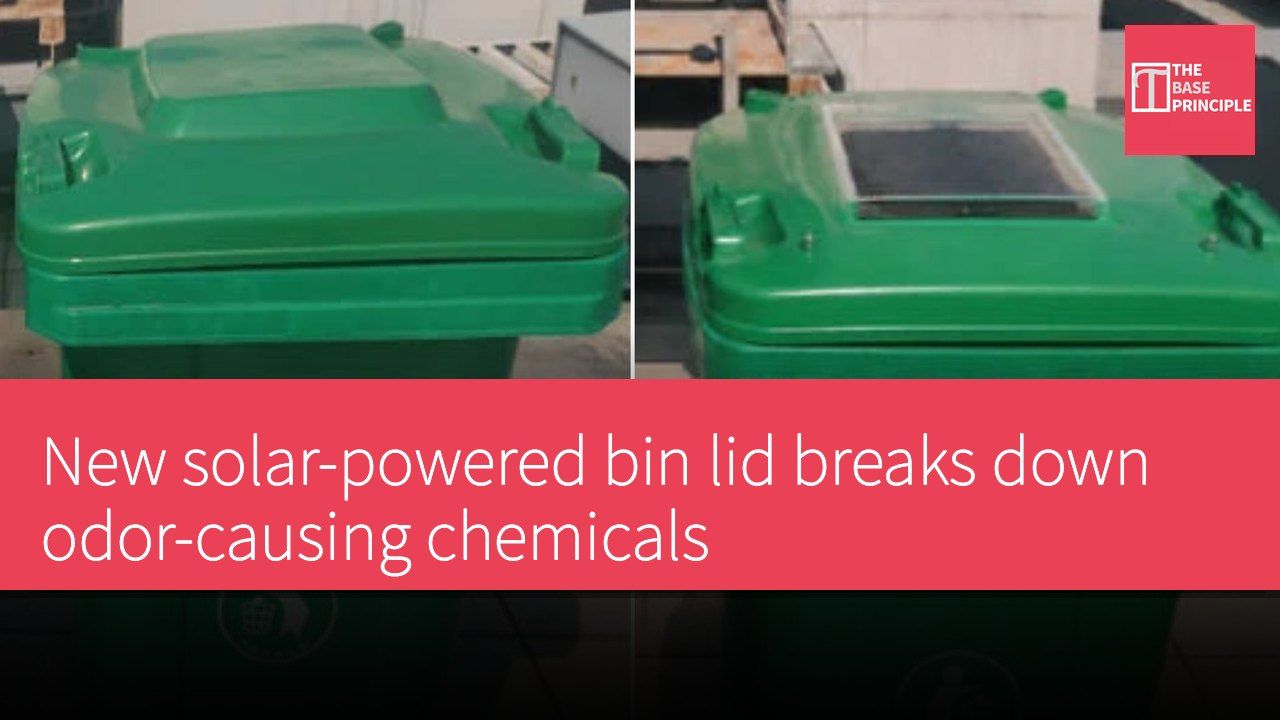
- New device uses solar energy to break down garbage odor chemicals.
- Acetic acid is the main odor component when food waste decomposes.
- Improved catalyst maintains performance in humid environments.
- Study shows sustainable waste management odor control method.
A solar-powered device designed to control garbage odors has shown promising results in tests with real food waste. Researchers developed a removable lid insert compatible with standard wheeled bins that uses sunlight to break down odor-causing chemicals. The device primarily targets acetic acid, a key component producing sharp odors during food waste decomposition. In outdoor tests, the system continuously broke down this compound under natural sunlight for more than 40 days. This approach may offer a practical solution for managing odors from bins placed outside homes, particularly in hot and humid environments where food rots quickly.
Food in household bins releases volatile organic compounds as it decomposes. Acetic acid, a vinegar-like compound, is one of the causes of the strong odor during garbage decomposition. Activated carbon filters can capture some of these compounds under bin lids, but their effectiveness can decline in hot and humid conditions. Researchers therefore considered using sunlight as an energy source for control. Their goal was to treat odor-causing chemicals inside the bin before they disperse into the surrounding air. The study's corresponding author, Jinlong Wang, said: "Our motivation is very practical.
"We want to solve the problem at the odor source — inside the bin — rather than letting it escape onto the street."
Catalyst selection and improvement
The team selected manganese dioxide (MnO2) as the catalyst base material. When activated by sunlight, the material can capture volatile organic acids and help break chemical bonds in acetic acid. Researchers then combined lithium in ionic form with manganese dioxide. This improvement gave the material a greater ability to break down acetic acid than untreated MnO2 and activated carbon in simulated sunlight experiments. The improved catalyst also maintained its performance in humid conditions, a crucial point because outdoor bins may be exposed to moisture while containing wet food waste.
The results show the material can operate under the environmental conditions expected during everyday garbage storage.
Experimental design and test results
In outdoor experiments, researchers built a transparent insert that allows gas to pass while directing sunlight onto the catalyst. A lens inside the removable module focuses incoming light onto the catalytic layer. The insert is designed to attach to standard wheeled bin lids, enabling researchers to test with actual food waste rather than relying solely on lab simulations. During testing, the catalyst continuously broke down acetic acid released as fruit, bread, and wine rotted. It remained effective under natural sunlight for more than 40 days, showing the material can sustain performance over extended periods.
Jinlong Wang added: "Traditional catalytic odor reduction relies on electric heating to activate the catalyst, whereas we use light."
Researchers say the result could ultimately support a more sustainable odor control method for waste management, achieved by using sunlight instead of electric heating. The study was published in the journal ACS Environmental Science & Technology.
Using solar energy to improve waste management efficiency
This research demonstrates the potential of using solar energy to address garbage odor problems, particularly in hot and humid environments. Traditional methods rely on electric heating to activate catalysts, which not only consumes energy but is also unsuitable for all environments. The new device's design effectively breaks down acetic acid, showing stable performance over long periods, which has practical significance for household and public waste management. As demand for sustainable development grows, this innovative technology could become a key solution for future waste disposal.