
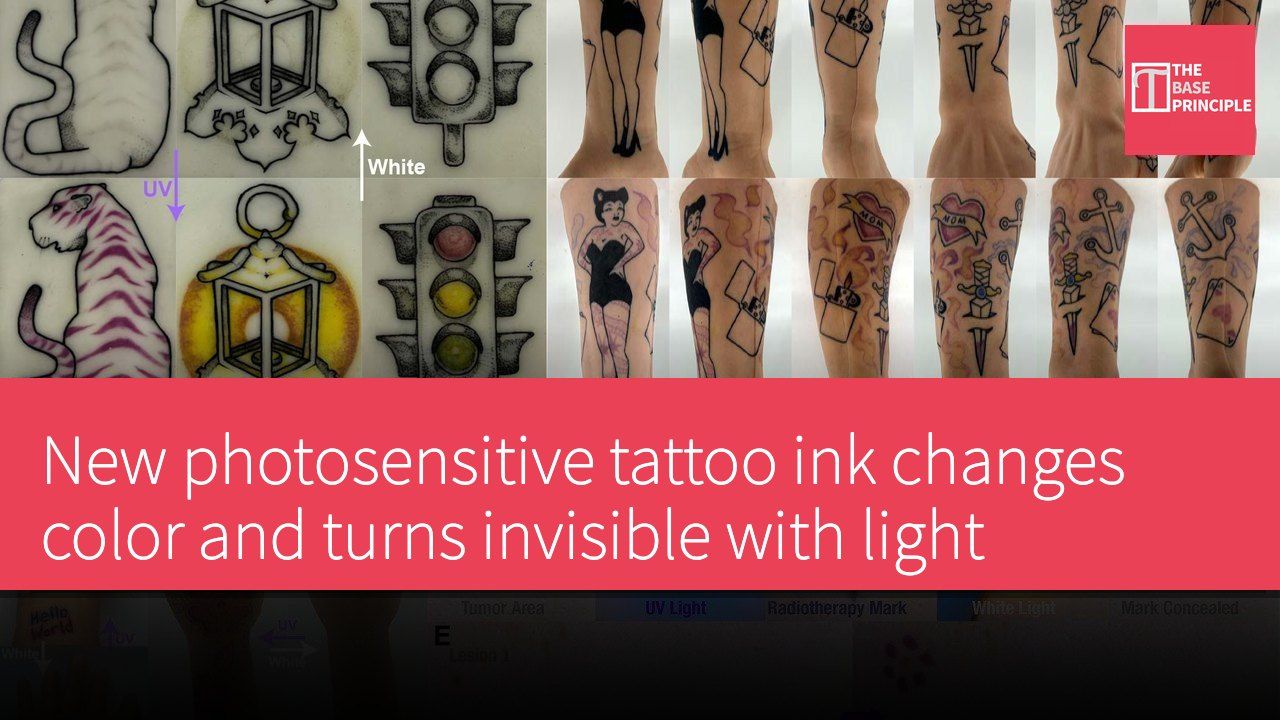
- PhotoTat lets tattoos change color or turn invisible with light, convenient for users in different settings.
- The technology can help conceal medical tattoos, reducing patients' psychological burden.
- Researchers have demonstrated multi-color designs but still need to overcome safety and durability issues.
- PhotoTat's production cost is higher than traditional tattoo pigments, but its future application potential is broad.
A new study shows that a research team at the University of Colorado Boulder has developed a photosensitive tattoo ink called PhotoTat, a technology that allows tattoos to disappear on demand or change color under different lighting conditions. PhotoTat enables users to hide tattoos before a job interview, then reveal them again for a night out, or even change colors for different occasions. The study's lead researcher, Carson Bruns, said: "PhotoTat is like a switch — when you use ultraviolet light, it activates, but when you go to grandma's house, you can turn it off again."
Properties of photosensitive tattoo ink
This technology has the potential to turn body art into a controllable form, while also providing a way to hide medical tattoos until a doctor needs to see them.
The key to PhotoTat lies in a class of chemicals called photochromic dyes, which change color when exposed to specific wavelengths of light. The researchers encapsulated three commercially available dyes inside tiny poly(methyl methacrylate) (PMMA) spheres, a transparent plastic also known as acrylic. Each capsule measures only a few hundred nanometers in diameter. Under normal visible light, these dyes are nearly colorless, but under ultraviolet (UV) light they reveal vivid colors. The team selected dyes that respond to 365-nanometer UV light, a wavelength emitted by LED lights.
Activating or deactivating these pigments takes about two to three seconds of bright light. UV cameras can reveal details invisible under normal light, illustrating how different wavelengths of light alter our visual perception.
The three dyes produce blue, magenta, and yellow. By mixing them in different ratios, researchers can create 16 distinguishable colors and at least 300 distinct shades. They used stencils, patterned UV light, and a laser projector to demonstrate multi-color designs on silicone and pig skin. White light can switch the dyes back to a colorless state, while selected wavelengths can deactivate individual colors. Unlike traditional tattoos, where visible designs typically persist until the pigment is removed or altered, PhotoTat allows users to toggle between color and near-invisibility.
These colors fade gradually over several hours, though bright visible light can erase them more quickly.
"You can turn off the tattoo whenever you don't want to see it, and it disappears from view," Bruns said. "If you never want to see it again, you just don't activate it anymore." The technology has already moved beyond lab models — Bruns has tattooed a fish-scale design on his own leg with PhotoTat. In this self-test, the three color channels remained responsive to light and rewritable between 1.4 and 2.2 years after tattooing. The researchers report that Bruns' tattoo showed no noticeable fading or known side effects over more than two years.
However, a single individual's experience cannot prove these inks are safe for the broader population.
Potential applications and challenges
PhotoTat's potential applications extend beyond those who want to hide tattoos for job interviews or show different designs on different days. It could also help patients who need permanent skin markers to guide radiation therapy. During radiotherapy, small tattoos help clinicians repeatedly align radiation beams with the correct treatment area. These markers can remain after treatment, becoming unwanted reminders of a traumatic experience. Bruns added: "These markers aren't aesthetic, and they become permanent reminders of trauma. With PhotoTat, we can turn an involuntary medical tattoo into something only the doctor can see when you walk into the clinic, and then it's invisible the rest of the time."
The researchers also demonstrated a similar approach for marking biopsy sites, where the markers become visible when activated. Such applications could make skin markers easy to conceal while retaining their utility when needed. Related research also highlights the potential for tattoo technology to serve purposes beyond decoration. However, PhotoTat still faces several hurdles before everyday use. The ink's visibility decreases as skin pigmentation increases, though it remains detectable even in the darkest skin-tone models tested. Sunlight can also activate the dyes, so sunscreen or other UV protection may be needed outdoors.
Research on skin's response to ultraviolet radiation underscores the importance of managing sun exposure. The blue dye degrades with repeated activation and deactivation, eventually leaving a permanent purple color instead of switching between color and colorless states. The researchers have not yet developed a true cyan, and white does not function as a switchable color, limiting the range of possible designs. Safety testing is another major hurdle. The formulations still need to be tested for toxicity, purity, and sterility; PMMA's history of biomedical use does not prove the complete ink is safe. Human evidence is limited to Bruns' self-test, while full multi-color patterns have been demonstrated on silicone and pig skin.
Future outlook for commercialization
Bruns hopes to commercialize PhotoTat, but improving the blue dye's durability and completing safety testing remain priorities.
These specialty dyes and the encapsulation process make the ink more expensive to produce than traditional tattoo pigments. Other light-responsive materials that hide and reveal color suggest controlling visibility may have applications beyond body art. For now, PhotoTat offers a glimpse of a future where tattoos might one day be changed simply by changing the light source. The study was published in the journal Matter & Light.
Item Specification Technology name PhotoTat Dye type Photochromic dyes Light source wavelength 365-nanometer UV light
Application potential and challenges of photosensitive tattoo technology
The development of PhotoTat technology brings revolutionary changes to tattoo art, particularly in controllability and privacy. Users can hide or display tattoos as needed, which is especially important for individuals facing social situations or medical needs. However, the technology still needs to overcome challenges such as safety and durability, particularly its performance across different skin tones and environments. Additionally, higher production costs may limit its adoption. With further research and development, PhotoTat has the potential to change the concept and use of tattoos in the future.