
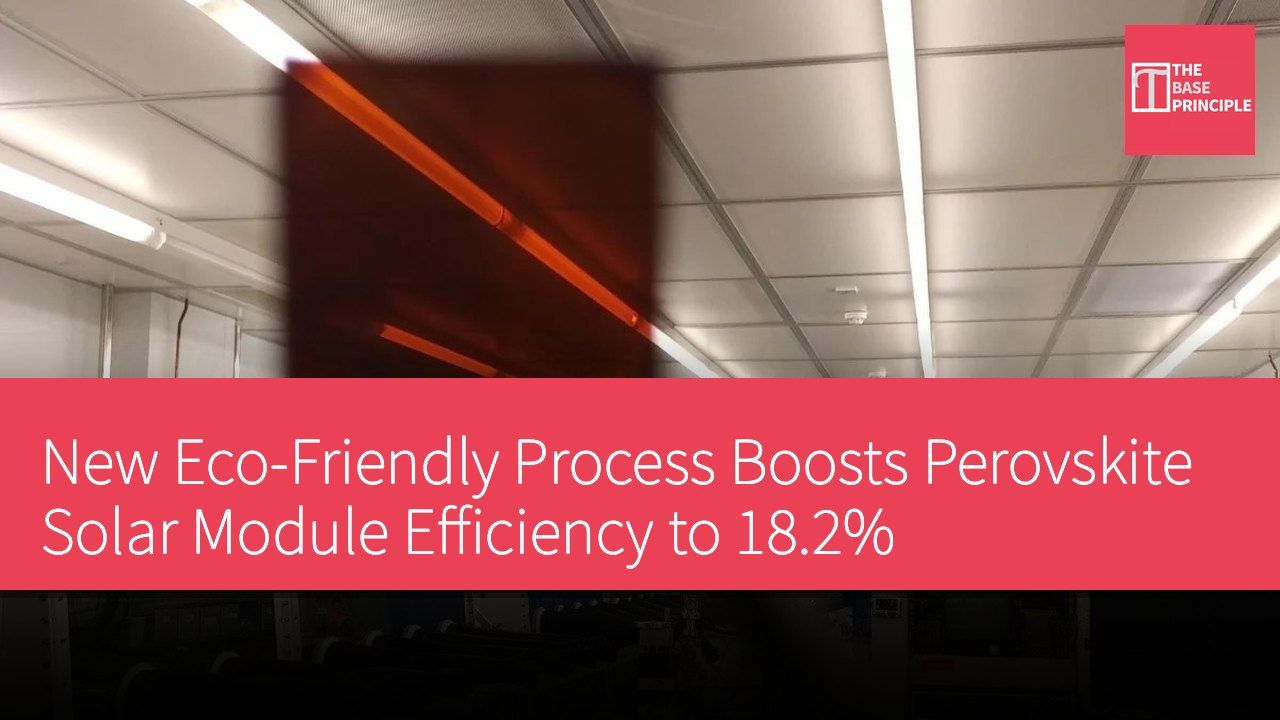
- Surrey University proposed an eco-friendly method for producing perovskite solar cells.
- The new method uses low-toxicity solvents, reducing the use of harmful chemicals.
- Flexible solar cells achieve over 18.2% power conversion efficiency.
- The technology can be integrated into existing production lines, supporting large-scale deployment.
A novel, eco-friendly, low-toxicity method could assist in the industrial-scale production of flexible perovskite solar cells using roll-to-roll printing technology. This safe approach was proposed by Surrey University to produce high-performance perovskite solar modules. The method employs a low-toxicity, bio-derived solvent formulation that operates at room temperature and reduces the use of harmful industrial chemicals. This process utilizes continuous printing technology similar to newspaper printing, potentially making large-scale production both eco-friendly and cost-effective. Professor Ravi Silva, an outstanding professor at Surrey University, director of the Advanced Technology Institute (ATI), and head of the Nanoelectronics Centre, stated: "The potential impact of our innovative technology goes beyond just replacing harmful solvents."
A process based on easy-to-use, non-toxic solvents and simpler coating steps reduces the need for solvent handling, waste disposal, and related safety infrastructure.
New Method Reduces Harmful Chemicals
Lightweight, flexible perovskite solar cells have long been considered a potential replacement for silicon panels. However, harmful production processes have hindered their commercial potential. Typically, manufacturing printable perovskite inks requires a large amount of toxic solvents, including dimethylformamide and acetonitrile. These chemicals pose safety risks to factory workers and create significant environmental burdens. Surprisingly, a single gigawatt-scale production line can consume over 90,000 liters of toxic solvents. Now, this chemical barrier is gradually being dismantled. Researchers have discarded harmful traditional chemicals and developed a "significantly reduced toxicity" (SRT) ink system based on bio-derived components.
The team combined ethanol and 2-methyltetrahydrofuran to create a fast-drying formulation, which is an eco-friendly solvent derived from agricultural and forestry waste. This bio-derived mixture eliminates the need for anti-solvent treatment steps, saving energy and protecting raw materials during the manufacturing process.
High Performance and Environmental Friendliness
Green production does not mean sacrificing performance. The team used a bar coating method compatible with roll-to-roll technology to print solar mini-modules with an active area of 11.5 square centimeters. These flexible panels, coated at room temperature and dried using rapid gas jet flow, achieved over 18.2% power conversion efficiency while maintaining stability under continuous illumination. These mini-modules feature an inverted structure, with the bar-coated self-assembled monolayer serving as the hole transport layer, reducing the need for additional intermediate layers. According to the research, the team utilized a laser-based P1 to P4 scribing process to connect individual solar cell units for easier patterning of industrial modules.
Future Industrial Integration Potential
The scientific paper further indicates that the development tested eco-friendly solvents using gas-jet bar coating methods, while ensuring compatibility with standard slot-die coating machines used in factories. Therefore, this process could be integrated into Qualcomm's manufacturing lines in the future, ensuring that eco-friendly manufacturing technologies are ready for large-scale industrial deployment.
Silva added, "We hope to help promote clean energy globally, and if we can support large-scale decarbonization in the same process, it would be a double victory for society." Integrating green chemistry into high-speed printing technology makes large-scale production of flexible solar cells a reality. Flexible perovskite solar cells may soon power portable consumer electronics, building-integrated windows, and ultra-light solar arrays. The research findings have been published in the journal Nano Energy.
Impact of Eco-Friendly Technology on the Solar Industry
This new eco-friendly process not only enhances the efficiency of perovskite solar cells but also significantly reduces the use of harmful chemicals during production, which is crucial for environmental protection. As sustainability becomes a global focus, the promotion of this technology will help drive the application of clean energy and facilitate the transformation of related industries. If successfully integrated into existing production lines, it will enable the large-scale deployment of eco-friendly technologies at an industrial scale, further advancing the development of renewable energy.