
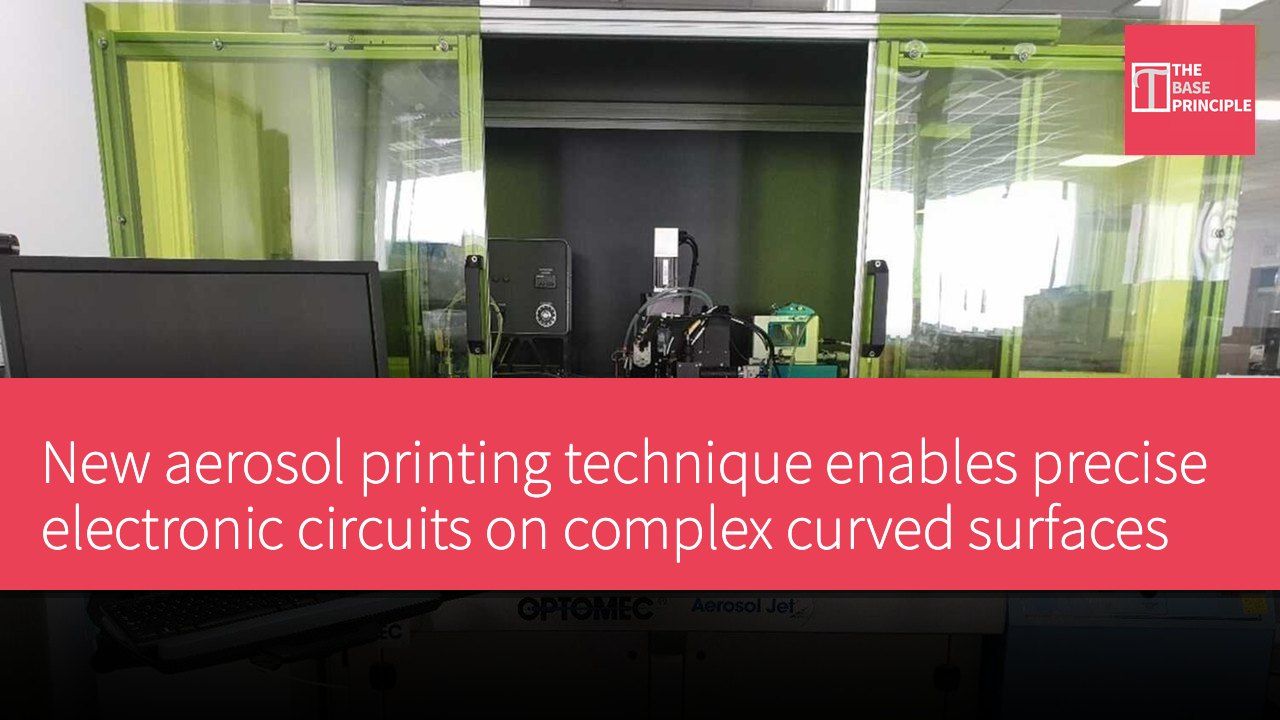
- A new printing technique can deposit electronic circuits directly onto curved surfaces, creating possibilities for new applications.
- The research team combines robotics and real-time monitoring to improve printing precision.
- New ink materials are being developed to withstand extreme environments, enhancing the durability of electronic products.
- Contour Circuits has received funding to advance the technology and explore multi-material printing.
A new printing technique could allow electronic circuits to be deposited directly onto curved and three-dimensional surfaces, opening the door to sensors and other electronic devices that cannot be made with conventional flat manufacturing. The research is led by Ethan Secor, an associate professor of mechanical engineering at Iowa State University, and his startup Contour Circuits. The team is developing an aerosol-based printing method that deposits electronic materials onto complex geometries with high precision. Unlike conventional inkjet printers, aerosol printing converts liquid ink into a fine mist that is carried by a gas stream through a nozzle, allowing the system to print features as small as 10 to 100 micrometers.
Combining robotics to improve precision
Researchers are now combining the printing process with robotics, software, and real-time monitoring to control how circuits are deposited on curved surfaces.
One of the team's systems mounts the aerosol printer on a movable robotic arm, an arrangement that allows the nozzle to travel across uneven surfaces but also introduces new challenges in positioning and motion planning. The goal is to make the process precise enough to produce reliable electronic circuits on complex three-dimensional shapes. "The work that's exciting me right now is conformable printing," Secor said. "That's going to be a major effort for us in the next two to three years. We are going to focus on developing applications for this technology." Potential applications span energy, medical, manufacturing, aerospace, communications, and security.
New ink materials for extreme environments
Improving the durability of printed electronics is equally critical and depends on whether the devices continue to function after fabrication. Secor is studying new ink materials designed to withstand extreme conditions, including the wide temperature swings encountered in space. The work is supported by a recent grant from the National Science Foundation. The team is paying particular attention to failures that happen at the junctions where silicon-based semiconductors connect to larger electronic circuits. "Electronic systems capable of operating in extreme environments have high relevance for energy, infrastructure, aerospace, and space applications," the researchers wrote in the project abstract.
NASA is also supporting the commercialization effort.
Exploring multi-material printing
Contour Circuits, founded by Secor and former graduate student Jeremy Rurup, has received a US$150,000 (about HK$1,170,000) Small Business Technology Transfer contract to advance the technology. The company carries out its work at Iowa State University's Roy J. Carver Co-Laboratory. The team is also exploring ways to print multiple materials in the same deposition pass. Secor likens the concept to moving from black-and-white to grayscale printing, where the composition of the printed material can vary across the surface, giving engineers finer control over the electrical and physical properties of printed components.
Secor's interest in printed electronics began during his graduate studies at Northwestern University, where he initially focused on graphene inks. As his research deepened, his scope expanded to flexible electronics, liquid-metal electronics, micro-supercapacitors, and lithium-ion batteries. He eventually began building and modifying printing hardware rather than relying solely on commercially available systems. "I learned how to build printers, and that opened up a lot of research directions for me," Secor said. "Now we build and customize our own hardware. So while other research groups are working with a black box, we can open it up, understand how it works, and improve it."
Implications for electronics applications
The development of this new aerosol printing technique is set to revolutionize how electronic products are manufactured. By enabling precise printing of electronic circuits on complex curved surfaces, it will allow the creation of more flexible and adaptable electronic devices, particularly in critical fields such as medical and aerospace. The research team's focus on improving durability and resilience in extreme environments points to far-reaching consideration of future applications. As the technology matures, this printing approach could become standard for a new generation of electronic products, driving innovation and development across the industry.