
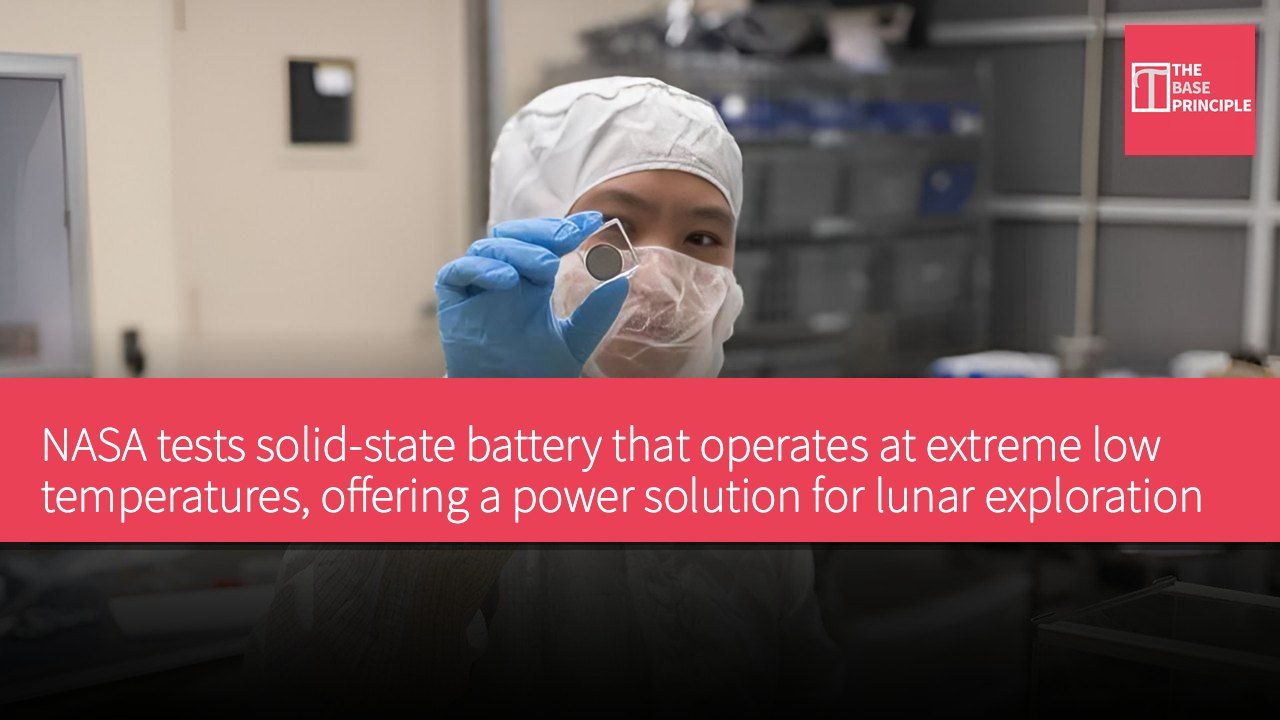
- NASA tested a solid-state battery that operates at extreme low temperatures, offering a power solution for lunar exploration.
- The SPEARS project aims to develop batteries that can survive the Moon's extreme temperatures.
- Solid-state batteries reduce the need for heavy thermal management equipment, improving the feasibility of lunar exploration.
- Potential applications for the technology include aircraft, drones and portable electronic devices.
The National Aeronautics and Space Administration (NASA) has tested a solid-state battery that can operate normally at temperatures as low as -274 degrees Fahrenheit (about -170 degrees Celsius) without damage, an important step toward developing power systems for future lunar south pole exploration missions. The prototype battery can also operate at temperatures as low as -112 degrees Fahrenheit (about -80 degrees Celsius), though with reduced performance. NASA said the batteries performed well in recent thermal vacuum tests at temperatures ranging from -76 degrees Fahrenheit (about -60 degrees Celsius) to 176 degrees Fahrenheit (about 80 degrees Celsius).
The significance of the SPEARS project
The results come from NASA's Solid-State Batteries for Extreme Environmental Adaptability and Resilience (SPEARS) project, which aims to develop batteries that can survive the Moon's extreme temperature swings without continuous heating. The technology could eventually power lunar rovers, scientific instruments and astronaut emergency equipment under NASA's Artemis program. However, the batteries remain small laboratory prototypes and have not yet been tested in space.
Temperatures near the lunar south pole can drop to -328 degrees Fahrenheit (about -200 degrees Celsius), posing a major challenge for conventional lithium-ion batteries that rely on liquid electrolytes to transport charged particles between electrodes. In extreme cold, these liquids may freeze, while excessive heat can affect battery performance. Exposure to the vacuum of space also causes problems for conventional liquid-based systems. NASA's SPEARS batteries instead use solid ceramic or polymer-based electrolytes designed to increase resistance to extreme temperatures while reducing the fire hazards associated with flammable liquid electrolytes.
Researchers at NASA's Langley Research Center in Virginia conducted thermal vacuum tests to examine how the prototype batteries performed under conditions relevant to lunar operations.
Yi Lin, lead for SPEARS testing and research at NASA's Langley Research Center, said: "We have demonstrated for the first time that these batteries can operate normally at low temperatures of -80 degrees Celsius." The tests also showed that the batteries can withstand temperature ranges from 212 degrees Fahrenheit (about 100 degrees Celsius) to -274 degrees Fahrenheit without damage. However, at the lowest test temperatures, the batteries cannot generate power and must be heated to operating temperature before use.
Potential applications of solid-state batteries
This ability to survive extremely low temperatures without continuous heating could reduce the need for heavy thermal management equipment on lunar spacecraft and rovers. Small heaters could bring the batteries to operating temperature when power is needed, without keeping them warm throughout the lunar night. NASA researchers are also exploring different electrode materials to tune battery energy capacity, power output and durability for specific applications. The SPEARS project launched in 2026 with funding from NASA's Research and Technology Mission Directorate.
NASA's Glenn Research Center in Ohio leads the project, while Langley researchers carry out materials development and testing. Ames Research Center in California is developing test boards and electronics to help prepare the technology for future spaceflight tests. The agency believes potential applications for the technology extend beyond lunar exploration to aircraft, drones, vehicles and portable electronic devices. However, these batteries still require further development and testing before they are ready for operational use.
Impact of solid-state battery technology on lunar exploration
NASA's solid-state battery technology is significant for lunar exploration, especially for its ability to operate in extreme environments. Conventional lithium-ion batteries have limited performance at low temperatures, while solid-state battery designs can overcome these challenges and reduce reliance on heavy thermal management systems, thereby improving the efficiency of exploration missions. This technology applies not only to the Moon but may also expand to other fields such as aviation and portable devices, demonstrating its broad application potential.