
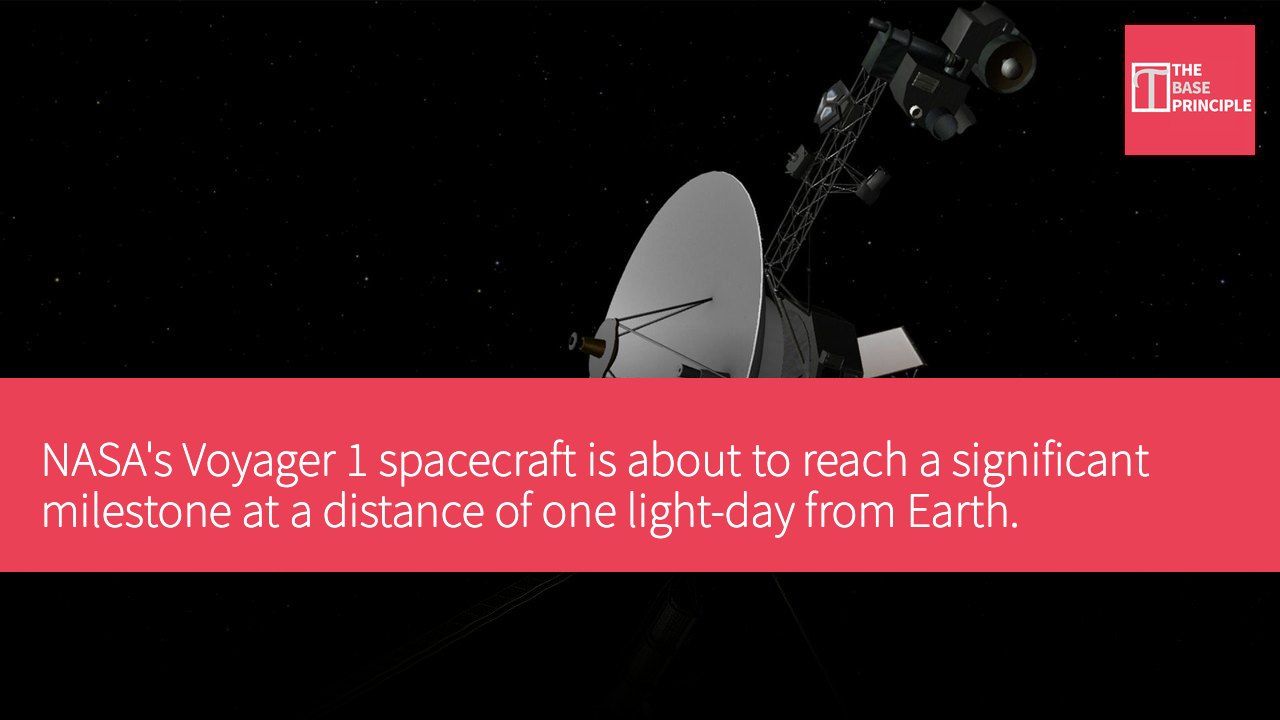
- The Voyager 1 spacecraft, launched in 1977, is preparing to reach a region one light-day away from Earth.
- The spacecraft discovered rings and new moons around Jupiter and captured several important images.
- Voyager 1 crossed the heliopause in 2012, studying the interstellar medium and capturing the "Pale Blue Dot" image.
- The spacecraft currently has only four scientific instruments remaining and has begun shutting down some systems to extend its operational life.
Since its launch in 1977, NASA's Voyager 1 spacecraft is preparing to enter the region one light-day away from Earth. The spacecraft's original mission was to study Saturn and Jupiter, planned to last thirty months. In August 2012, it crossed the edge of our solar system, the heliopause, and is now the farthest human-made object. While en route to Jupiter on March 5, 1979, Voyager 1 discovered the planet's rings and two previously unseen moons: Metis and Thebe.
Significant Discoveries by the Spacecraft
It also captured images of Jupiter's cloud layers and its four major moons: Callisto, Ganymede, Europa, and Io. The closest approach to Saturn occurred on November 12, 1980, when five new moons and a previously unobserved new ring, known as the G ring, were discovered, containing many small moons that help maintain the ring's orbit.
In nearly 50 years of space exploration, researchers studied Titan's atmosphere, finding that its primary component is nitrogen (about 90%), along with some hydrocarbons and methane, which may indicate that this moon could help initiate prebiotic chemistry. On January 1, 1990, the Voyager Interstellar Mission began, allowing the spacecraft to further traverse our solar system. On February 26, 1998, Voyager 1 surpassed Pioneer 10, becoming the farthest human-made object in space.
Current Operational Status
On August 25, 2012, Voyager 1 crossed the heliopause to study the interstellar medium and captured the famous "Pale Blue Dot" image from a distance of 40 AU from Earth. Despite being operational for fifty years, NASA is still able to receive signals from the spacecraft; however, due to insufficient remaining power, NASA has begun shutting down some instruments. Recently, one more instrument was turned off to ensure that data can continue to be transmitted back to Earth.
Currently, Voyager 1 has only four scientific instruments remaining: a magnetometer, plasma wave instrument, cosmic ray telescope, and low-energy charged particle instrument. The spacecraft is powered by three radioisotope thermoelectric generators (RTGs), which generate electricity using the heat from the decay of plutonium-238. The spacecraft also contains a 30-centimeter diameter gold-plated copper record, known as the "Golden Record." This record includes 115 images of life on Earth, 90 minutes of music, greetings in 55 languages, and sounds from Earth, as well as messages from former United Nations Secretary-General Kurt Waldheim and former U.S. President Jimmy Carter.
Carter).
Voyager 1 is currently nearly one light-day away from Earth, meaning that any radio waves or light traveling between the spacecraft and Earth takes 24 hours to reach each other. This journey of Voyager 1 is remarkable and provides researchers with valuable information about the outer solar system.
The Significance of Voyager 1's Space Exploration
The mission of Voyager 1 is not only to explore the inner solar system but also to significantly contribute to human understanding of interstellar space. Its discoveries, such as Jupiter's rings and new moons, demonstrate the diversity of planetary systems and provide crucial data for future space exploration. As the spacecraft moves farther from Earth, the increasing signal delay serves as a reminder of the challenges and hardships of space exploration. Despite the gradual shutdown of instruments, this mission remains a milestone in humanity's quest to explore the universe, symbolizing our pursuit of the unknown.