
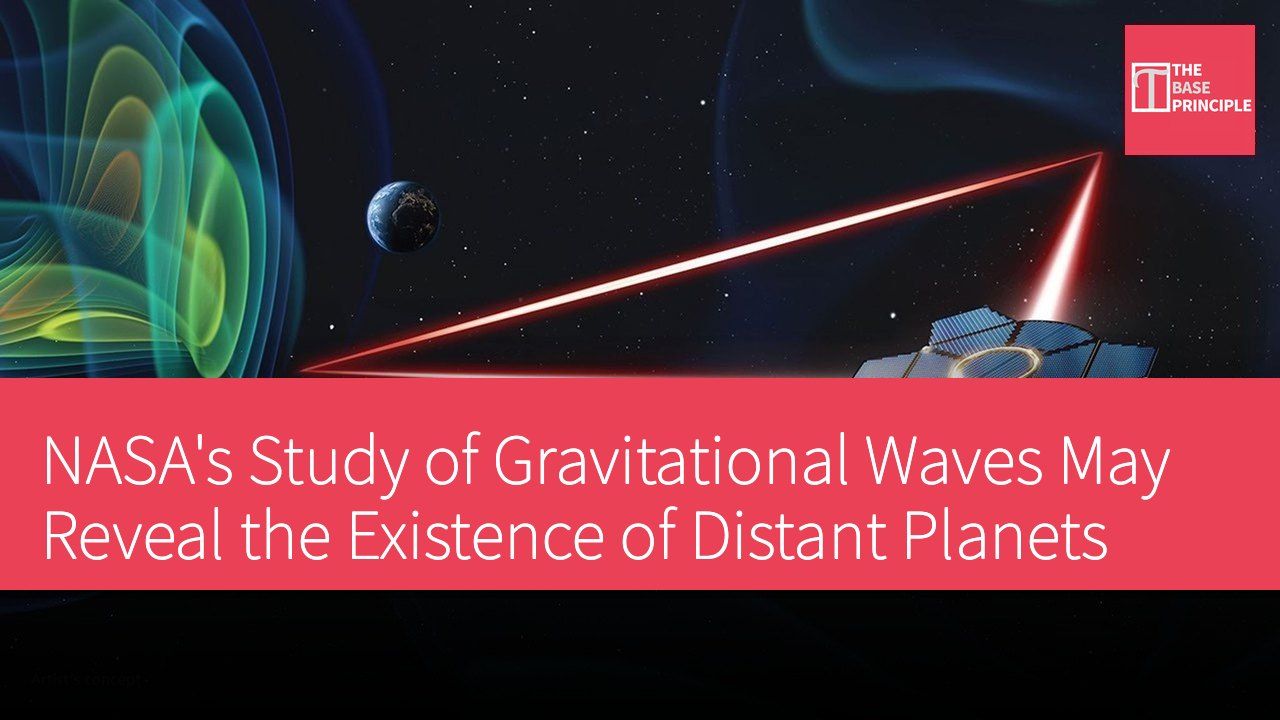
- NASA's research shows that LISA can reveal new populations of exoplanets in the Milky Way.
- The existence of binary white dwarf systems affects gravitational wave signals, indicating the presence of planets.
- LISA is set to launch in the mid-2030s, with three spacecraft flying in a triangular formation.
- The James Webb Space Telescope can detect infrared light from planets in binary white dwarf systems.
A planet orbiting a pair of dead stars may leave a fingerprint in the ripples of spacetime, NASA astrophysicists say, with future space observatories capable of reading these signals. Two studies indicate that the Laser Interferometer Space Antenna (LISA) will be able to reveal new populations of exoplanets in the Milky Way. The first study, led by postdoctoral researcher Casey McGrath from the University of Maryland, Baltimore County, and NASA's Goddard Space Flight Center, explored detection methods and the optimal ranges for planet mass and orbital period.
The second study was co-authored by McGrath and others, demonstrating how the James Webb Space Telescope can confirm the existence of such planets.
LISA's Detection Capabilities
According to expectations, LISA will primarily probe binary white dwarfs, which are pairs of Earth-sized stellar remnants orbiting closely together. Individually, such binary systems emit gravitational waves at nearly constant frequencies. The presence of planets alters this situation. Their gravity causes the binary system to wobble, adding a Doppler modulation to the signal, said Scott Noble, a theoretical astrophysicist at Goddard and co-author. In LISA's data, this modulation will appear as a sideband signal, a weaker signal below the main frequency. McGrath likened it to a radio, where the carrier waveform generates adjacent frequencies to carry sound or music.
Here, the sideband signal conveys the message of a planet's presence.
Why choose binary white dwarfs? Astronomers estimate that the Milky Way contains about 10 million binary white dwarfs with periods of less than one hour, which is precisely the range where LISA can operate effectively. They expect to resolve about 10,000 binary white dwarfs, as well as around 100 mixed combinations containing neutron stars or black holes. While planets have been discovered around a few single white dwarfs, none have been found in binary systems, so any detection by LISA would represent a new type of exoplanet. According to NASA, LISA will be able to detect planets with masses comparable to Jupiter, at distances of up to several thousand light-years.
The Supporting Role of the Webb Telescope
Mary Anne Limbach, an assistant research scientist at the University of Michigan and co-author, stated that some of LISA's detection results will need to be verified to rule out false positives. The team proposed using Webb's infrared sensitivity. Planets in binary white dwarf systems emit more infrared light than solitary stars, and Webb can detect this excess infrared light at distances of at least 500 light-years. In a test case at this distance, Webb could detect a planet with a mass about five times that of Jupiter, while ideally, LISA could detect planets with masses less than that of Jupiter.
LISA's Launch Plans
Regarding the observatory, LISA is led by the European Space Agency (ESA) and is scheduled to launch in the mid-2030s, with NASA as a partner. NASA will provide telescopes, lasers, charge management devices, data analysis, and engineering and scientific support. The observatory will consist of three spacecraft flying in a triangular formation, with each side measuring 1.6 million miles. The telescopes on each spacecraft will emit infrared lasers to their neighboring spacecraft to measure distance changes smaller than the width of a helium atom. Gravitational waves are a consequence of general relativity predicted by Einstein in 1916 and were first detected by ground-based observatories in 2015.
The idea of searching for planets in this way dates back to Japanese astronomer Naoki Seto, who proposed the concept in 2008. These research findings have been published in the Astrophysical Journal.
The Importance of LISA for Exoplanet Exploration
The launch of LISA will provide astronomers with a new tool for exploration, particularly for detecting planets in binary white dwarf systems. As the gravitational wave signals from these systems will change due to the presence of planets, this will enable scientists to identify new exoplanets, further expanding our understanding of the universe. Additionally, the infrared sensitivity of the James Webb Space Telescope will assist in confirming the existence of these planets, and such collaboration will enhance the accuracy and efficiency of planet exploration.