
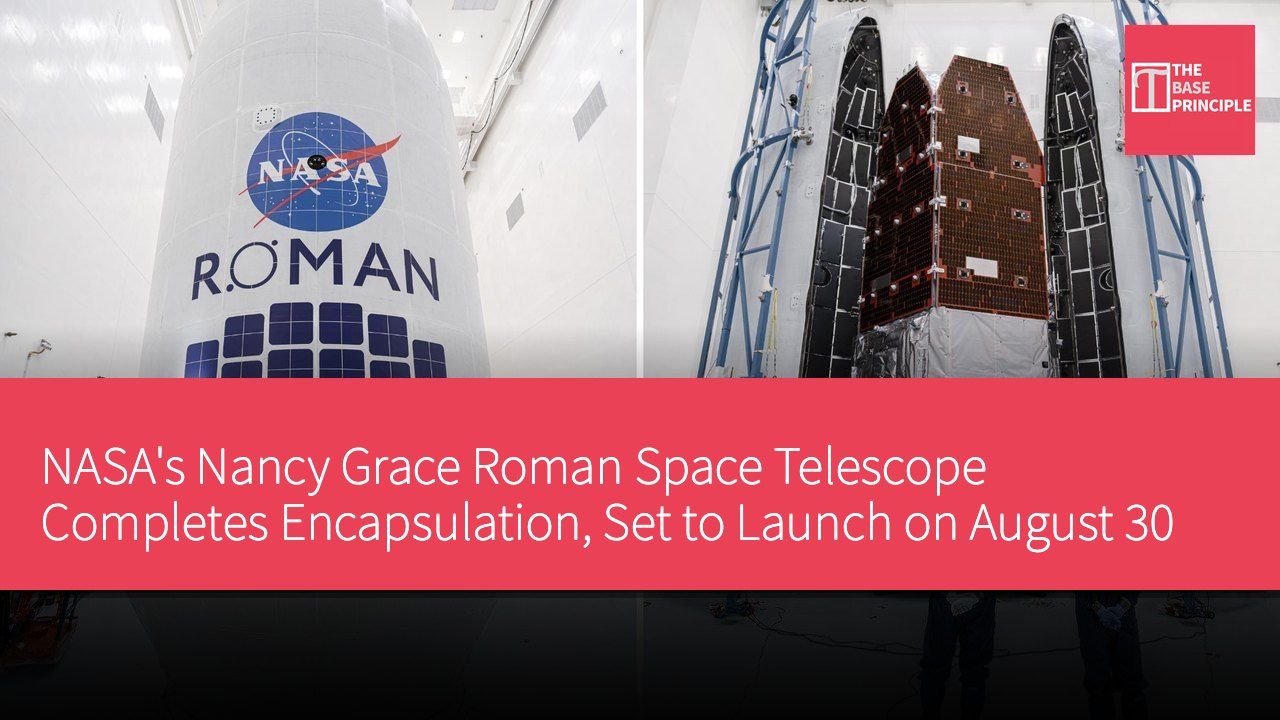
- NASA's Nancy Grace Roman Space Telescope has completed its encapsulation process.
- The fairing provides protection against intense sound waves and heat during launch.
- The Roman Telescope will travel to the Sun-Earth Lagrange L2 point for observations.
- The telescope will study dark matter and dark energy, unraveling mysteries of cosmic evolution.
The Nancy Grace Roman Space Telescope, operated by NASA, has completed its encapsulation process, being fitted inside the rocket's fairing, marking one of the final stages before launch. On August 21, the Kennedy Space Center team secured this observatory within the protective fairing of a SpaceX Falcon Heavy rocket. This step was completed ahead of the scheduled launch time of 7:26 am EDT on August 30 at the earliest. The work took place at the Payload Hazardous Servicing Facility in Florida.
NASA and SpaceX still need to move the encapsulated telescope to the hangar at Launch Complex 39A, where it will be mated to the Falcon Heavy rocket, and then roll the fully assembled rocket out to the launch pad for final preparations.
The Protective Role of the Fairing
The fairing, standing at 43 feet tall, provides critical protection for the Roman Telescope during the harshest phase of the launch. As the Falcon Heavy rocket traverses Earth's atmosphere, the telescope will be subjected to intense sound waves, aerodynamic pressures, and significant heat. The fairing is designed to shield against these factors. Along with specialized ground support equipment, the fairing also helps maintain the telescope in a controlled environment as the team moves it between facilities. Once the rocket reaches a sufficient altitude where the surrounding atmosphere no longer poses a threat, this protection is no longer necessary.
Minutes after liftoff, the two halves of the fairing will separate and fall away, allowing the Roman to continue its journey to its final deep-space destination. SpaceX plans to recover the fairing components after they return to Earth.
The Scientific Goals of the Roman Telescope
The Roman Telescope will travel to the Sun-Earth Lagrange L2 point, located approximately 1 million miles from Earth. At this location, the combined gravitational forces of the Sun and Earth help the spacecraft maintain a relatively stable position. This stability makes L2 the preferred location for powerful observatories that require continuous, uninterrupted observation of the universe. Once the Roman Telescope begins its scientific operations, researchers expect it to discover thousands of exoplanets, which are worlds orbiting stars outside our solar system. Studying such a large population of planets will help astronomers understand how common different types of planetary systems are in the universe, and may also reveal which distant worlds are similar to the planets near Earth.
The Roman Telescope will also focus on two major unsolved mysteries of modern cosmology: dark matter and dark energy. Dark matter cannot be directly observed, but its gravitational effects seem to shape galaxies and other large-scale cosmic structures. Dark energy is the term scientists use to describe a force driving the accelerated expansion of the universe. By surveying vast regions of the sky and tracking the distribution of matter and galaxies in the universe, Roman hopes to provide new clues about these phenomena. Its observations may ultimately help scientists understand how the universe evolved into its current form and explain why, over billions of years of cosmic evolution, the rate of expansion has not slowed down but has instead accelerated.
The Impact of the Roman Telescope on Cosmology
The launch of the Nancy Grace Roman Space Telescope marks a significant milestone in astronomical research. Its design not only enables the detection of thousands of exoplanets but also allows for in-depth studies of dark matter and dark energy. These studies will help scientists understand the structure of the universe and its evolutionary processes, and may reveal the reasons behind the accelerated expansion of the universe. As the telescope launches, the astronomical community anticipates the significant discoveries it will bring, which will open a new chapter in our understanding of the universe.