
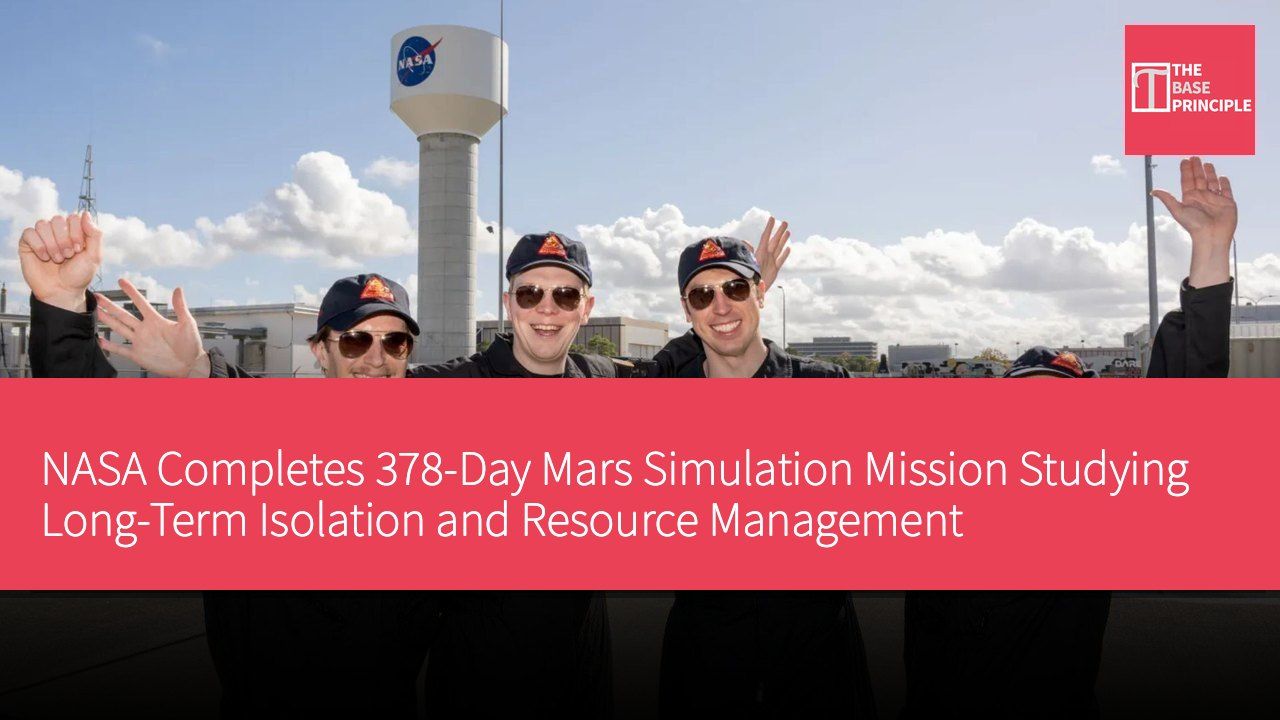
- Four volunteers completed a 378-day Mars simulation mission, exploring the effects of long-term isolation.
- Participants relied on delayed email communication, unable to connect with family and friends in real-time.
- The team conducted simulated Mars walks and plant cultivation, tracking the usage of everyday items.
- Findings will provide important references for future lunar and Mars exploration.
Four research volunteers completed a 378-day Mars simulation mission at NASA's Johnson Space Center in Houston, Texas, on October 31, 2026. The members emerged from the 1,700-square-foot (approximately 158 square meters) 3D-printed habitat known as Mars Dune Alpha, marking the end of the second mission of NASA's CHAPEA (Crew Health and Performance Exploration Analog) program. This experiment investigated the conditions of long-term isolation, limited resources, and communication delays.
The four participants entered the habitat on October 19, 2025, relying on delayed email communication instead of real-time conversations with family and friends. The team included Commander Ross Elder, Medical Officer Ellen Ellis, Flight Engineer James Spicer, and Science Officer Matthew Montgomery. They lived for 378 days under simulated planetary exploration conditions, without windows and unable to communicate with family and friends in real-time.
Challenges of the Mars Simulation Mission
During the technical research and Mars exploration activities, the team conducted simulated Mars walks, operated robotic systems, maintained habitat equipment, exercised, grew plants, and participated in medical research. They remotely operated drones and rovers to survey the simulated Martian landscape and collected geological samples. The group also tracked the usage of everyday items, including dish soap and respirator filters, to understand how inventory management affects long-duration missions. Elder, as an experimental test pilot in the U.S. Air Force, applied his flying experience to lead the team. He noted the similarities between simulated Mars walks and robotic operations, emphasizing the importance of rest, fitness, and nutrition.
Ellis, as an officer in the U.S. Space Force, assisted in organizing the collection of biological samples for medical research. She described the team's practical problem-solving methods as "tactical creativity" and emphasized the necessity of coordinating ground support.
Spicer utilized his background in satellite communications and spacecraft development to help maintain the habitat. The team monitored the usage of food, water, cleaning supplies, and air filters. He reflected that the relationships formed during the mission made the experience "not a labor, but a joy." Montgomery, as the science officer, contributed his expertise in hardware engineering, robotics, and indoor agriculture. He supported the habitat's 3D printing capabilities, helped identify rock samples, and conducted a seed germination experiment comparing a control group with simulated Martian soil.
He also focused on team safety and data quality, emphasizing that "the people who make exploration possible" are crucial in space exploration.
Insights for Future Exploration
The communication delay during the simulation could reach 22 minutes, with signals traveling between Earth and Mars. Future teams may need to make decisions and solve problems more independently as a result. Health monitoring and professional support are also vital, while regular exercise and nutrition routines helped participants manage their physical needs. Vanessa Wyche, director of the Johnson Space Center, stated, "Their work is significant not just for completing the mission," highlighting the value of this research for future exploration. NASA astronaut Jack Hathaway praised the team's "tremendous physiological and psychological resilience, teamwork, and human tenacity."
After leaving the habitat, participants began a two-week post-mission assessment and briefing period. Principal investigator Grace Douglas noted that researchers are examining the team's health and performance, as well as the challenges of communication and resource management. Project scientist Sara Whiting described this research as "a moment in time for this kind of data." CHAPEA Mission 2 follows the program's first Mars simulation mission, which concluded on July 6, 2024.
Findings will provide references for future lunar and Mars exploration, including ongoing human operations near the lunar south pole.
Impact of the Simulation Mission on Future Space Exploration
This Mars simulation mission provided crucial data to help the research team understand the effects of long-term isolation on humans, particularly under conditions of limited resources and communication delays. As plans for human exploration of Mars and other celestial bodies become clearer, these research findings will aid in the design and execution of future missions, especially regarding how to manage team health, resources, and communication. The success of this study not only showcases the resilience of the volunteers but also underscores the importance of teamwork in extreme environments, laying the groundwork for future space exploration.