
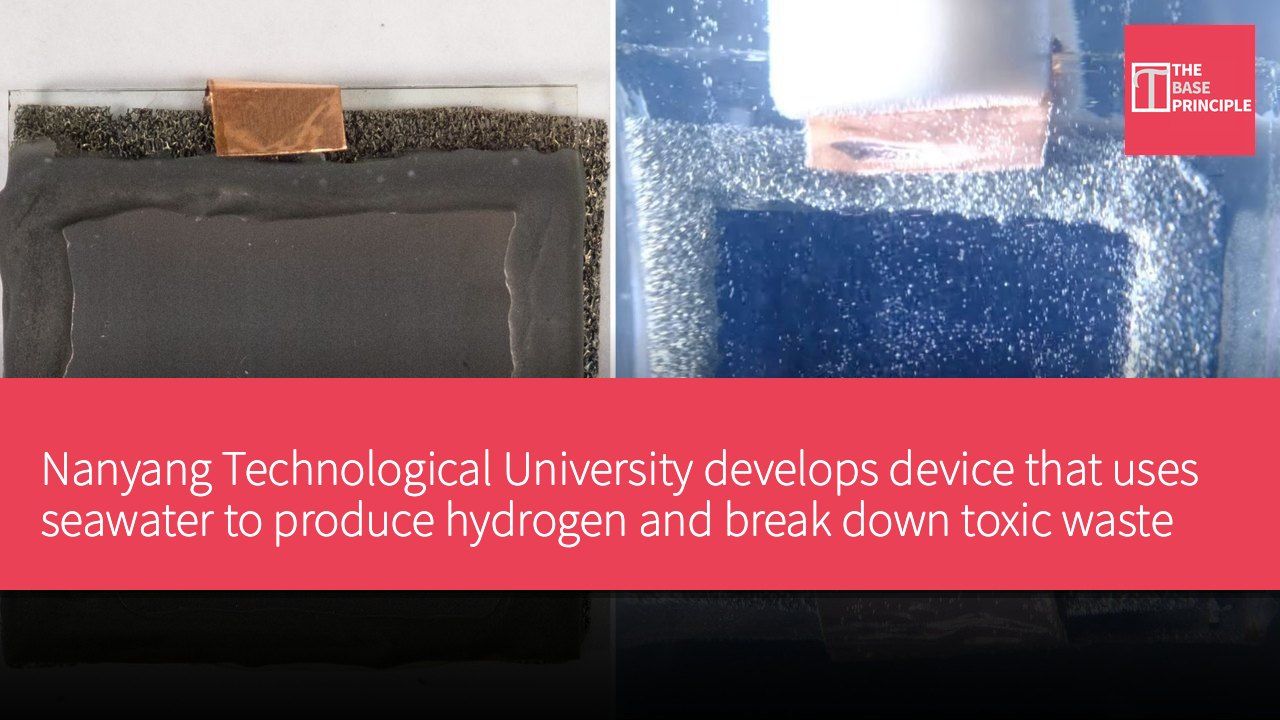
- The device developed by NTU can produce hydrogen from seawater and break down hydrazine.
- The system uses sunlight to drive chemical reactions, requiring no external power source.
- The device degrades hydrazine directly in water, reducing concentrations to safe levels.
- Research shows the system offers economic and environmental value for solar fuel technology.
Scientists at Nanyang Technological University in Singapore have developed a solar-powered device that generates hydrogen from seawater while simultaneously breaking down hydrazine, a highly toxic industrial pollutant. The researchers describe the system as a dual-purpose approach that combines clean fuel production with wastewater treatment. The device uses sunlight to generate the electricity needed to drive chemical reactions, taking inspiration from the way leaves capture sunlight, and requires no external power supply.
Hydrogen is typically produced through the electrolysis of water, a process in which electricity splits water molecules into hydrogen and oxygen. Electrons travel to the cathode, the negatively charged electrode, where they help form hydrogen. Using seawater can make the process more sustainable, as it eliminates the need for fresh water and additional treatment to remove salts. However, chloride ions present in seawater can interfere with electrolysis, and the process can also generate corrosive and toxic chlorine compounds that damage electrodes. The NTU team, led by Professor Liya Huang from the School of Materials Science and Engineering, addressed these challenges by changing the reaction at the anode.
How the device works
The catalyst at the anode is composed of iron, cobalt and chromium, and can break down hydrazine into hydrogen and nitrogen. Because this reaction requires less energy than producing oxygen in traditional water electrolysis, the system can generate hydrogen with lower energy demands. The anode also removes hydrazine from the water while producing additional hydrogen.
The researchers built the cathode using a lead halide-based perovskite, a semiconductor material capable of absorbing sunlight and converting it into electricity. A conductive epoxy containing silver and copper particles, along with titanium foil, was used to shield the cathode from degradation. Testing on simulated and real seawater showed that the device produces a stable current when illuminated. It achieved a photocurrent density of 25 mA cm⁻², a measure of the current generated per unit area of the illuminated electrode. The system operated continuously for more than 72 hours under illumination equivalent to sunny conditions on Earth's surface, producing hydrogen at a rate of 466 μmol cm⁻² h⁻¹, which the researchers said is comparable to other solar-powered systems.
A major step forward for environmental technology
The device also demonstrated its wastewater treatment capabilities. It degraded hydrazine directly in the water, without the need to first separate out the pollutant. Within 30 hours, the system reduced the hydrazine concentration from 0.5 M (approximately 1.6% by weight) to 0.5 ppb. This final concentration is more than 20 times lower than the 10 ppb limit permitted by the U.S. Environmental Protection Agency. "This dual-function device represents a major step forward in environmental technology. By efficiently harnessing solar energy to break down toxic industrial pollutants while harvesting clean fuel, we are tackling both the energy and pollution problems," Professor Huang said in a press release.
"The breakthrough here is not just the production of solar hydrogen, but the demonstration of a practical route toward multifunctional photoelectrochemical systems. Such dual-purpose approaches, where economic value and environmental impact must go hand in hand, will become increasingly important as we deploy solar fuel technologies in the future," added James Durant, professor of photochemistry and sustainable energy in the Department of Chemistry at the University of Oxford, who was not involved in the study.
The team is now developing catalysts that can address additional pollutants and convert waste into useful products, including fuels and industrial chemicals. The research was published in the journal Nature Communications.
The potential of multifunctional photoelectrochemical systems
The significance of this research lies in its innovative combination of hydrogen production with wastewater treatment, demonstrating the potential of sustainable technology. As global demand for clean energy increases, such dual-purpose systems can not only effectively address energy challenges but also tackle environmental pollution, aligning with current trends in sustainable development. In addition, the research team's ongoing development of catalysts will further broaden the scope of applications and could have a profound impact on future environmental technologies.