
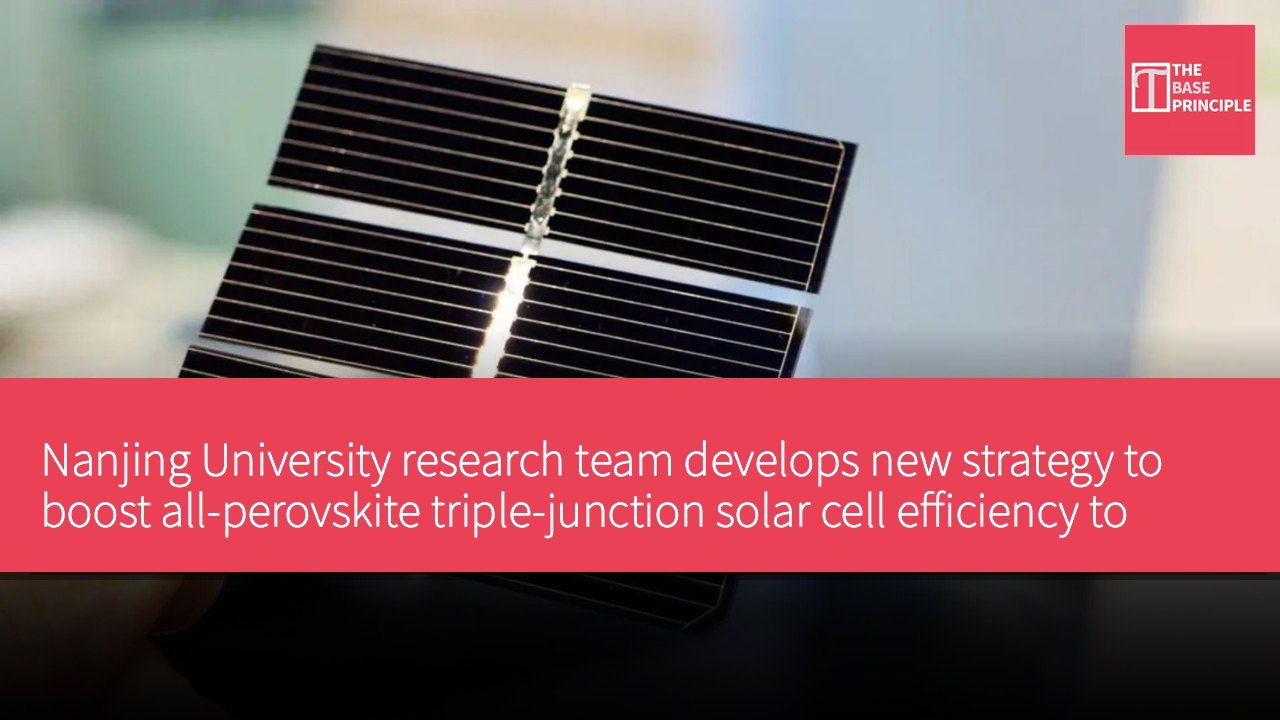
- A Nanjing University research team has developed a new strategy that raises the efficiency of all-perovskite triple-junction solar cells to 30.1%.
- The new strategy resolves performance-limiting issues in perovskite films and offers high stability.
- The monolithic triple-junction cell design targets different parts of the solar spectrum for optimal energy capture.
- The technology can be used in ultralight, flexible solar modules suitable for commercial and wearable applications.
Researchers from Nanjing University in China and collaborating institutions have developed a novel processing strategy to address the main efficiency issues in monolithic all-perovskite triple-junction solar cells. Specifically, the team devised a surface reconstruction and halide homogenization approach to tackle performance limitations in 2.0 eV ultrawide-bandgap (UWBG) perovskite films. This strategy enabled the development of perovskite triple-junction solar cells reaching an impressive power conversion efficiency of 30.1% (certified at 29.3%). According to the study, this integrated design offers high stability under continuous operation and the potential to push the efficiency of future multilayer solar cells beyond 35%.
Standard silicon panels currently dominate the solar industry, but they face physical limits that restrict their ability to convert sunlight into energy. Perovskites offer a promising alternative because these synthetic materials can be stacked in layers to absorb a broader range of wavelengths in the solar spectrum more efficiently. To capture high-energy sunlight, scientists have built ultrawide-bandgap (2.0 eV) perovskite films rich in bromide. However, high bromide content behaves unstably during fabrication. The top surface dries and crystallizes first, while the bottom remains wet. This mismatch creates a rigid shell over a fluid core, causing the film to wrinkle, crack, and separate its chemical composition.
As a result, energy is wasted and severe voltage losses occur.
Addressing film performance limitations
The researchers addressed this problem by creating a dual-treatment technique that smooths the material's surface and manages crystal formation. The technique combines a targeted solvent bath with a small amount of an oil-based ammonium chloride additive to resolve uneven drying. The balanced solvent treatment reshapes and flattens the top layer, while the chloride addition causes the bromide and iodide components to crystallize simultaneously. This combined approach prevents premature surface hardening and creates a smooth and structurally uniform film throughout the material.
A monolithic triple-junction cell combines three interconnected light-absorbing layers, each engineered with a different bandgap to target different parts of the solar spectrum. Eliminating surface wrinkles and structural defects enables the three-layer solar cell to be optimized for maximum energy capture. The top 2.0 eV subcell achieved a high open-circuit voltage of 1.46 V, paired with a 1.60 eV middle layer to match the spectrum and a 1.22 eV bottom layer to absorb deep infrared. Together, this monolithic triple-junction configuration achieved a record 30.1% power conversion efficiency, independently certified at 29.3%.
Future applications and research directions
The researchers noted: "The final UWBG perovskite film shows uniform surface potential, suppressed non-radiative recombination, improved carrier mobility, and an open-circuit voltage of 1.46 V." The technology is not only effective but also durable. The completed cells reportedly retained more than 90% of their initial efficiency after 569 hours of continuous maximum power operation under simulated sunlight. After completing initial laboratory tests, the research team plans to reduce voltage and fill-factor losses, refine current matching, and scale up devices for larger applications. Future work will shift from initial efficiency measurements to evaluating module performance under real operating conditions, with particular attention to radiation, ultraviolet, vacuum, and thermal cycling durability to support potential space missions.
By avoiding the use of heavy silicon wafers, the technology points to ultralight, flexible solar modules intended for commercial rooftops, wearable electronics, and satellite deployment.
The potential and application prospects of perovskite technology
Perovskite materials have demonstrated superior performance in solar cells, particularly in improving energy conversion efficiency. This new technology not only boosts efficiency but also addresses the instability issues encountered with traditional materials during fabrication. As research advances, perovskite cells are expected to see widespread deployment in commercial applications in the future, especially in wearable devices and lightweight modules, which will reshape the market's demand for and application of solar technology.