
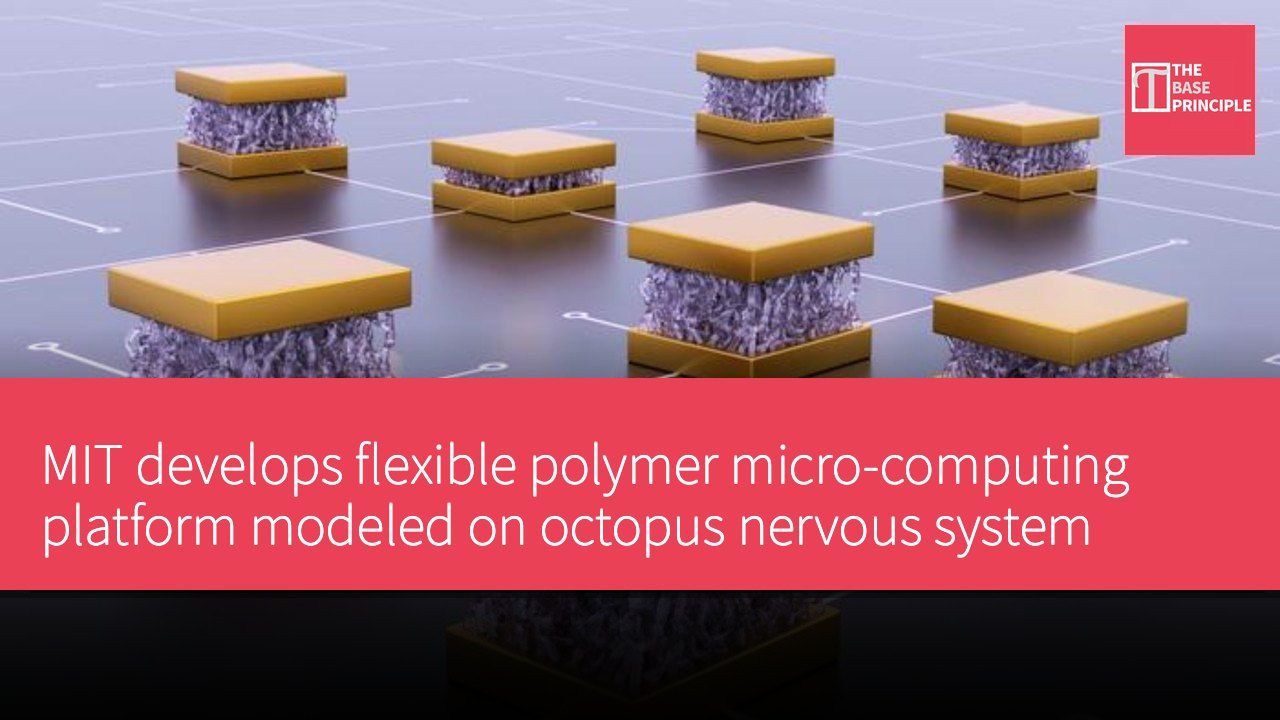
- The computing platform developed at MIT mimics the octopus nervous system.
- The technology uses soft polymer materials, reducing the need for external circuitry.
- The device can dynamically remember a history of applied force and voltage.
- It could pave the way for low-power electronics in the future.
In the deep ocean, octopuses can change their skin color instantly without sending every small decision back to a central brain. Their arms think locally. Researchers at MIT have now translated that soft, decentralized magic into a micro-computing advance. The newly designed nanoscale computing device uses soft, flexible polymers to process information within a single microscopic unit. Notably, the platform mimics the way biological brains use physical motion to compute. It shrinks complex electronic systems into an ultra-thin, energy-efficient package that could advance smart robots, wearable medical patches and biocompatible sensors.
Technology inspired by the octopus
Drawn from the distributed nervous systems of creatures such as the octopus, the technology uses a soft polymer that compresses and rebounds when voltage is applied, mirroring the way brain neurons store and fire information. Building these functions directly into the material reduces the need for bulky external circuits and heavy power supplies. This was no simple feat, however. In earlier attempts, other engineers ran into a physical obstacle when building mechanical computers at the nanoscale. When two metal surfaces come too close together, powerful intermolecular adhesion bonds them permanently, jamming the components and causing the device to fail.
To get around this problem, the MIT team inserted an ultrathin layer of polydimethylsiloxane (PDMS) between two metal electrodes. PDMS is a soft, viscoelastic polymer.
The nanoscale device uses three core components that work together to mimic biological computation. Metal electrodes receive incoming electrical signals and compress when voltage is applied. The soft PDMS layer sandwiched between them acts as a viscoelastic nanospring, balancing adhesive forces so the electrodes can move reversibly without sticking permanently. The polymer's gradual rebound creates a mechanical memory capable of retaining a history of forces applied over time. "PDMS is viscoelastic, which means that after being compressed, it takes time to recover to its original state. This allows the device to dynamically remember the history of forces and voltages applied to it, and to translate that history into an electrical response," said co-lead author Peter Satterthwaite.
How the device operates
Charge accumulates over time. Once a specific threshold is reached, the device fires — just like a biological neuron — and then relaxes to reset. Biological neurons accumulate electrical signals until they reach a threshold, at which point they fire and pass information along. The MIT team's device replicates this mechanism: applied voltage slowly compresses the polymer layer until a threshold is exceeded, triggering a bio-style firing, and the device then relaxes to reset. Modern AI consumes large amounts of power because hardware constantly shuttles data between separate memory and processor units. MIT's platform eliminates that pipeline entirely.
Memory, sensing and logic occur in the same place. Integrating memory and computation directly into a single nanoscale component reduces the need for extra circuitry or capacitors.
Outlook for future applications
This soft, brain-inspired hardware opens the door to a future generation of adaptive electronics, including low-power edge computing, smart prosthetics, wearable health monitors and autonomous environmental sensors. Next, the researchers plan to integrate sensing directly with memory and computation, creating fully adaptive nanomechanical computing systems. The study was published in the journal Science Advances.
Item Specification Processor Nanoscale computing device Material Polydimethylsiloxane (PDMS)
The potential impact of this technology
This work at MIT shows how bio-inspired design can be applied to computing; in particular, the use of flexible polymers makes the devices more adaptive and efficient. This decentralized approach to computation not only reduces energy consumption but could enable higher levels of integration in future smart devices, advancing wearable technology and intelligent robotics. As the technology matures, these nanoscale computing devices have the potential to play important roles in medicine, environmental monitoring and other fields.