
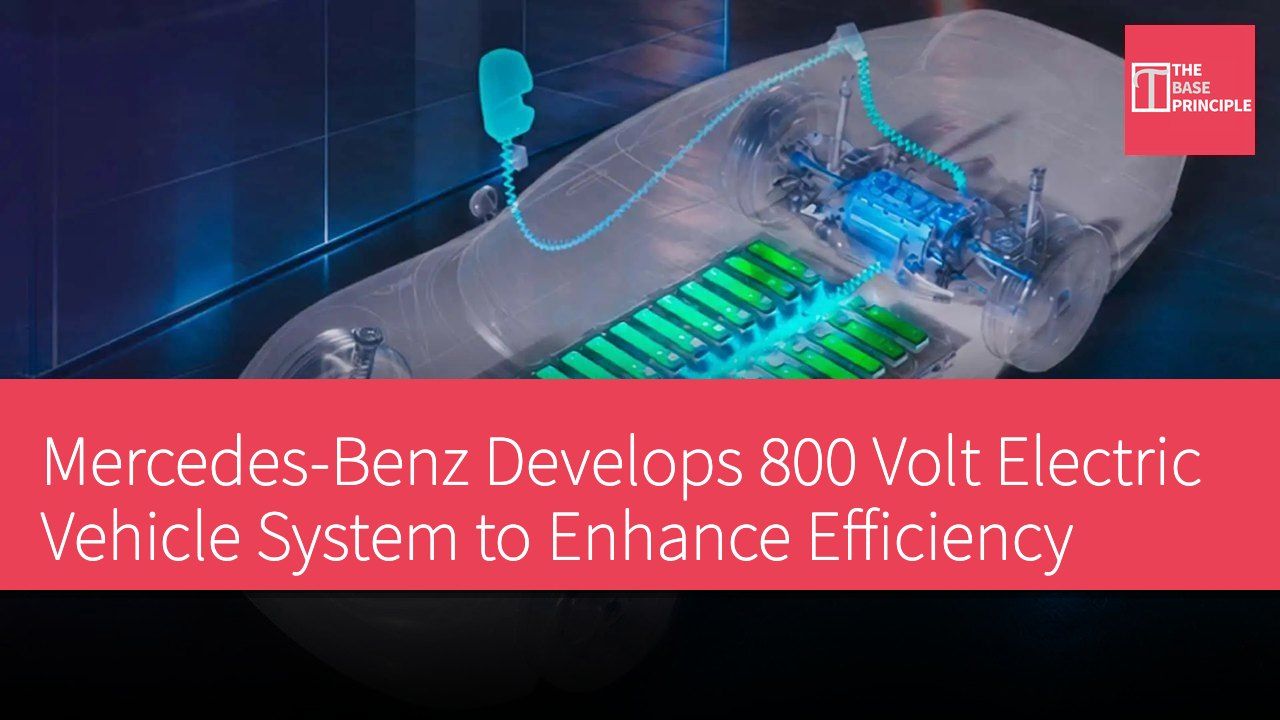
- Mercedes' electric vehicle system can maintain 800 volts of power supply, enhancing efficiency.
- Micro-converters alleviate the burden on weaker batteries, coordinating energy transfer.
- The fixed voltage design simplifies the power system and reduces production costs.
- Charging functions can be managed via software, potentially supporting wireless updates in the future.
Mercedes-Benz is developing an electric vehicle architecture designed to maintain a power supply of up to 800 volts to the traction inverter even during battery discharge. The system utilizes small power converters to manage individual battery cells or packs, ensuring a stable high-voltage supply as battery charge levels fluctuate. In traditional electric vehicles, the voltage of the battery pack is determined by the series connection of battery cells, which decreases as the batteries discharge. Weaker or aging battery cells may also limit the performance of the entire battery pack. This approach by Mercedes will enable vehicles to more effectively control the contributions of individual battery cells while rethinking the components required for charging and propulsion.
The Role of Micro-Converters
Micro-converters alleviate the burden on weaker batteries. Mercedes' design distributes power conversion across multiple devices, each capable of up to 3 kilowatts. These units, known as power converters, are connected in parallel to coordinate the energy transfer from individual battery cells or packs to the vehicle's high-voltage system. The control system can ease the load on weaker batteries while the micro-converters work together to maintain a stable DC supply. This provides a method for the vehicle to manage differences between battery cells within the same battery pack. At the same time, the converters can adjust the voltage delivered to the inverter during battery pack discharge.
Fixed voltage may simplify the power system. The traction inverter converts DC into the AC required by the electric motor. With a stable 800-volt input, Mercedes can optimize the inverter for fixed voltage, thereby improving its efficiency. A unified input voltage may also make it easier to use power system components across different drive designs. These converters can also handle power conversion typically performed by separate onboard chargers. When the electric vehicle is connected to an AC charging point, this charger converts AC to the DC needed by the battery. Offloading this task to micro-converters may allow Mercedes to eliminate standalone units, freeing up space, reducing weight, and lowering production costs.
Software Integration of Charging Functions
Charging functions may shift to software. Mercedes' architecture can integrate AC, DC, and bidirectional charging capabilities into the converter hardware. As relevant electronic components are installed, software can manage functions such as maximum charging power or enable the vehicle to return power through compatible charging setups. This may give Mercedes the option to enable certain features through wireless updates. For instance, bidirectional charging could be activated later on vehicles equipped with supporting hardware. This design also raises a service issue. Placing more power electronic components near the battery means technicians may need to deal with more complex assemblies when faults occur.
How much repair work this will require remains unclear. Therefore, the production impact will, to some extent, depend on how Mercedes packages these converters and their ease of maintenance.
The Innovative Significance of Mercedes' Electric Vehicle System
The 800-volt electric vehicle architecture from Mercedes-Benz represents a significant advancement in electric vehicle technology. Through the design of micro-converters, vehicles can manage battery performance more effectively, especially as batteries age or discharge. Additionally, the optimization of fixed voltage enhances compatibility among power system components, which will help improve overall efficiency and reduce production costs. With the software integration of charging functions, future vehicle feature updates will become more flexible, enhancing user experience and potentially changing the maintenance approach for electric vehicles.