
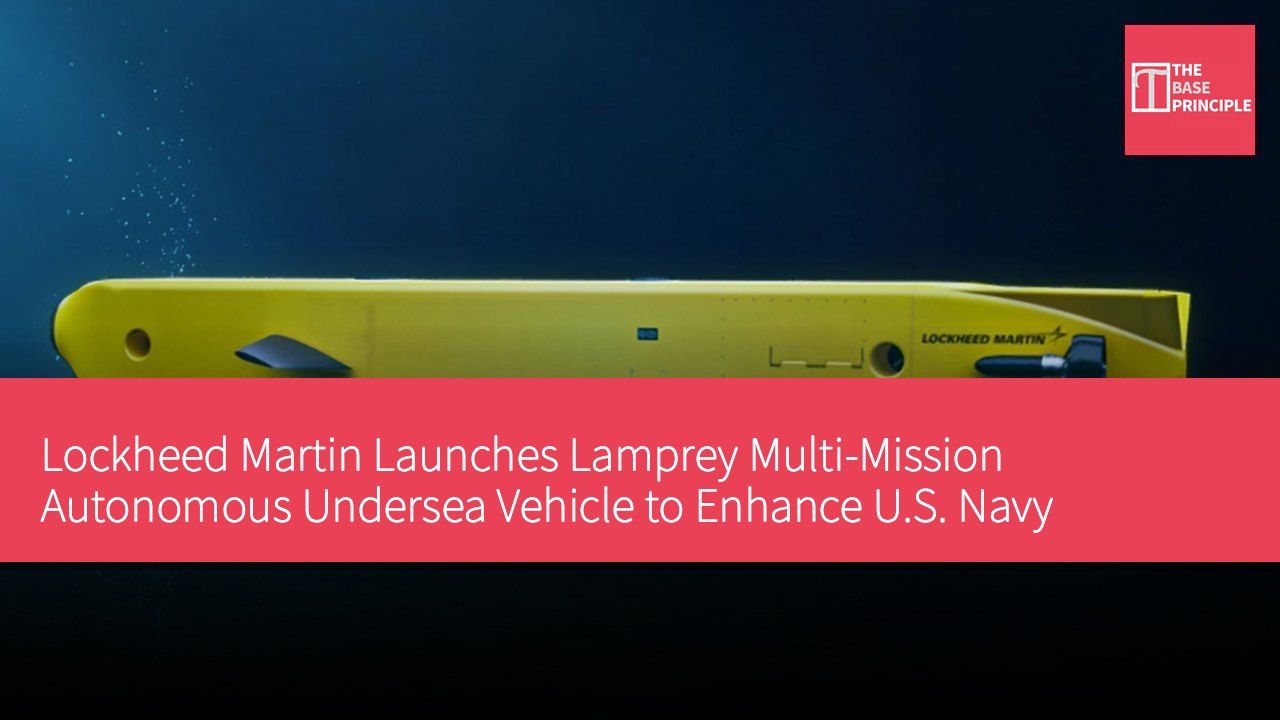
- The Lamprey MMAUV is a multi-mission autonomous undersea vehicle that enhances naval operational capabilities.
- The vehicle can conduct covert intelligence gathering, underwater surveillance, and electronic warfare missions.
- The modular design of Lamprey supports the integration of various mission-specific equipment.
- Its core mission concepts include assured access and sea denial, enhancing strategic flexibility.
Lockheed Martin has recently launched its Lamprey Multi-Mission Autonomous Undersea Vehicle (Lamprey MMAUV), an advanced underwater platform aimed at expanding the U.S. Navy's capabilities in increasingly challenging maritime environments. The system combines autonomous underwater operations with a flexible payload design, allowing it to support a variety of missions and operate in conjunction with existing vessels.
The Lamprey is designed for the U.S. Navy and its allies, capable of assisting in covert intelligence gathering, underwater surveillance, electronic warfare, and sea denial operations. Its unique design allows it to be attached to a mother ship or submarine, moving with the vessel to designated operational areas, where it can then independently carry out assigned missions.
Design Features of Lamprey
Another important feature is its onboard charging capability. The built-in hydrogen generator can produce power to charge the vehicle while it is still attached to the mother platform, ensuring that the Lamprey's batteries are fully charged and ready for operation upon arrival at its destination. The vehicle's design is inspired by marine organisms that can attach to large animals or objects, and Lockheed Martin has applied a similar concept to create an underwater platform that connects with ships and submarines without requiring modifications to the mother ship. Its modular payload architecture is another key element of the system, allowing the vehicle to accommodate various mission-specific equipment, including anti-submarine torpedoes, drone launch systems, sensors, and decoys.
This flexibility enables naval operators to configure the platform according to evolving operational requirements.
In addition to carrying equipment, the Lamprey is also designed to execute intelligence, surveillance, and reconnaissance (ISR), target acquisition, and various intelligence-gathering tasks. It can provide both kinetic and non-kinetic effects, deploying equipment to the seabed and supporting missions involving electronic jamming and deception. Paul Lemmo, Vice President and General Manager of Sensors, Effectors, and Mission Systems at Lockheed Martin, stated that the platform reflects the changing demands of modern naval warfare. "The modern battlefield requires platforms that are covert, adaptable, and dominant," said Paul Lemmo. "The Lamprey MMAUV is internally funded, allowing us to iterate quickly and deliver a truly multi-mission weapon to the Navy that can independently detect, jam, deceive, and engage in combat."
Core Mission Concepts
Lockheed Martin has developed the Lamprey MMAUV around two core mission concepts: Assured Access and Sea Denial. The Assured Access role focuses on covert intelligence gathering, persistent underwater monitoring, and precision strike capabilities. Through these functions, the vehicle can help naval commanders understand activities in strategically important maritime areas while reducing the risk to manned platforms facing potential threats. Sea Denial aims to restrict adversaries' freedom of action in contested waters. The Lamprey MMAUV can support this goal through electronic jamming, decoy deployment, and kinetic attack capabilities.
These capabilities collectively provide commanders with additional options for addressing underwater and maritime threats.
The Lamprey MMAUV is set to be launched on February 9, 2026, and is an autonomous underwater vehicle developed by Lockheed Martin for the U.S. Navy and allied forces. Its internal payload bay has a capacity of 24 cubic feet (approximately 0.68 cubic meters), accommodating various mission-related equipment, including torpedoes, decoys, sensors, and drone-related systems. The built-in hydrogen generator can charge the vehicle while it is attached to the mother ship or submarine, helping it to be ready for deployment upon reaching the operational area.
Impact of Lamprey on Naval Operations
The launch of the Lamprey MMAUV marks a significant advancement for the U.S. Navy in addressing the challenges of modern naval warfare. As the maritime environment becomes increasingly complex, the flexibility and multifunctionality of this underwater unmanned vehicle will enable the Navy to execute a wider range of missions more effectively, from intelligence gathering to electronic warfare. Its modular design and onboard charging capability further enhance operational efficiency and reduce reliance on manned platforms. Additionally, the mission concepts of assured access and sea denial will help the Navy gain strategic advantages in countering potential threats, which is crucial for maintaining national security.