
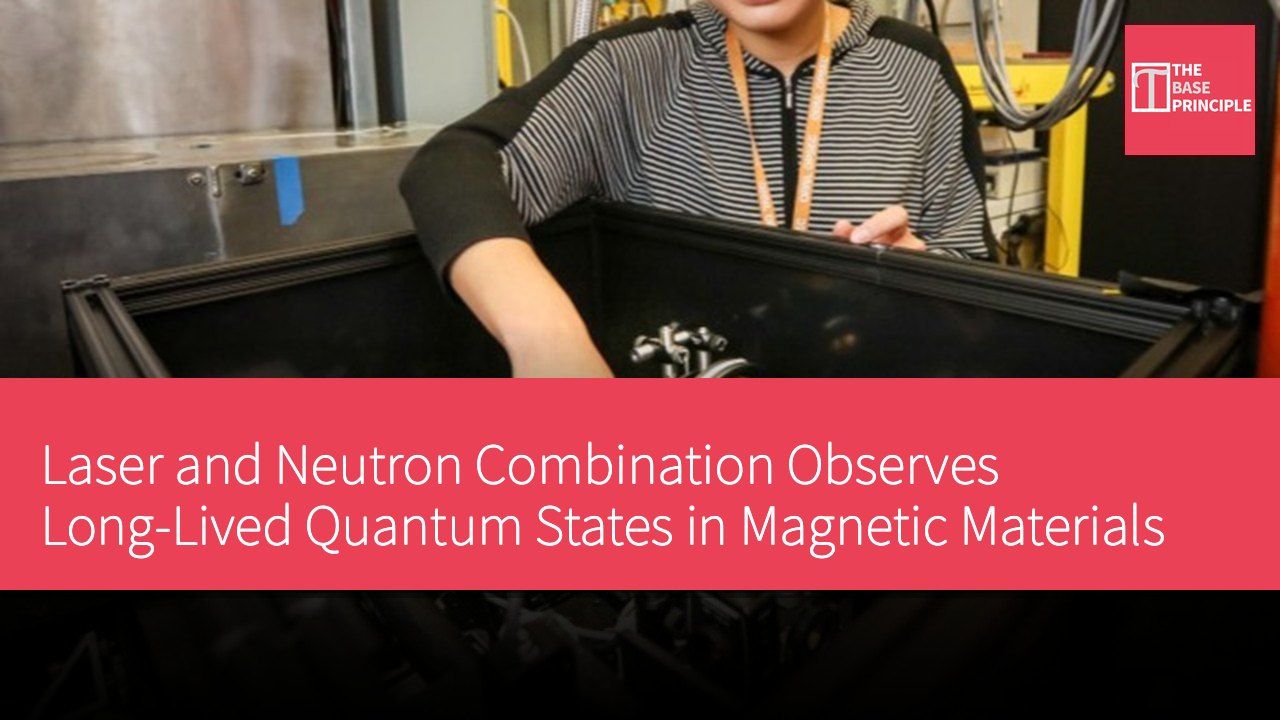
- Researchers observed a long-lived quantum state, opening new pathways.
- Laser-driven magnons are crucial to magnetic behavior and can carry information.
- The system violates the detailed balance principle, exhibiting a long-lived non-equilibrium steady state.
- The research provides an experimental foundation for future quantum materials and information technology.
Researchers at Oak Ridge National Laboratory (ORNL) and their collaborators have observed a long-lived quantum state in a magnetic material through the combination of laser and neutron techniques. This method opens new avenues for studying materials far from equilibrium, ORNL announced. Manipulating quantum magnets is essential for quantum information science, potentially reducing losses in information transfer, improving memory devices, and benefiting other quantum technologies.
The team studied laser-driven magnons, whose quantum excitations are crucial to magnetic behavior. Magnons can carry information, while quantum magnets can support long-term memory for data transmission. In the experiment, rapid laser pulses drove the material away from its normal equilibrium state. ORNL's Spallation Neutron Source, a user facility of the U.S. Department of Energy's Office of Science, enabled researchers to investigate the microscopic magnetic behavior within the material. Neutron scattering detects the structure and behavior of materials at atomic and nanoscale, making it well-suited for analyzing magnetic excitations.
Success of Multidisciplinary Collaboration
This combination, utilizing a pump-probe setup with neutron scattering, is typically not applied to non-equilibrium studies. ORNL's Hua Chengyun stated that the success of this work required multidisciplinary collaboration, involving mechanics, safety personnel, hardware and software engineers, and researchers, all needing to break conventional thinking. Measurement results showed that the material violated the detailed balance principle, a physical law that predicts the relationship between energy gain and loss events in a stationary system. Under the influence of rapid laser pulses, this balance was disrupted, with neutron data showing additional signals only on one side.
The non-equilibrium state did not quickly dissipate; the excess polarization of magnons persisted, indicating that the team did not observe a transient heating effect. Instead, this is a long-lived non-equilibrium steady state maintained by periodic laser pulses. Hua Chengyun noted that no one has previously directly detected violations of detailed balance in condensed matter systems.
Future Potential of the Research
This rule-violating behavior makes the system a powerful platform for studying other non-equilibrium quantum physics. Insights from other materials may guide future research on quantum materials, coherent transport, and low-loss electronics. The study also provides scientists with a new benchmark, demonstrating the information that neutron scattering can reveal when observing materials in an actively driven rather than stationary state. This approach was initially conceived by Hua Chengyun, Barry W. and Allen Tennant, building on a long-standing ORNL effort to develop specialized infrastructure for such measurements.
An ORNL seed grant enabled them to explore high-risk, high-reward non-equilibrium physics early on.
For ORNL, this research lays an experimental foundation for understanding new quantum materials. It also supports the exploration of how these materials may be studied alongside quantum computers and used in future information technology. The U.S. Department of Energy's Office of Science's Basic Energy Sciences program supported inelastic neutron scattering, simulations, data analysis, and modeling. Additionally, the Quantum Science Center also supported related theoretical research. The study was published on November 9 in Nature Communications.
Breakthrough Discoveries in Non-Equilibrium Quantum Physics
This research reveals a new method for observing long-lived quantum states in magnetic materials, demonstrating the persistence of non-equilibrium states. By combining laser and neutron scattering, researchers successfully broke the detailed balance principle, which is crucial for the development of quantum information science. This discovery not only provides an experimental foundation for understanding novel quantum materials but may also drive future applications in quantum computing and low-loss electronics, showcasing its profound impact in the field of technology.