
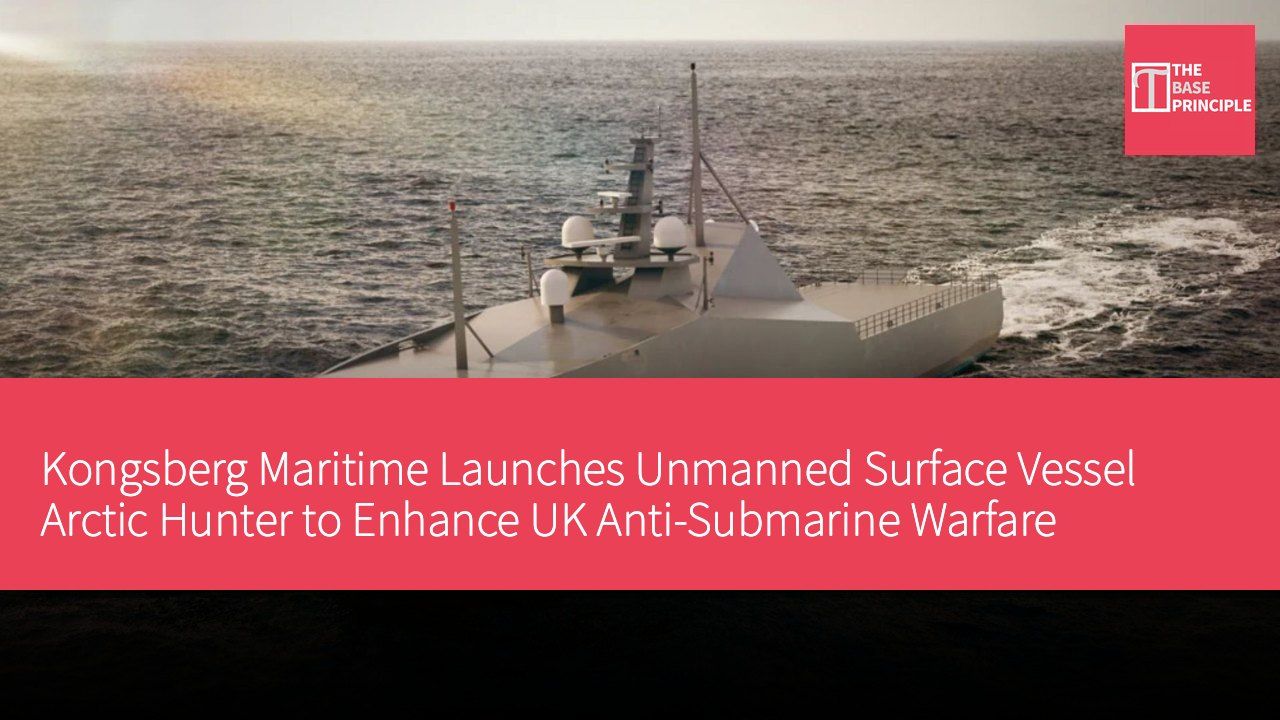
- Kongsberg Maritime has launched the unmanned surface vessel Arctic Hunter to enhance the UK's anti-submarine warfare capabilities.
- Arctic Hunter is based on a commercial fishing vessel design, integrating autonomous navigation technology and submarine detection sensors.
- The vessel can operate for up to 60 days and provide submarine detection coverage.
- Arctic Hunter remains a proposal, with future configurations and procurement quantities yet to be announced.
Kongsberg Maritime has recently launched an unmanned surface vessel aimed at assisting the Royal Navy in detecting submarines in the increasingly competitive Arctic and North Atlantic waters. The vessel, named Arctic Hunter, is based on a commercial fishing vessel design and combines autonomous navigation technology with submarine detection sensors, providing a faster and more cost-effective way to expand the UK's anti-submarine warfare capabilities. The vessel made its debut on November 9, 2026, and is proposed for the Royal Navy's Type 92 requirement as part of the UK's planned mixed fleet, which will include both manned and unmanned naval platforms.
Kongsberg is collaborating with Thales UK to develop sonar and military communication systems, while shipbuilding partner Balaena Maritime is expected to construct these vessels at its shipyard in Bideford, should the proposal be approved. The company plans to have these vessels ready for military integration and operational deployment by the end of the century.
Design and Functionality of Unmanned Vessels
The unmanned vessel transforms commercial fishing boats into submarine hunters. Kongsberg did not design an entirely new military vessel but opted for an existing Arctic commercial vessel design as the basis for Arctic Hunter. The platform is based on a 56-meter (184-foot) fishing vessel hull, originally developed to withstand the harsh conditions of the North Atlantic and Arctic. After modification, the vessel's fishing and processing equipment has been replaced with remote control systems, autonomous technology, and military mission equipment. Its internal space and deck area also allow for the installation of additional sensors and payloads according to operational needs.
The vessel is designed to operate without a crew on board, with Kongsberg proposing missions lasting up to 60 days, and will operate from forward support bases within the Arctic Circle, providing continuous submarine detection coverage alongside manned warships and other surveillance platforms.
A key aspect of the design is to reduce the vessel's underwater acoustic signature. Noise from mechanical equipment and propellers can interfere with sensitive sonar equipment, making a quiet operating platform crucial for submarine detection. Kongsberg has stated that it is optimizing the hull and propulsion system to minimize underwater noise.
Arctic Hunter will be equipped with Thales UK's submarine detection sonar and secure military communication systems. According to reports from The War Zone, the planned sensor is the Sonar 2087, a towed sonar already used by the Royal Navy's Type 23 frigates and planned for the updated Type 26 fleet. The towed sonar consists of sensitive hydrophones mounted on a long cable, towed behind the vessel. These sensors are used to listen for underwater sound signals, including noise generated by submarine machinery and propulsion systems.
Unlike active sonar, which emits sound pulses and analyzes their echoes, passive sonar listens without sending signals. This can help naval forces detect and track submarines while minimizing the risk of exposing their own positions. By carrying these devices on an unmanned platform, the Royal Navy can distribute submarine detection sensors over a wider area without needing to allocate additional manned warships for each surveillance mission. The information gathered can be transmitted to other naval resources for further assessment and coordinated operations.
Relationship Between Arctic Hunter and the Royal Navy
Arctic Hunter is proposed for the Royal Navy's Type 92 program, which is part of its broader mixed naval concept. This approach combines traditional manned warships with unmanned surface vessels, underwater systems, and autonomous platforms. The initiative is closely related to the UK's "Atlantic Fortress" strategy, aimed at enhancing surveillance and protection of critical underwater infrastructure and monitoring submarine activity in the North Atlantic and Arctic regions. The UK and Norway have also committed to expanding cooperation on autonomous maritime systems through the Lunna House agreement, designating the Arctic region as a priority for joint defense development.
However, Arctic Hunter remains an industry proposal rather than an operational Royal Navy vessel. Its selection for Type 92, final configurations, and procurement quantities have yet to be announced. If adopted, the design would provide the Royal Navy with a method to expand its underwater surveillance network, utilizing commercially built vessels equipped with specialized military sensors. Arctic Hunter is not intended to replace frigates and other anti-submarine platforms but aims to provide more persistent sensing coverage over strategically significant waters for NATO.
Potential Impact and Challenges of Arctic Hunter
The launch of Arctic Hunter reflects modern navies' emphasis on unmanned technology, particularly in submarine detection. This vessel not only has the potential to reduce operational costs but also to expand the navy's surveillance capabilities, especially in strategic waters like the Arctic and North Atlantic. However, the vessel is still in the proposal stage, and its future practical application will depend on its acceptance within the Royal Navy and specific configurations. If successfully implemented, Arctic Hunter could become a crucial part of naval modernization, enhancing monitoring of submarine activities.