
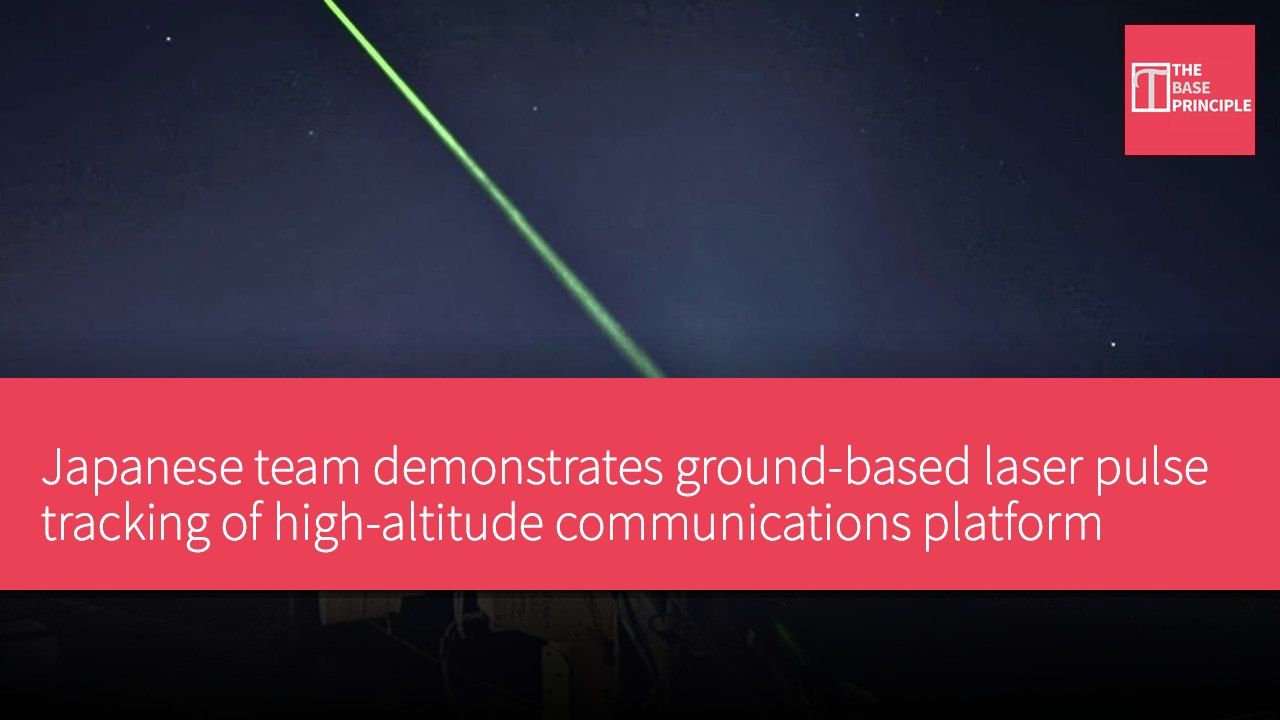
- A Japanese team has demonstrated ground-based laser pulse tracking of a high-altitude communications platform.
- This is the world's first demonstration of ground-based laser ranging to a stratospheric HAPS.
- Future HAPS communications systems will need optical transceivers installed to transmit data.
- SoftBank aims to build a three-dimensional communications network connecting ground users with infrastructure.
SoftBank, Hosei University and Japan's National Institute of Polar Research have demonstrated a method of tracking a high-altitude communications platform from the ground using laser pulses, marking an important step toward future optical links between the ground, the stratosphere and satellites. The demonstration used a corner cube reflector (CCR) mounted on a lighter-than-air (LTA) type high-altitude platform system (HAPS) operated by the U.S. company Sceye. A compact, portable laser ranging system on the ground continuously tracked the HAPS and detected laser pulses reflected back from the reflector while the platform operated in the stratosphere.
SoftBank said this is the world's first demonstration of this specific form of ground-based laser ranging to a stratospheric HAPS, based on publicly available information reviewed by the three organizations through September 8, 2026.
Why conduct a laser reflection test
Why perform laser reflection on a HAPS? The experiment sounds simpler than a conventional laser communications demonstration, because the HAPS did not send data through an optical terminal but instead carried a passive reflector. A CCR is designed to return incoming light back to its source regardless of the angle of incidence. By mounting it on a HAPS, researchers can test whether a ground station can continuously acquire and track a moving platform, aim a laser beam at it, and detect an extremely faint return signal. The HAPS platform operates around 20 kilometers above the Earth, with its position and orientation constantly changing.
As a result, a communications system needs to locate the vehicle, achieve optical acquisition, keep a narrow laser beam pointed at it, and maintain tracking as it moves. SoftBank refers to this combined set of capabilities as pointing, acquisition and tracking (PAT). The CCR test allowed researchers to examine these challenges before fully installing optical communications terminals.
The laser ranging to optical communications demonstration was conducted on August 23 and 24, 2026, following initial observations and software adjustments on August 22. The HAPS operated over waters near Cape Muroto in Kochi Prefecture. The ground system continuously acquired and tracked the HAPS while sending pulsed laser beams to its CCR and receiving reflected signals. The experiment also generated data on the degree of attenuation experienced by the laser signal as it traveled between the ground and the stratosphere. This atmospheric information helps determine the requirements for future HAPS optical communications equipment, including how the terminals will be installed and operated.
The test was also technically challenging because the light reflected by the CCR returns within a very narrow angular range. SoftBank said the pointing and reception tracking accuracy required for satellite laser ranging is roughly an order of magnitude higher than that needed for conventional optical communications links.
Notably, the laser power used in the experiment was not high, and the system halted transmission when it detected a manned aircraft heading toward the HAPS. The demonstration builds on prior work showing that optical communications can operate between the stratosphere and the ground. In 2005, the German Aerospace Center's STROPEX experiment demonstrated a 1.25 Gbit/s optical downlink from a stratospheric balloon at about 22 kilometers altitude to a ground station. The U.S. Navy's Pacific Naval Information Warfare Center has also developed the Stratospheric Optical Link Demonstration (SOLD) as a high-altitude balloon experiment to reduce the risk of optical communications technology.
SoftBank's approach was different: rather than sending communications data between an optical terminal and the ground, it created a round-trip laser path: ground → HAPS → ground.
Direction of future communications systems
The next step is connecting with light. A CCR itself cannot transmit data because it is passive. Future communications systems will need optical transceivers installed on the HAPS, capable of transmitting and receiving laser signals while maintaining a link with a ground station or satellite. SoftBank said the tracking system being developed for its optical communications terminal uses the same software architecture as the laser ranging system, meaning the experience gained in this demonstration can be carried over to the next phase. The company's broader goal is to establish a three-dimensional communications network in which HAPS platforms link ground users with infrastructure and potentially low Earth orbit (LEO) satellites via optical connections, serving as high-capacity links between network layers at different altitudes.
SoftBank has already tested HAPS communications services with Sceye, including smartphone connectivity, and is working toward potential commercialization after 2027. This latest demonstration addresses a fundamental problem this kind of network must solve: reliably finding, tracking and maintaining a laser link with a platform moving at an altitude of 20 kilometers.
Item Specification HAPS type LTA Operating altitude About 20 kilometers Laser transmission rate 1.25 Gbit/s
Potential impact of the laser pulse technology
The successful demonstration of this technology marks a further expansion of the boundaries of optical communications applications on high-altitude platforms. Through laser pulse tracking, researchers can overcome the challenges of tracking high-altitude moving platforms, laying the foundation for future communications systems. As the technology develops, it will help improve connectivity between the ground and the stratosphere as well as low Earth orbit satellites, thereby promoting more efficient data transmission and the establishment of communications networks. This has important implications for the future development of communications infrastructure.