
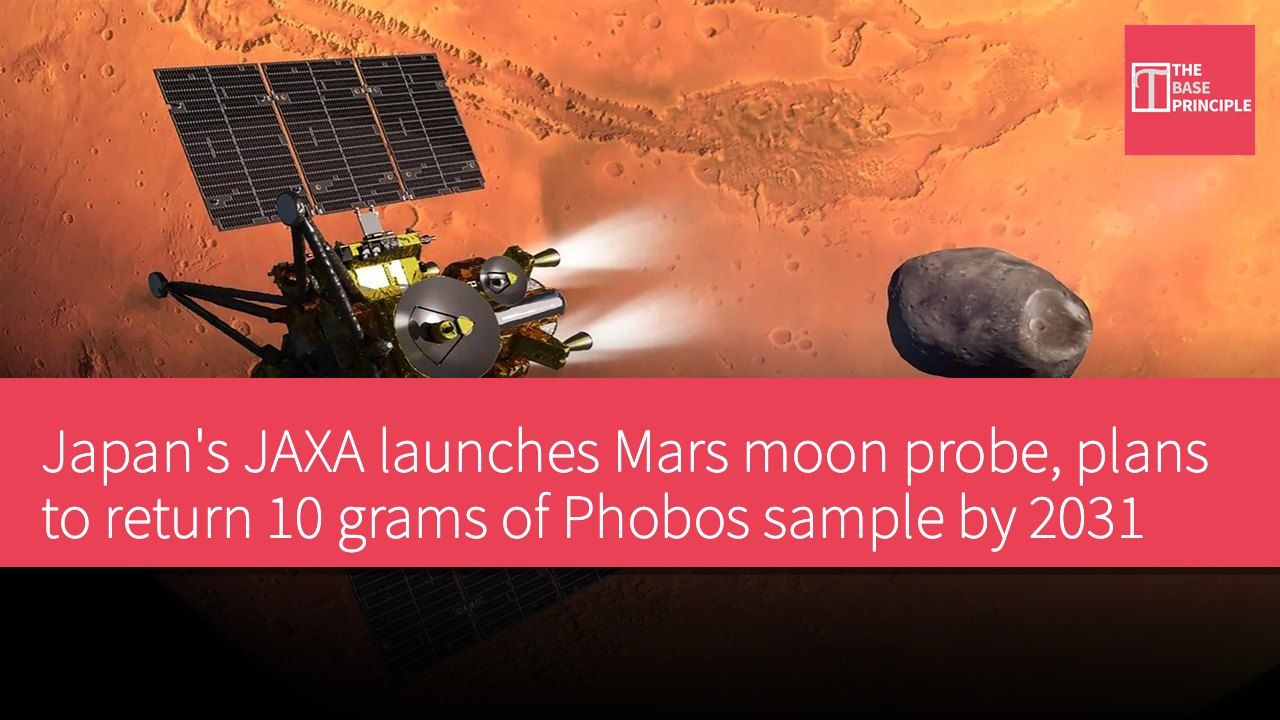
- JAXA successfully launched the Martian Moon eXploration spacecraft, targeting Phobos.
- MMX will be the first spacecraft to collect samples from Phobos.
- The lander Idefix will conduct landing and research on the surface of Phobos.
- Samples are expected to return to Earth in 2031 and may contain Martian particles.
The Japan Aerospace Exploration Agency (JAXA) successfully launched the Martian Moon eXploration (MMX) spacecraft on October 20, Japan time, aiming to land on Mars' moon Phobos, collect at least 10 grams of material, and return to Earth by 2031, according to IEEE Spectrum. According to the German Aerospace Center (DLR), Phobos is approximately 27 kilometers (about 17 miles) long, and its origin remains a mystery. One theory suggests it is a captured asteroid, while another posits it is debris formed from a massive impact on Mars.
Design and Mission of the MMX Spacecraft
The European Space Agency states that MMX will be the first spacecraft to orbit Phobos and collect samples at the site. The spacecraft consists of three modules for the journey to Mars, operations on Phobos, and the return to Earth, with DLR indicating that it is expected to arrive at Mars in the second half of 2027.
According to IEEE Spectrum, landing the lander on the uneven surface of Phobos is quite challenging, as the moon's gravity is about 1/1,800 that of Earth, making it prone to tipping over or bouncing. JAXA's MMX project manager Yasuhiro Kawakatsu stated in the magazine that landing on Phobos is akin to trying to land a balloon. The first lander, named Idefix, is jointly built by DLR and the French space agency CNES, weighing approximately 25 kilograms (about 55 pounds).
According to DLR, the mothership plans to release Idefix from a height of about 40 meters (about 131 feet) between 2028 and 2029, with the lander free-falling without airbags. Idefix's co-principal investigator Stephan Ulamec noted that the lander may bounce several times before coming to a stop. Then, four legs will help it stand upright.
Landing and Sample Collection by Idefix
According to DLR and the magazine, Idefix will move using paddle-like wheels for about three months, studying the adhesion of surface particles. The main lander will then descend to about 10 meters (approximately 33 feet) above the surface and land in free fall. JAXA aims to collect at least 10 grams of samples. The robotic arm, designed with a hollow core tube, will penetrate the surface to a depth of at least 2 centimeters (about 0.8 inches), while a sampler provided by NASA will spray nitrogen to capture loose particles.
Deeper material should better record the moon's origin. Additionally, Phobos may contain Martian particles ejected by impacts. Patrick Michel, research director at the French National Centre for Scientific Research (CNRS), estimates that the samples may include hundreds of Martian particles.
These plans are still in progress. IEEE Spectrum notes that predicting the landing conditions for Idefix is quite difficult, and the number of Martian particles is merely an estimate. If the deceleration engine fails to ignite on Mars, MMX may miss the planet. According to orbital expert Nicola Baresi, MMX is expected to leave Mars in November 2030, with the sample capsule landing in Australia in 2031. Detailed information was reported by Andrew Jones in IEEE Spectrum on November 6.
Challenges and Opportunities in Mars Exploration Missions
JAXA's MMX mission marks a significant step in humanity's exploration of Mars and its moons. The unique environment of Phobos makes landing and sample collection extremely challenging, particularly due to its low gravity and uneven surface. Successfully collecting samples will not only help scientists understand the origin of Phobos but may also reveal Mars' history. The success of this mission will lay the groundwork for future Mars exploration and could promote research on other celestial bodies.