
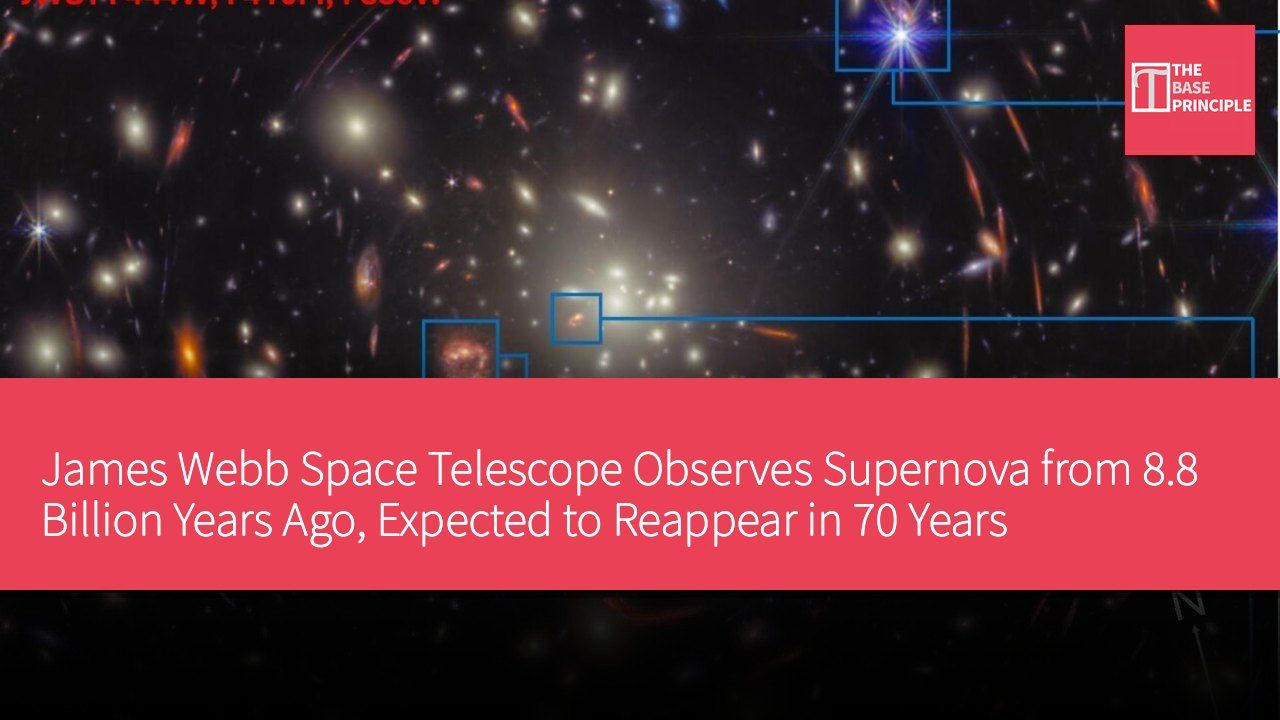
- The James Webb Space Telescope has discovered a supernova from 8.8 billion years ago.
- This supernova, named SN Ares, is expected to reappear in about 70 years.
- JWST is capable of capturing images of the early universe, aiding in the understanding of galaxy evolution.
- The gravitational lensing effect will enhance the brightness of background sources, helping to observe faint objects.
Astronomers at the Space Telescope Science Institute (STScI) have discovered a supernova from 8.8 billion years ago in high-resolution images captured by the James Webb Space Telescope (JWST). These images were taken in August 2025, and through gravitational lensing, astronomers will have the opportunity to observe this star again in about 70 years. JWST was launched in December 2021 and serves as the successor to the Hubble Space Telescope. It is a space-based infrared observatory, a collaborative project of NASA, the European Space Agency (ESA), and the Canadian Space Agency (CSA).
The telescope is located approximately 930,000 miles (about 1.5 million kilometers) from Earth, capturing images of exoplanets, star formation, and galaxy evolution, helping us understand the early universe. In terms of supernova detection, JWST has achieved remarkable success, capturing some of the earliest supernovae that formed just 730 million years after the Big Bang.
JWST's Observational Capabilities
Scientists have combined data from Hubble and JWST to explain some of the "missing red supergiants," and JWST has also identified characteristics of the brightest supernova ever recorded. This time, astronomers will be able to observe the supernova named SN Ares in 70 years with the help of gravitational lensing. What is gravitational lensing? According to Einstein's general relativity, massive objects distort the fabric of spacetime. Although light has no mass, the curvature of spacetime caused by gravity can bend light rays, creating a cosmic magnifying glass or lens that enhances the brightness of background sources, helping astronomers clearly observe faint or distant objects.
This is known as the gravitational lensing effect.
Some examples of gravitational lensing include the Einstein Cross, where gravity splits the light from a distant quasar into four distinct images arranged in a cross shape. The molten ring amplifies the light from the background galaxy by 20 times and distorts it into a glowing molten ring. However, in some cases, light rays bent by gravitational lensing may arrive at different times. While the difference may be just a few hours, in the case of SN Ares, other light rays are expected to arrive in about 73 and 76 years.
Characteristics and Classification of SN Ares
Astronomers discovered SN Ares in the near-infrared images of the galaxy cluster MACS J0308.9+2645 taken by JWST in August 2025. They classified it as a Type IIb supernova based on spectral results, which showed features of helium and hydrogen, indicating that the star lost its outer hydrogen layer due to the explosion. Their analysis using a triple lens model indicated that there are two additional supernova images that have yet to reach us. These images are expected to arrive in seventy years, marking a rare opportunity for cross-generational lens observations.
We cannot predict how astronomy will evolve over the next seventy years, but this will allow the next generation to glimpse the past.
The significance of this event also lies in the fact that the arrival time of the next set of images depends on the geometry of space. As the universe is also expanding, measuring the delay in the arrival of the images will help astronomers calculate the Hubble constant, which is the rate of expansion of the universe. Researchers will conduct further spectral measurements in 2027 to understand the characteristics of the lens and accurately predict the delay time. The research findings have been published on the preprint server arXiv.
The Importance of Gravitational Lensing and Future Prospects
The gravitational lensing effect not only amplifies faint light sources in the universe but also provides crucial data regarding cosmic expansion. This observation will assist astronomers in calculating the Hubble constant, furthering our understanding of the evolution of the universe. As JWST's data continues to grow, future observations will reveal more mysteries of the cosmos and provide valuable research opportunities for the next generation of astronomers.