
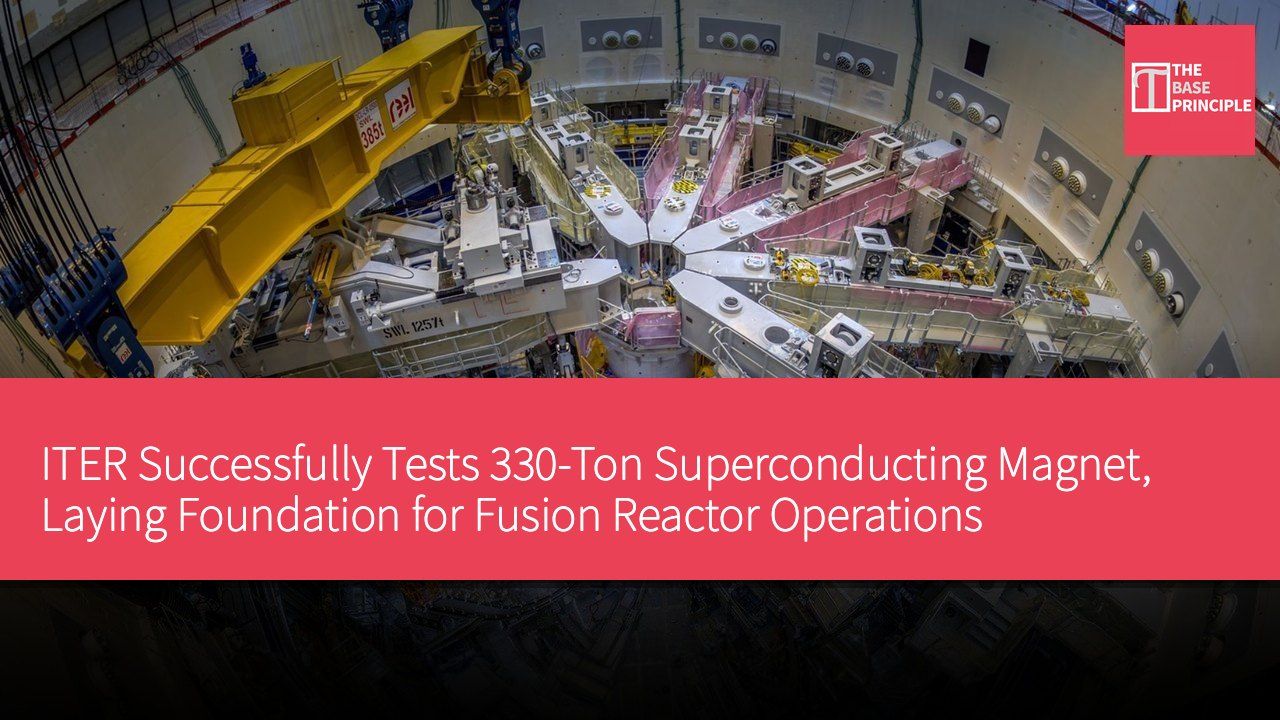
- ITER successfully tested the 330-ton superconducting magnet to 34 kA, laying the foundation for fusion reactor operations.
- This achievement provides valuable operational experience for the commissioning of ITER's magnet system.
- The next testing program will focus on cooling and testing the toroidal field coil #19.
- The cold test program aims to identify potential issues and reduce risks for future operations.
ITER has completed an important testing program, successfully activating its 330-ton superconducting magnet to 34 kiloamperes (kA), and subsequently removing it from the magnet cold test facility. This D-shaped toroidal field coil, numbered #17, was cooled to 4 Kelvin (i.e., -269 degrees Celsius) and tested at half of its rated operating current of 68 kA. This successful test allows engineers to assess the deformation of the magnet under electromagnetic loads and compare its behavior with structural models. The coil was transferred to a transport frame on October 30 and will be shipped to ITER's assembly hall after temporary storage to be integrated into the final block module of the plasma chamber.
This achievement provides valuable operational experience for the commissioning of ITER's integrated magnet system.
Superconducting coil passes testing
Testing Program and Future Goals
The development of the magnet cold test facility aims to evaluate ITER's superconducting magnets and their supporting infrastructure, which are tested before installation in the tokamak, including the cryogenic system, vacuum system, power supply, electrical supply, and control systems. The first testing program will commence in May 2026, focusing on toroidal field coil #7. Engineers will cool the magnet to 4 K and activate it to 10 kA to assess the resistance of its joints and evaluate the system responsible for detecting the loss of superconductivity, known as "quenching." Testing of coil #17 began in August, and reaching 34 kA marks a significant increase in test current, allowing engineers to examine the structural response of the component under stronger electromagnetic forces.
ITER's Chief Mechanical Engineer Adrien Deydier stated, "Reaching 34 kA is an important step and confirms that the coil's behavior aligns with the model's predictions." He added that the testing program also provides operational experience for the team preparing for integrated commissioning.
Next coil target full current
With the removal of coil #17, the magnet cold test facility will prepare to produce the backup toroidal field coil #19. Cooling of this coil will begin in April 2027 down to 4 K, followed by testing at 34 kA. The next testing program will introduce a Paschen tight connection between the cooler power lines and the coil. These connections simulate the planned connections in the tokamak, allowing engineers to assess the high-voltage grounding insulation of the magnet. Subsequently, the facility will be opened for the installation of a design intended to prevent deformation of the coil when activated to its full rated operating current of 68 kA.
Engineers will also conduct temperature margin tests, deliberately heating parts of the coil to trigger the loss of superconductivity, which will help verify the operational margin and protection system of the magnet. After testing coil #19, the facility will be reconfigured to accommodate toroidal field coil #1, which is another part of the ITER magnetic confinement system. ITER's toroidal field magnets are crucial for confining the superheated plasma within the reactor. The project will utilize 18 D-shaped toroidal field coils, along with six poloidal field coils and a central solenoid, to generate and control the magnetic fields necessary for fusion experiments.
Importance of the Cold Test Program
The cold test program aims to identify potential issues to reduce risks during commissioning and future operations before the magnets are integrated into the machine.
Item Specification Coil Number #17 Cooling Temperature 4 K (-269 degrees Celsius) Test Current 34 kA Rated Operating Current 68 kA
Significance of ITER's Superconducting Magnet Testing
ITER's superconducting magnet testing marks a significant advancement in fusion technology. Successfully activating to 34 kA not only demonstrates the structural stability of the magnet but also provides important operational experience for future commissioning. With the upcoming testing program for the next toroidal field coil, engineers will be better able to assess the magnet's performance under high currents, which is crucial for ensuring the safe operation of the fusion reactor. Additionally, the design of the cold test program aims to identify potential issues in advance, which will help reduce risks in future operations and further advance the practical application of fusion technology.