
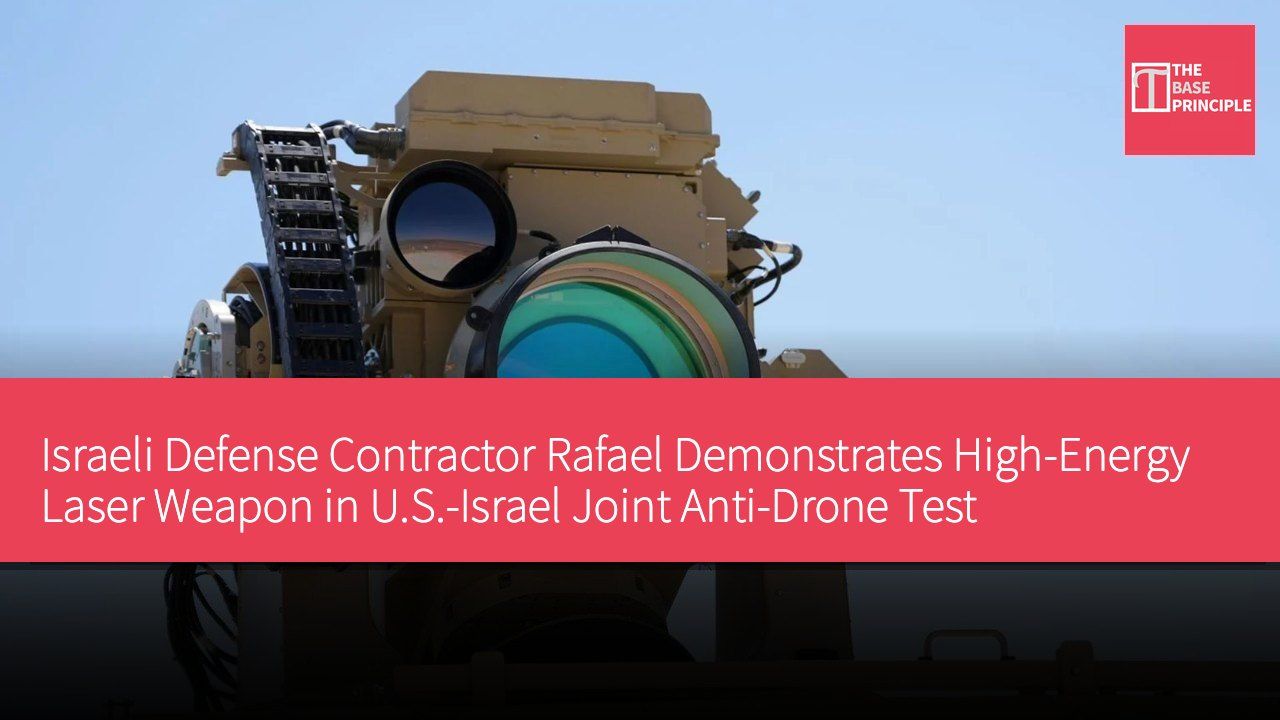
- Rafael demonstrated its high-energy laser weapon in operation during the U.S.-Israel joint anti-drone test.
- The trial brought together approximately 20 detection and interception technologies to assess drone threats.
- The cost per engagement for high-energy solid-state lasers is only a few dollars, offering an economic advantage.
- The joint test helps refine the integration of directed energy systems and kinetic interceptors.
Israeli defense contractor Rafael Advanced Defense Systems has released a new video showcasing its high-energy laser weapon attacking aerial targets during the "Black Sand" exercise. This exercise is the first U.S.-Israel joint anti-drone test conducted within Israel, taking place in November 2026. The live assessment brought together about 20 detection and interception technologies from Israel and the United States, allowing military operators from both countries to test emerging counter-unmanned aerial systems (C-UAS) hardware in a simulated combat environment.
The trial was led by the Israeli Ministry of Defense's Directorate of Defense Research and Development (DDR&D) in collaboration with U.S. Central Command, Special Operations Command, the Navy Research Office, and Joint Task Force 401, assessing the performance of various technologies against different drone threats. The Israel Defense Forces' ground and air units participated directly, evaluating field applicability alongside U.S. military users. A statement released by Rafael on the X platform confirmed that its laser hardware participated in the live-fire demonstration, while the Israeli Ministry of Defense noted that the 20 systems involved tested against multiple types of unmanned aerial vehicles.
Background of the U.S.-Israel Joint Test
According to reports, the video showcased Rafael's flagship product, the Iron Beam high-power laser system, although defense officials did not disclose specific interception scores, target analysis, or procurement timelines. Daniel Goldfarb (Res.), head of DDR&D, stated in a Ministry of Defense announcement: "Addressing drone threats requires ongoing technological innovation and close collaboration with partners. Conducting the Black Sand exercise in Israel and working with U.S. defense and development agencies allows us to connect the knowledge and operational experience accumulated in Israel with other capabilities and technologies, and to jointly assess the solutions needed by field forces."
Advantages of High-Energy Lasers
The economic model of anti-drone warfare has shifted, making the Black Sand demonstration highlight why directed energy weapons have become a priority for Washington and Jerusalem. Traditional aerial defense interceptors, such as the Iron Dome's Tamir missiles, cost tens of thousands of dollars per shot, creating a severe cost-exchange imbalance when used against inexpensive mass-produced quadcopters or one-way attack drones. This imbalance was particularly evident in February 2026, when Iran's retaliatory attacks combined high-density, mixed munitions types with radar suppression, overwhelming these advanced systems.
Moreover, the increasing use of fiber-optic tethered drones on the battlefield has rendered traditional radio frequency jamming ineffective against certain threats.
High-energy solid-state lasers focus concentrated beams on the body or optical sensors of drones, heating structural materials to the point of failure for critical components in mid-air. Since this weapon uses electricity rather than consuming physical ammunition, the cost per engagement is only a few dollars, and as long as power and thermal cooling systems are available, it can provide nearly unlimited ammunition. Iron Beam was developed by Rafael in partnership with laser source collaborator Elbit Systems, designed to neutralize rockets, mortars, and drones at a range of approximately 10 kilometers (6 miles).
Rafael delivered the first operational Iron Beam battery to the Israel Defense Forces in December 2025 and expanded the family to include smaller variants, such as the vehicle-mounted Lite Beam and the mobile Iron Beam-M.
While fog, dust, or rain can limit the range of lasers compared to radar-guided missiles, joint tests like Black Sand help commanders refine the integration of directed energy systems with kinetic interceptors within layered air defense networks.
When was this high-energy laser weapon test conducted?
The high-energy laser weapon test was conducted in November 2026.
Which company collaborated with Rafael to develop the high-energy laser weapon?
Iron Beam was developed by Rafael in collaboration with laser source partner Elbit Systems.
How many systems participated in this test?
Approximately 20 systems participated in this test, featuring detection and interception technologies from Israel and the United States.
What is the cost per engagement for high-energy laser weapons?
The cost per engagement for high-energy laser weapons is only a few dollars, as they use electricity instead of consuming physical ammunition.
What is the effective range of Iron Beam?
Iron Beam is designed to neutralize rockets, mortars, and drones at a range of approximately 10 kilometers (6 miles).
Strategic Significance of High-Energy Laser Weapons
The development of high-energy laser weapons like Iron Beam reflects the shift in current warfare paradigms. As drone technology advances, traditional defense systems face challenges in cost and effectiveness. High-energy laser weapons not only reduce the cost per engagement but also provide nearly unlimited ammunition under sustained power conditions, which is crucial for addressing drone threats. The conduct of joint tests allows Israel and the United States to test and refine these new technologies in real combat environments, enhancing military cooperation and defense capabilities for both sides.