
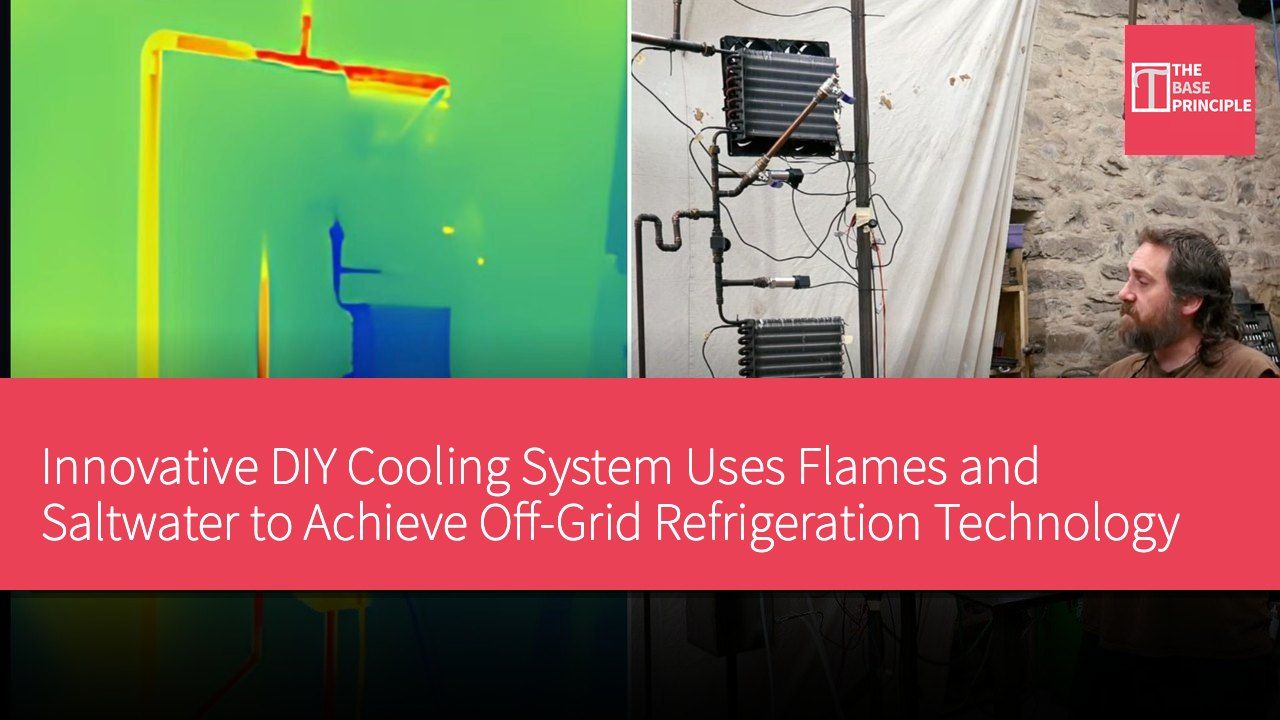
- The DIY cooling system developed by Greenhill Forge uses flames and saltwater for cooling.
- The system employs absorption cooling technology, eliminating the need for electric compressors.
- The system operates at extremely low pressure, allowing water to evaporate at temperatures below its normal boiling point.
- While the prospects are promising, further testing is needed to ensure stability.
A new DIY cooling system developed by Greenhill Forge challenges conventional notions of cooling and flames, utilizing heat, water, and road salt for cooling without relying on traditional electric compressors. According to a YouTube video, the experimental setup lowered the temperature in the cooling area to about 5°C (41°F), while the surrounding environment was approximately 16°C (61°F). This represents a significant temperature drop for a system primarily driven by flames, although it remains a prototype and is not yet a viable alternative to household refrigerators.
The project explores an ancient engineering concept and offers potential modern applications for cooling systems operating in areas with scarce or unreliable electricity.
Overview of Absorption Cooling Technology
The technology employed by the system is known as absorption cooling, a process that has been around for over a century. It does not rely on electric compressors to circulate refrigerants but instead utilizes heat to drive a chemical process for cooling. Greenhill Forge's design primarily consists of two components: a generator and an absorber. The generator contains a calcium chloride solution and distilled water. When the flame heats the mixture, water vapor separates from the solution and flows through pipes to the condenser, where it cools and returns to liquid form. The liquid water then enters an evaporator that operates under strong vacuum conditions through a small adjustable valve.
At the system's extremely low pressure (about six millibars), water can evaporate at temperatures far below its normal boiling point. This evaporation process absorbs heat from the surrounding area, creating a cooling effect.
However, this process has a limitation. As water vapor accumulates, pressure increases, ultimately limiting further evaporation. To prevent this from occurring, the system sprays concentrated calcium chloride solution into the absorber. This solution absorbs the vapor, helping to maintain the low-pressure environment necessary for cooling. In effect, the flame provides the heat that drives the entire cycle, while the salt solution helps maintain the conditions required for water to evaporate at low temperatures.
The device is also a considerable metalworking project. Greenhill Forge constructed most of the components from stainless steel sheets and tubing, welded the casing, and used silver solder for smaller pipe connections. The manufacturer formed the cooling coils by filling pipes with water, freezing them, and bending them around a frozen core to prevent the pipes from collapsing. Before filling the system, the manufacturer tested for leaks and evacuated it using a vacuum pump. Maintaining the vacuum is crucial, as even small leaks can disrupt the low-pressure evaporation process.
Power Requirements and Control System
An Arduino-based controller monitors the system's temperature and pressure, adjusting the pump speed and triggering safety alarms. The system still requires electricity to power the circulation pump and cooling fan, with the pump consuming approximately 30–50 watts. This means the refrigerator is not entirely off-grid; however, a small solar panel or battery may suffice to meet its modest power needs while the flame provides most of the heat.
Preliminary test results show promising prospects, but temperature data requires contextual information for interpretation. According to a report from Hackaday, the system achieved a cooling effect of about 5°C (41°F) when the ambient temperature was close to 16°C (61°F). This indicates a cooling effect; however, it does not demonstrate how the prototype performs under hotter conditions, how much food it can keep cool, or whether it can maintain safe storage temperatures consistently. The technology itself is not new, as absorption refrigerators have long been used in environments where traditional electric compressors are impractical.
Greenhill Forge's project explores the DIY implementation using readily available materials and heat sources like firewood. With further development, similar systems could serve in remote workshops, cabins, or other locations where fuel acquisition is easier than reliable grid power.
Item Specification Power Requirement 30–50 watts Cooling Effect 5°C (41°F)
Potential Applications and Challenges of the DIY Cooling System
The innovation of this DIY cooling system lies in its use of flames and saltwater instead of traditional electricity, providing a feasible cooling solution for areas with limited power. While absorption cooling technology has a long history, it still holds potential for modern applications, especially in remote areas. Although preliminary tests indicate good cooling effects, the system's stability and performance under varying environmental conditions require further validation, which is crucial for its practical application.