
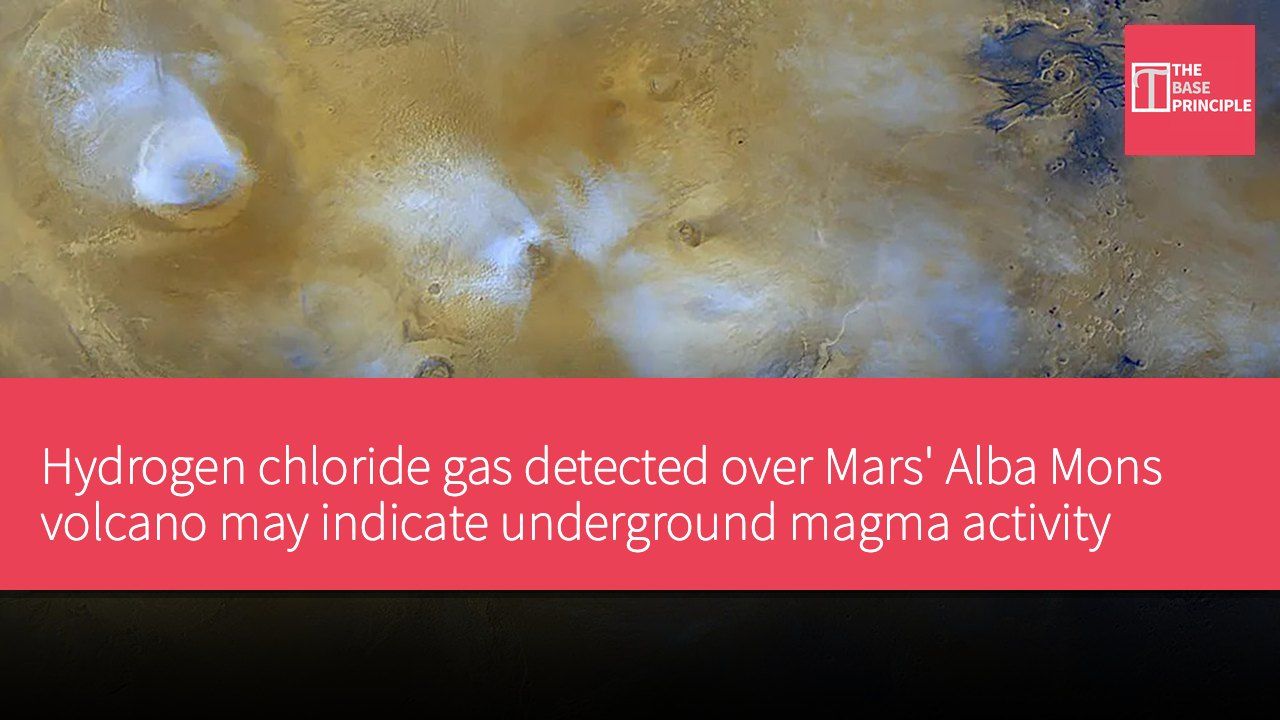
- Hydrogen chloride gas detected at Mars' Alba Mons volcano may originate from magma.
- The detection pattern of the gas shows eruptive characteristics that do not align with meteorological models.
- Non-seasonal gas primarily appears locally and has not been detected elsewhere.
- The connection to magma activity remains hypothetical and requires further study for confirmation.
A team led by Alexander Trokhimovskiy from the Russian Space Research Institute has detected hydrogen chloride gas over Mars' Alba Mons volcano, which may originate from magma. Hydrogen chloride (HCl) is a harmful gas that typically escapes from magma vents on Earth. The ExoMars Trace Gas Orbiter, developed jointly by the European Space Agency and the Russian Federal Space Agency, first detected this gas on Mars in 2021.
Alba Mons is the largest volcano on Mars by area, despite Olympus Mons being taller. The team reported that the orbiter's Atmospheric Chemistry Suite detected this gas at a concentration of one part per billion under non-seasonal conditions.
Detection Pattern of Hydrogen Chloride
Kevin Olsen, a visiting researcher at the University of Oxford and co-author, told Live Science that the detection pattern resembles "a gas eruption" rather than conventional atmospheric chemistry. According to the paper in Science Advances, the low-altitude detection results cannot be explained by meteorological models, and the geological features of the area suggest a connection to magma. The European Space Agency's announcement noted that this gas typically peaks in the northern hemisphere during winter and largely disappears in summer, but a peak was observed on the slopes of Alba Mons in early summer.
Olsen mentioned that this targeted study has been ongoing for two Martian years, or about four Earth years.
During the four Martian years of observation, this non-seasonal gas primarily appeared locally and was not detected elsewhere. He noted that three cameras, including the orbiter's CaSSIS camera, captured images of narrow fissures beneath the detection site, some only a few tens of centimeters wide. The announcement also added that color changes around the fissures may indicate gas deposition. Assuming this gas persists in the atmosphere for one Martian day (sol), the authors estimate a leakage rate of about three kilograms per second. This figure is close to the lower end of emissions from terrestrial volcanoes, which range from a few kilograms to over 100 kilograms.
Connection Between Magma Activity and Life
However, several perspectives remain unproven. Olsen stated that the connection to volcanic activity is still a hypothesis. Early readings did not show other gases released by volcanic activity, such as sulfur, and the seasonal characteristics of hydrogen chloride make it difficult for scientists to link it to magma. The European Space Agency's announcement pointed out that no new lava flows or eruptions have ever been observed on Mars. The authors noted that the estimated seasonal release of this gas is about 180 kilograms per second and is not considered directly related to volcanic activity. The research team suggested that Alba Mons may have environments similar to Earth's hydrothermal vents, where life could potentially have originated.
Daniel Mège, a professor at the Polish Academy of Sciences and co-lead author, emphasized that magma activity itself does not equate to signs of life. He cautioned that favorable conditions must be maintained for at least millions of years, which is difficult to assume for such small leakage points. The team stressed that further research is needed to confirm that this gas originates from magma.
Potential Geological Activity at Mars' Alba Mons
The detection of hydrogen chloride at Mars' Alba Mons volcano may suggest the presence of underground magma activity, which is crucial for understanding Mars' geological history and its potential environments for life. Although current data indicate seasonal characteristics of the gas, which do not directly prove a connection to volcanic activity, these findings have nonetheless garnered significant attention from the scientific community. Future research will help clarify the origins of these gases and their relationship to Martian geological activity, further advancing our understanding of the Martian environment.