
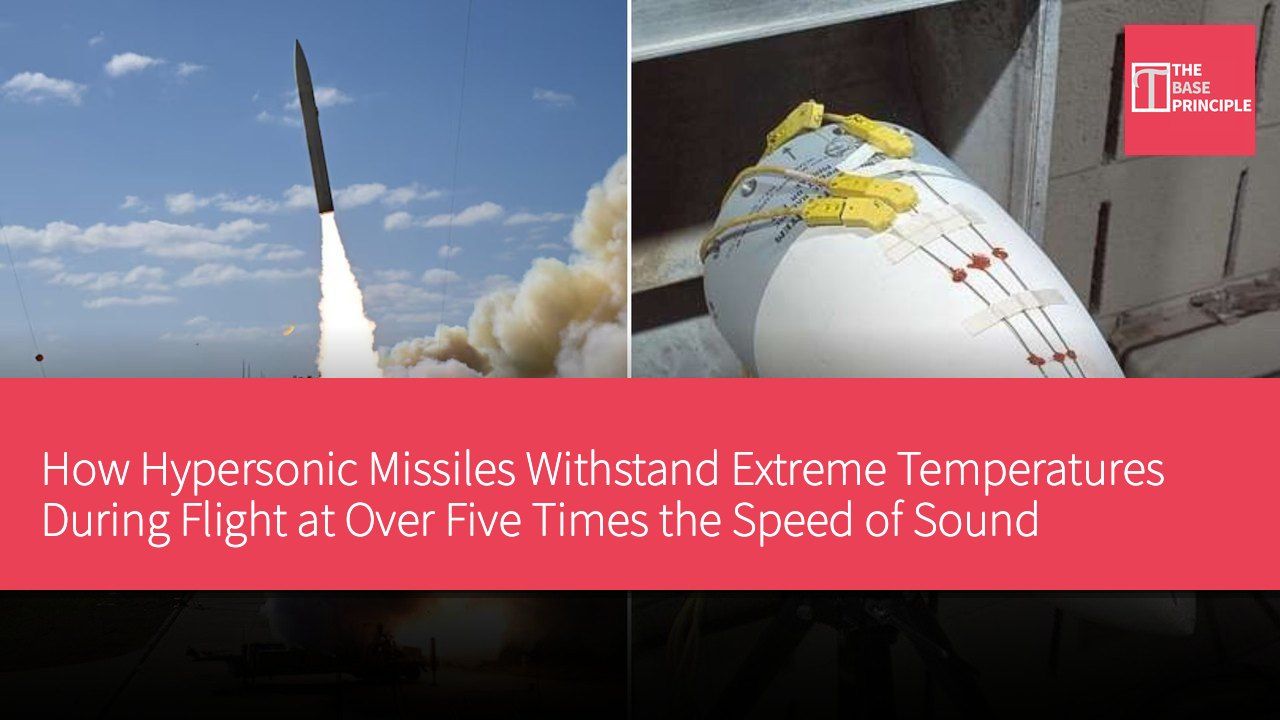
- Hypersonic missile surfaces must endure extreme temperatures, relying on heat-resistant materials and design.
- Carbon-carbon composites maintain structural properties at high temperatures but need protection against oxidation.
- Ablative thermal protection systems use material loss to shield internal structures.
- Missile designs must balance aerodynamic efficiency with thermal management, considering flight paths.
Hypersonic missiles can traverse the atmosphere at speeds exceeding five times the speed of sound, exposing their surfaces to temperatures high enough to damage or destroy conventional aircraft materials. Their survival depends on heat-resistant materials, protective coatings, carefully designed shapes, and, in some designs, systems that actively remove heat. The challenge is not just rapid movement. At hypersonic speeds, air cannot quickly yield, resulting in strong shock waves that compress surrounding gases. This process heats the air around the missile, while aerodynamic heating transfers energy to its surface. The nose and leading edges of the missile typically face the most intense thermal loads.
The National Aeronautics and Space Administration (NASA) states that thermal protection systems are designed to prevent these heat loads from reaching internal structures and components. For hypersonic weapons, this means designing devices that can survive under extreme temperatures and mechanical stresses during high-speed flight.
1. Heat-resistant materials form the first line of defense
Selection of Heat-Resistant Materials
Conventional aircraft materials, including many traditional metal alloys, may lose strength under the high temperatures encountered during hypersonic flight. Therefore, engineers turn to specialized composites and ceramics. One important choice is carbon-carbon composites, made from carbon fibers embedded in a carbon matrix. They can withstand extremely high temperatures while maintaining practical structural properties, making them well-suited for exposed surfaces like the nose and leading edges. However, carbon-carbon materials have a weakness: oxygen attacks the material at high temperatures, necessitating protective coatings to limit oxidation and prevent structural degradation.
Ceramic matrix composites offer another option. Materials like silicon carbide-reinforced composites combine high-temperature resistance with relatively low weight. Researchers are also investigating ultra-high-temperature ceramics for components exposed to particularly harsh heating. The Defense Advanced Research Projects Agency (DARPA) has highlighted the challenges of protecting sharp leading edges in hypersonic materials research, as thermal loads are especially intense in those areas. Materials must survive at high temperatures without losing the shapes required for aerodynamic performance.
Applications of Ablative Thermal Protection
2. Sometimes, missiles are designed to burn away
Not every hypersonic device needs to endure multiple flights. Some can utilize ablative thermal protection, where external materials gradually decompose, carbonize, melt, or erode, carrying heat away from the underlying structure. This can be viewed as a sacrificial barrier. The system does not completely prevent surface damage but uses controlled material loss to protect the structure beneath. NASA has employed ablative heat shields to protect spacecraft returning through Earth's atmosphere, where the thermal environment is particularly harsh. Similar principles can help protect disposable high-speed devices. The trade-off is that ablative protection alters the surface during operation, which may render it unsuitable for devices that need to maintain aerodynamic shapes over multiple missions.
3. Active cooling can remove heat before it accumulates
Some advanced designs explore active cooling, where liquids circulate through internal channels to carry heat away from vulnerable areas. Fuel, before entering the engine, could potentially serve as a coolant, absorbing heat through specially designed channels. Other concepts combine active cooling with insulation layers, allowing the external surface to withstand high temperatures while limiting heat transfer into the device. A study published in 2026 in the journal Applied Thermal Engineering examined a thermal protection structure combining ceramic insulation and cooling channels. Simulation results indicated that cooling with aviation fuel could enhance the thermal protection efficiency of the modeled system.
These are research findings, not evidence that the same arrangements are used in actual missiles.
Thermal Management Considerations in Design
4. Shape and flight time are equally important
Relying solely on materials cannot solve the problem. Missile designers must balance aerodynamic efficiency with thermal management. Sharp edges can enhance aerodynamic performance under certain flight conditions, but they also concentrate heat. Blunt shapes can spread heating over a larger area, although they may increase drag. Engineers must also consider the time the device spends in dense atmosphere, flight paths, and the distribution of heat across its surface. Boost-glide systems, such as the U.S. Army's planned Dark Eagle, use rockets to accelerate gliders before re-entering the atmosphere.
In contrast, hypersonic cruise missiles are designed to maintain powered flight at hypersonic speeds, potentially using air-breathing scramjet engines. Their thermal challenges overlap, but propulsion systems and flight characteristics differ. Overall, there is no single miracle material that can make a missile completely heat-resistant. Surviving at speeds of Mach 5 and above requires an integrated system of materials, coatings, cooling, structural design, and flight planning.
Thermal Protection Technology Challenges for Hypersonic Missiles
The thermal protection challenges faced by hypersonic missiles involve not only material selection but also the overall design strategy. As flight speeds increase, thermal loads rise, rendering traditional materials ineffective. Therefore, engineers need to explore new materials and innovative designs, such as ablative thermal protection and active cooling systems, to ensure missile reliability under extreme conditions. The development of these technologies not only impacts military applications but may also drive advancements in aerospace, holding significant implications for future aircraft design.