
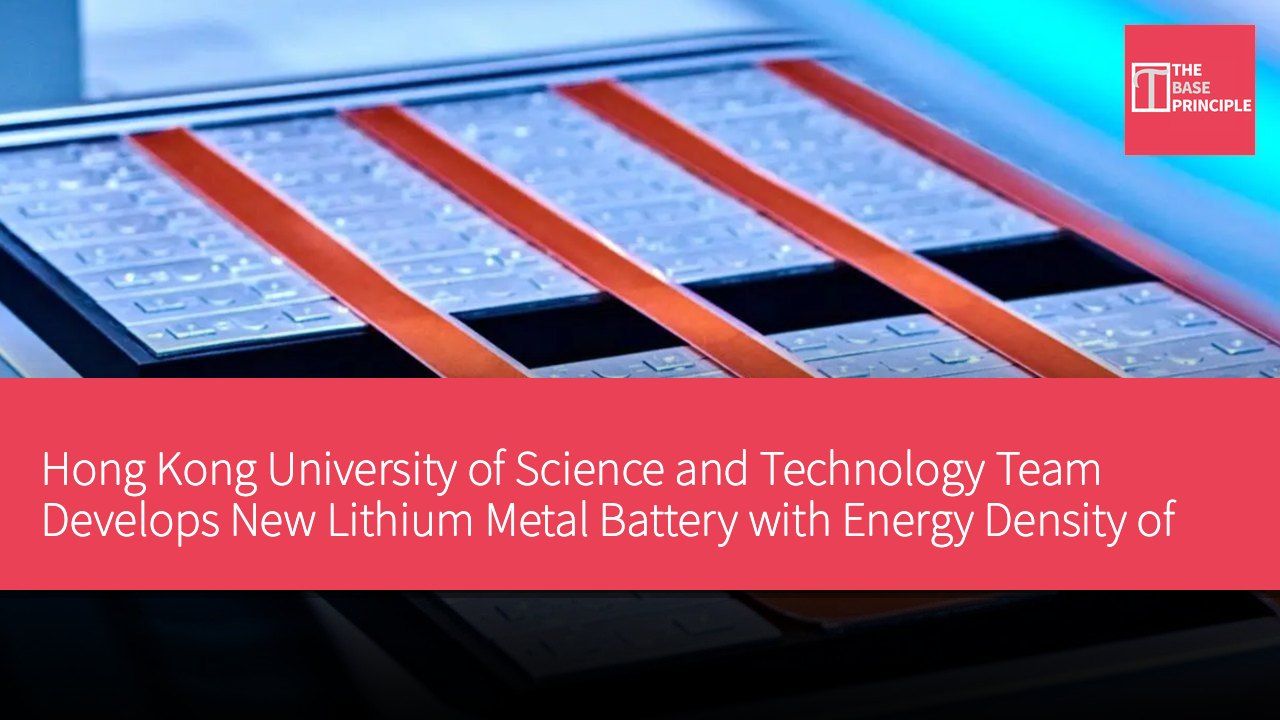
- The Hong Kong University of Science and Technology has developed a new anode-free lithium metal battery with an energy density of 467 Wh/kg.
- The battery retains 90% capacity after 200 charge-discharge cycles, demonstrating its durability.
- The research team improved lithium deposition by altering the battery interface, enhancing performance.
- The addition of the AMI additive helps stabilize the solid electrolyte interface, enhancing safety.
A research team at the Hong Kong University of Science and Technology (HKUST) has created a novel battery design that promises to make future energy storage systems lighter and more durable. Their anode-free lithium metal battery achieves an energy density of 467 Wh/kg (212 Wh/lb) in pouch cells, bringing its performance closer to that of current commercial batteries. The complete coin cell retains 90% capacity after 200 charge-discharge cycles. These results stem from a strategy that improves lithium deposition by altering key battery interfaces and stabilizing the internal layers that dominate battery performance.
The research group, led by Professor Minhua Shao, developed this method to address the ongoing issues that limit the lifespan and energy density of anode-free lithium batteries.
Challenges of Anode-Free Design
Anode-free designs face challenges with lithium deposition. Lithium metal is a promising battery material due to its high specific capacity and low reduction potential. Anode-free batteries use bare copper current collectors to store lithium instead of a separate anode, reducing inactive materials and simplifying the manufacturing process. However, traditional copper surfaces do not easily attract lithium, which can lead to uneven deposition during charging, promoting the growth of needle-like crystals that may damage battery components and pose safety risks. Another issue is the solid electrolyte interface (SEI), a layer that naturally forms on the surface of electrodes.
When this layer becomes unstable, it interferes with the movement of lithium ions, shortening the battery's lifespan.
Role of AMI Additive
To address these issues, researchers added an AMI additive containing silver ions and anions. This additive activates multiple processes after battery assembly, helping to modify the copper surface and control the manner of lithium deposition. The silver-modified surface enhances lithium affinity, allowing for more uniform deposition. Additionally, it stabilizes substances originating from anions, helping to establish a more stable SEI. The resulting interface features a rich organic inner layer and a rich inorganic outer layer, designed to support lithium ion transport while limiting conditions that promote needle-like crystal growth.
The released anions also initiate reactions in the electrolyte, forming a quasi-solid gel located between the organic inner layer and the inorganic outer layer of the SEI. This maintains close contact between the electrode and the electrolyte, stabilizing the interface through multiple charge-discharge cycles. These changes facilitate more reversible lithium deposition and stripping, thereby reducing battery wear. Researchers indicate that this integrated approach can also enhance battery safety by preventing the formation of needle-like crystals.
Professor Shao, as the corresponding author and head of the Department of Chemical and Biological Engineering at HKUST, explained that this method integrates multiple functions into a single process. "The key is not just adding silver salts or polymer initiators. Our AMI releases multiple functionalities through a controlled process after battery assembly, allowing us to modify the current collector, construct solvent structures derived from anions, and form a robust organic inner layer/inorganic outer layer SEI in an integrated process." He added, "This makes lithium deposition and stripping highly reversible in an anode-free quasi-solid configuration, laying a more solid foundation for the development of next-generation batteries."
The research has been published in the journal Nature Communications.
Item Specification Energy Density 467 Wh/kg Charge-Discharge Cycles 200 cycles
Potential and Challenges of the New Lithium Metal Battery
The development of anode-free lithium metal batteries marks a significant advancement in battery technology, particularly in terms of energy density and durability. This new type of battery not only improves energy storage efficiency but also maintains stable performance over multiple charge-discharge cycles, demonstrating its potential in future energy storage systems. The use of the AMI additive addresses issues of uneven lithium deposition and instability of the solid electrolyte interface, which are crucial for enhancing battery safety and lifespan. However, further research is needed to commercialize this technology to ensure its feasibility and economic viability in practical applications.